Published on: 2026-01-28
Updated on: 2026-01-28
The US dollar has slipped to a four-year low, reshaping how traders are thinking about 2026. On January 27, 2026, the DXY fell 1.2% to around 95.86, the lowest level since February 2022. The dollar also drop 2.6% since the start of 2026.
When the "greenback" falls this quickly, traders usually ask the same two questions. First, what changed in rates and risk? Second, is this a short move that will fade, or the start of a more extended downtrend?
In this article, we will break the move down using the most critical data points: interest rates, inflation, bond yields, and global flows. It also clarifies that "DXY at a four-year low" does not necessarily mean "the dollar is weak against everyone."
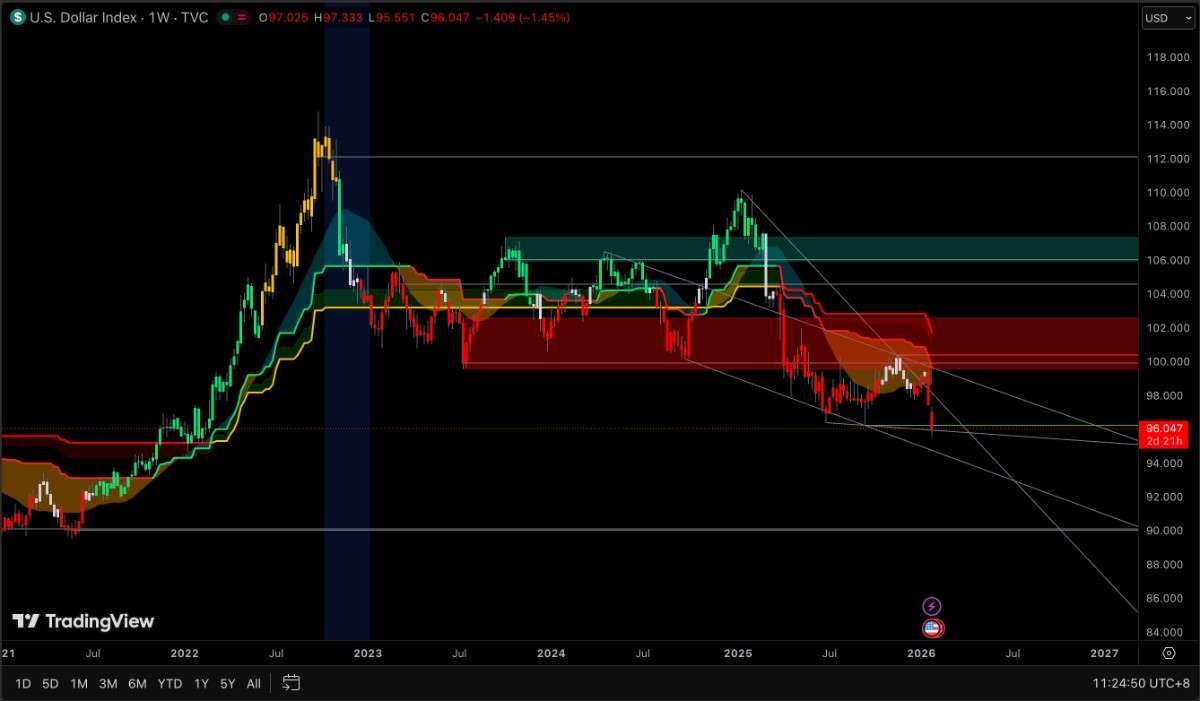
Here are the core numbers that set the backdrop for the latest move.
| Market driver | Latest published / referenced level | Why it matters |
|---|---|---|
| DXY (ICE U.S. Dollar Index) | ~95.86 (Jan 27, 2026) | Four-year low and sharp daily drop |
| Fed policy rate | 3.50% to 3.75% | The Fed cut to this range on Dec 10, 2025 |
| US 2-year Treasury yield | 3.56% (Jan 26, 2026) | Front-end yield sets FX carry appeal |
| US 10-year Treasury yield | 4.22% (Jan 26, 2026) | Long-end yield shapes capital flows |
| US CPI inflation | 2.7% (Dec 2025, YoY) | Inflation trend guides Fed tone |
| US PCE inflation | 2.8% (Nov 2025, YoY) | Fed’s preferred inflation gauge |
This combination explains why the dollar is vulnerable. The Fed is no longer in a hiking cycle, inflation has cooled from 2022 levels, and the bond market is trading with a "more cuts later" mindset, even if the upcoming meeting is expected to be a hold.
FX is often a rates market in disguise. When traders believe a central bank is more likely to cut rates rather than raise them, the currency typically loses value.
The Fed's last move in 2025 was a cut that took the policy rate to 3.50%–3.75%, and the January meeting is widely expected to hold steady.
A "hold" does not automatically lift the dollar. If markets believe the next move is down, the dollar can still slide because forward rate expectations matter as much as today's rate.
In simple terms, investors are paid a yield to hold dollars via US bonds. When that yield edge looks less attractive, the dollar can weaken.
Recent official market yields show:
2-year Treasury: 3.56% on January 26, 2026
10-year Treasury: 4.22% on January 26, 2026
If traders believe those yields will continue to ease as rate cuts approach, the dollar's support could diminish even before the Fed actually lowers rates again.
Debt headlines matter for FX when investors start linking them to future inflation risk, future tax risk, or political instability.
The Treasury's data indicates that total public debt outstanding is approximately $38.49 trillion as of January 2026.
A large debt stock does not force an immediate currency crisis.
It can, though, raise the long-run risk premium, especially when markets are already uneasy about policy direction.
The yen matters hugely for DXY. A strong yen often means a weaker DXY.
For example, the dollar previously slid as the yen jumped, with markets focused on intervention talk and official "rate check" signals.
On January 27, the yen's rally continued, reaching approximately ¥152.3 per dollar.
When USD/JPY declines rapidly, it can pull the entire dollar basket lower.
The euro's weight inside DXY is significant, so euro strength is dollar weakness by definition.
For instance, the euro and pound rose to their strongest levels since 2021 during the latest slide.
That matters because a "broad" dollar move in the headlines often starts as an euro- and yen-based move first.
This is the uncomfortable part of the story, but it is hard to ignore because it is being priced.
Firstly, the dollar dropped due to investor concern around policy direction and messaging from the White House. For context, the dollar weakened after President Trump commented that he was not concerned about the decline, causing investor unease over policymaking uncertainty.
The move was the steepest drop in years and pointed to concerns around confidence and policy direction as part of the market narrative.
Currencies tend to dislike uncertainty because it widens the range of possible outcomes.
This is one of the most interesting features of the latest move.
For instance, gold surged past $5,200 per ounce as the dollar slid in the same window, a pattern not typically seen.
Stocks also hit records even as the dollar fell sharply, which signals a different kind of risk backdrop than a standard panic.
When investors choose alternatives like gold or when they hedge US risk by buying other currencies, the dollar can weaken even in a tense headline environment.
A crisis usually shows up in at least three places at once:
A disorderly FX drop across measures
A sharp inflation break higher
A funding or credit stress event that forces policy action
Currently, inflation does not indicate a crisis. CPI was 2.7% in December 2025. PCE inflation was 2.8% in November 2025.
Rates are also not in a panic pattern. The 10-year yield near 4.22% is not, in itself, a "loss of control" level.
So the cleaner reading is this: the dollar is being repriced lower because the market expects easier policy ahead and because the policy risk premium has risen. That can still be a big move, but it is not the same thing as a breakdown in the system.
A firmer Fed tone that pushes back on near-term cuts, even if rates stay on hold.
Stronger US data that lifts yields, especially at the 2-year point.
A calmer policy backdrop, which would reduce the risk premium embedded in FX pricing.
More evidence of cuts ahead, especially if inflation stays near 2.5%–3.0% and jobs cool further.
Further yen strength, which can mechanically drag DXY lower.
More fiscal anxiety can push investors to demand a higher risk premium for holding dollar assets.
The Fed is currently in a two-day meeting, and markets expect it to keep rates unchanged. However, the tone can quickly influence FX.
The January 2026 CPI is scheduled for release on February 11, 2026, at 8:30 a.m. ET.
The Employment Situation for January 2026 will be released on February 6, 2026, and it will also include benchmark revisions.
If both CPI and jobs come in soft, the next-cut conversation will get louder. If they surprise to the upside, the dollar can bounce fast because positioning often gets crowded during selloffs.
The recent decline is attributed to changing rate expectations, reduced confidence in short-term dollar support, and investor apprehension regarding policy direction.
DXY is a basket that tracks the dollar mostly against major developed currencies, especially the euro and the yen. When EUR and JPY strengthen, DXY often falls.
A rebound could occur if the Fed counters rate-cut expectations, if US data surprises positively, or if global risk appetite returns and the dollar strengthens as a safe haven.
In conclusion, the US dollar has fallen to a 4-year low on DXY as investors reprice US policy risk and the path for Fed cuts in 2026.
Debt levels near $38.49 trillion and a sharp drop in consumer confidence have added pressure to the greenback's story.
Simply put, a weaker dollar can persist longer than many expect when the narrative centres on credibility and risk premiums.
Disclaimer: This material is for general information purposes only and is not intended as (and should not be considered to be) financial, investment or other advice on which reliance should be placed. No opinion given in the material constitutes a recommendation by EBC or the author that any particular investment, security, transaction or investment strategy is suitable for any specific person.