While oil prices could rise significantly from current levels, reaching $200 per barrel seems more like an extreme scenario than a likely outcome. The reason is simple. The market is already pricing a major disruption.
But, most official and analyst forecasts still stop well short of $200 unless the Strait of Hormuz stays severely impaired for longer and production losses deepen across the Gulf.

Regardless, Iran's warning is real. Ebrahim Zolfaqari, a spokesperson for the IRGC's Khatam al-Anbiya Central Headquarters, stated the world should "get ready" for $200 oil.
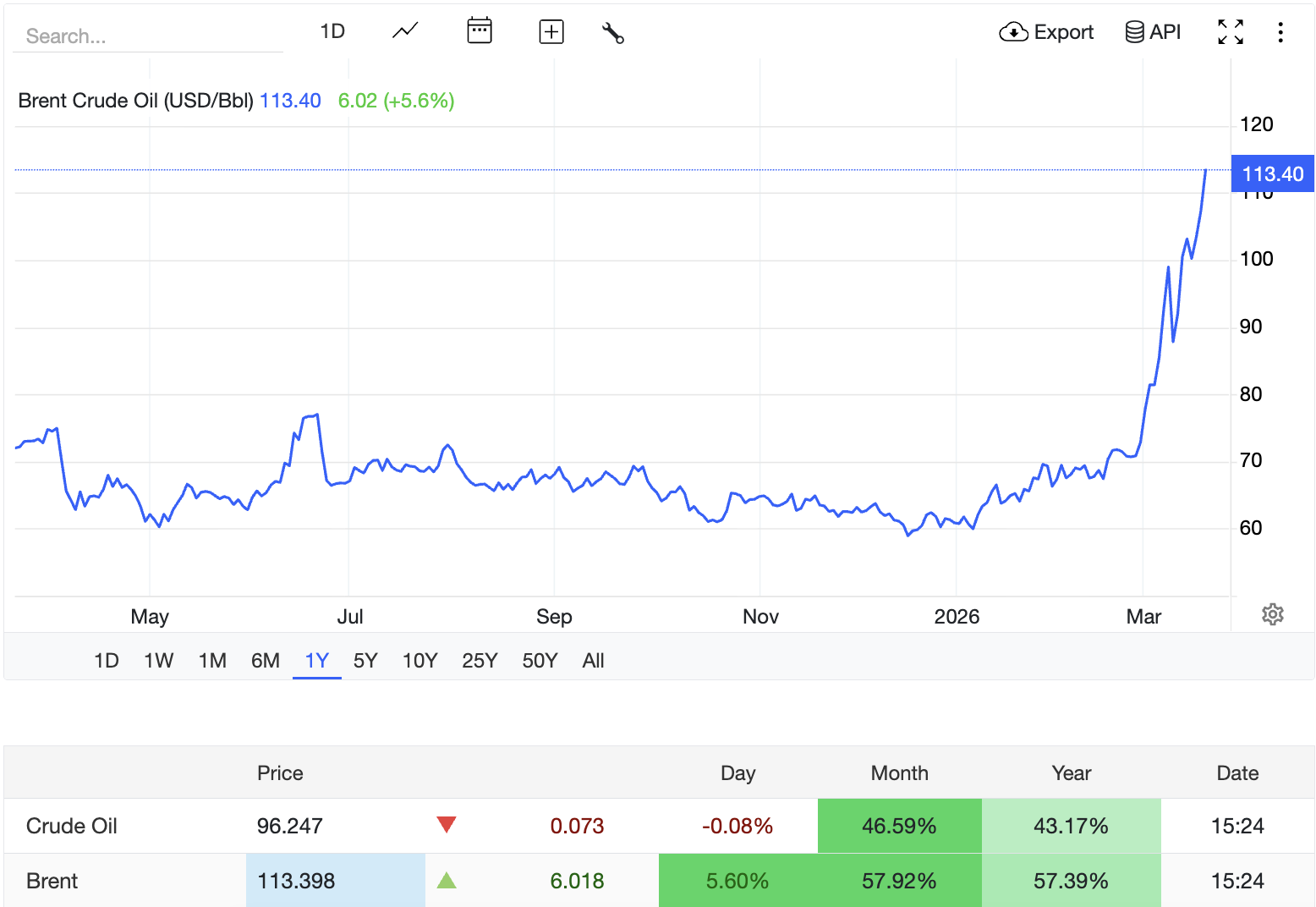
At the same time, the market has already moved sharply. Brent was indicated around $113 and WTI around $97 early on March 19, after oil had already spent recent sessions swinging through the low-$100s.
Iran's $200 message is not a forecast in the normal sense. It is a warning built around the economic leverage of the Strait of Hormuz.
The IEA said on March 11 that export volumes of crude and refined products through the strait were running at less than 10% of pre-conflict levels, while its March Oil Market Report said flows had fallen from about 20 mb/d to a trickle and that Gulf countries had already cut output by at least 10 mb/d. That is why the market has treated the threat seriously.
The chokepoint is unusually hard to replace. According to the EIA, the Strait of Hormuz processed over a quarter of the global seaborne oil trade and accounted for approximately one-fifth of worldwide oil and petroleum product consumption in 2024 and early 2025.
The EIA also estimates that the pipelines from Saudi Arabia and the UAE provide only about 2.6 million barrels per day of bypass capacity in case of disruptions. That means a long closure would not be solved by rerouting alone.
Yes, but it would likely require three things at once.
First, the situation around Hormuz must remain critically disruptive for longer than the market currently anticipates. The EIA's latest forecast explicitly assumes shut-in production peaks in early April and then gradually eases as transit resumes. That is why its near-term view is still high but not apocalyptic. If that assumption breaks, the forecast breaks with it.
Second, the disruption would likely need to spread beyond shipping into broader Gulf production and export infrastructure. Recent reporting already points in that direction, with oil jumping again after strikes involving the South Pars gas field and retaliation against a major fuel hub in Qatar.
The more the market believes the conflict is moving from shipping intimidation to sustained infrastructure damage, the easier it becomes to price a much larger supply shock.
Third, policy buffers would need to prove inadequate. So far, the IEA has already announced the largest ever coordinated emergency stock release, making 400 million barrels available to the market. According to the EIA's current projections, the OPEC+ is set to begin increasing production by 206,000 b/d in April.
Those steps may not solve a full Hormuz shock, but they do make a straight line to $200 less likely.
| Scenario | Brent range | What it would likely mean |
|---|---|---|
| De-escalation | $80 to $100 | Shipping improves, emergency stocks help, and the risk premium fades |
| Extended disruption | $110 to $150 | Hormuz remains heavily impaired for weeks, inventories tighten, and spare capacity cannot fully offset losses |
| Extreme shock | $150 to $200+ | Long-duration closure, more direct hits on Gulf infrastructure, weak offset from reserves, and severe market panic |
The clearest reason is that official forecasts remain far lower even after the conflict began. The EIA says Brent rose from an average of $71 on February 27 to $94 on March 9, and it now expects Brent to average $91 in the second quarter, then fall toward $70 by the fourth quarter as flows are reestablished and inventories build.
It also expects global oil inventories to rise by an average of 1.9 million b/d in 2026. That is a high-volatility forecast, but it is not a $200 forecast.
Private-sector stress scenarios are also lower than Iran's headline warning. For example, Goldman Sachs said Brent could reach $150 if Hormuz disruptions persist through March under a more severe shipping-outage assumption.
Oxford Economics said oil averaging around $140 for two months would be enough to push parts of the global economy into a mild recession. Those are already very severe outcomes, and both still sit well below $200.
There is also a market signal in physical pricing. For instance, the Omani crude, which bypasses Hormuz, surged above $150 as buyers scrambled for Gulf substitutes. That shows how quickly isolated physical barrels can become extremely expensive when regional supply is constrained.
It also suggests that a full-market move to $200 would likely require the tightness now visible in substitute grades to spread far more broadly across the global system.
If tanker traffic improves and insurance becomes available again, the panic premium can fade quickly. If export volumes remain low, the market will continue to test higher prices.
Shipping disruption is already serious. Sustained damage to upstream or export facilities would be a bigger step toward a true global shortage.
For instance, Standard Chartered estimates that 7.4 million to 8.2 million barrels a day of supply is currently offline across Iraq, Saudi Arabia, the UAE, Qatar, and Kuwait, with Iranian output also down by about 1 million barrels a day.
IEA emergency stock releases, OPEC+ flexibility, and higher U.S. output are the market's main shock absorbers. If those buffers look credible, they cap the upside.
If they start to look too small or too slow, the market will take the $150-to-$200 conversation much more seriously.
Yes, but it remains a tail-risk scenario, not the base case. Official forecasts remain far lower. The EIA still expects Brent to remain above $95 near term, then fall below $80 later in 2026.
Yes. A prolonged oil shock of that magnitude is likely to lead to stagflation, characterized by higher inflation and weaker economic growth.
Gasoline does not move one-for-one with crude, but the pressure is already visible. U.S. average gasoline prices were reported at around $3.84 a gallon in the current coverage period, and AAA had already shown a sharp earlier jump when crude first rose.
In conclusion, Oil prices can still rise sharply from here, and the current market has already shown that the jump from the $70s to above $100 can happen very quickly when Hormuz is impaired.
However, $200 a barrel remains a low-probability tail risk, not the central forecast. Achieving that outcome requires a lengthy and near-total disruption at Hormuz, significant damage to Gulf energy infrastructure, and a clear failure of reserve releases and alternative supply to stabilize the energy market.
Disclaimer: This material is for general information purposes only and is not intended as (and should not be considered to be) financial, investment or other advice on which reliance should be placed. No opinion given in the material constitutes a recommendation by EBC or the author that any particular investment, security, transaction or investment strategy is suitable for any specific person.