Decades of excessive government borrowing have prompted a clear response from the financial system: gold prices have reached record highs, reflecting growing investor concern.
Global debt has reached an unprecedented level, exceeding all previous records, including those set during the COVID-19 pandemic.
The relationship between sovereign debt and gold sentiment is now a key dynamic for investors monitoring capital flows during fiscal stress.
Here, we unpack that relationship in full, covering the debt figures driving investor anxiety, how central banks are responding, and why gold has re-emerged as the world’s preferred hedge against monetary disorder.
Global debt has reached a historic high, driven primarily by government borrowing across major economies.
Gold has surged to all-time highs as investors and central banks seek protection from currency debasement and fiscal instability.
Central banks worldwide are diversifying their reserves away from the US dollar, with gold playing an increasingly strategic role.
Geopolitical tensions, rising interest costs, and persistent inflation are reinforcing gold’s appeal as a safe-haven asset.
The outlook for gold remains broadly supported as long as sovereign debt pressures and macro uncertainty persist.
Global debt is not just high, it is accelerating. According to the Institute of International Finance (IIF), total global debt reached a record $348 trillion by the end of 2025, with nearly $29 trillion added in a single year. That represents the fastest annual build-up since the pandemic surge.
Governments are driving this expansion. The IIF notes that public sector borrowing accounted for over $10 trillion of the 2025 increase, with the United States, China, and the eurozone responsible for about three-quarters of the total.
Fiscal deficits, lingering COVID-related expenditures, and rising interest costs remain challenging to address.
The IMF’s Fiscal Monitor projects that global public debt will exceed 100% of world GDP by 2029, the highest level since 1948. The IMF’s Fiscal Affairs Department urges policymakers to act promptly to control debt and mitigate risks before they become unmanageable.
| Economy | Public Debt-to-GDP | Key Concern |
|---|---|---|
| Japan | ~230% | Persistent deficit spending, weak yen |
| United States | ~125% | Rising interest payments, trade tensions |
| France | ~117% | Acute fiscal pressure, euro exposure |
| Singapore | ~176% (gross) | Figure reflects gross debt including monetary securities; net position is a surplus |
| China | Elevated (broader perimeter) | Local government debt, property sector |
Note: Singapore’s gross debt-to-GDP ratio is high on paper, but this is a well-known statistical anomaly. The government issues securities primarily for monetary policy and CPF purposes and holds substantial assets that more than offset the liabilities.
Singapore’s net fiscal position is a surplus. The gross figure is included here for completeness but should not be read as a sign of fiscal stress.
As of March 18, 2026, gold was trading at approximately $4,861 per ounce at the open, up over $1,800 from the same point one year prior.
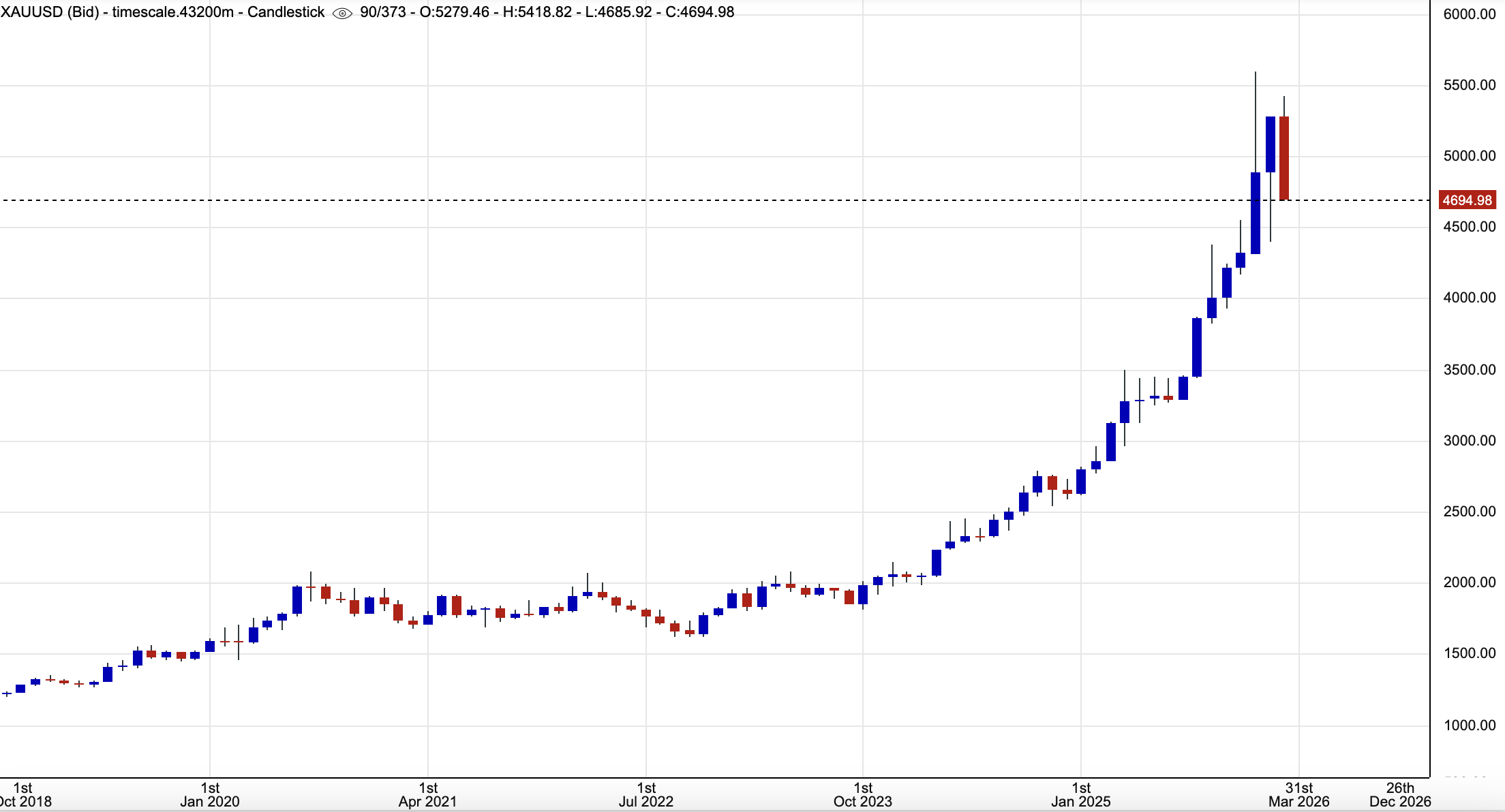
| Date | Spot Price (USD/oz) | Year-on-Year Change |
|---|---|---|
| March 12 | $5,181 | +$2,192 |
| March 13 | $5,114 | +$2,130 |
| March 16 | $5,025 | +$2,024 |
| March 17 | $5,011 | +$1,977 |
| March 18 | $4,861 | +$1,812 |
Short-term volatility reflects a market highly responsive to Federal Reserve actions, dollar movements, and geopolitical events.
The connection between sovereign debt and gold stems from concerns that excessive government borrowing and debt servicing challenges erode currency purchasing power over time.
Investors turn to gold as a store of value because it cannot be created, frozen, or defaulted upon.
In the United States, net interest payments on federal debt now exceed $1.2 trillion annually, accounting for approximately 17% of all federal spending.
When debt service limits productive government investment, it signals structural weakness, which both bond and gold markets factor into their pricing.
Emerging markets face their own version of this problem. Data shows that developing countries’ net interest payments on public debt reached $921 billion in 2024, a 10% increase year-on-year.
Over 3.4 billion people now live in countries where interest payments surpass spending on health or education.
One of the most significant recent developments in gold markets has been central bank activity.
From 2022 to 2024, central banks globally purchased more than 1,000 tonnes of gold annually, roughly double the historical average of the prior decade.
A 2024 World Gold Council survey found that approximately 68% of central banks plan to increase their gold reserve allocation over the next five years.
Notably, no respondents planned to reduce gold holdings, indicating broad institutional consensus on gold’s growing strategic importance.
China reported consecutive months of gold accumulation through much of the recent period, with total reported reserves surpassing 2,300 tonnes
Poland added over 100 tonnes in 2025 alone, leading European buyers, bringing its reserves toward 550 tonnes
Turkey, India, Brazil, and Kazakhstan continue to add steadily to reserves
Central banks globally now hold over 36,000 tonnes of gold in aggregate
This trend is driven by reserve diversification, protection against financial sanctions, and declining trust in dollar-denominated assets.
When Russia’s foreign currency reserves were effectively frozen in 2022, it sent an unmistakable signal to every central bank holding significant US dollar assets: sovereign reserves are only as safe as geopolitical relationships allow.
Gold holds a unique quality in the reserve management world: it carries no counterparty risk. Unlike US Treasuries, which represent a claim on the US government’s ability and willingness to pay, gold is a physical asset with intrinsic scarcity.
In a world where financial sanctions have become a tool of foreign policy, that distinction matters enormously.
De-dollarisation is accelerating in BRICS-aligned economies. Brazil, Russia, India, China, and South Africa are actively considering gold as an alternative to settlement frameworks, and this demand appears to be persistent.

Gold has responded strongly to these macro conditions, rising about 55% through 2025 according to J.P. Morgan Research, and setting multiple all-time highs throughout the year, nearly one per week per the World Gold Council.
On January 28, 2026, gold reached a record intraday high of $5,589.38 per ounce, a level few investors anticipated 18 months prior.
J.P. Morgan projects gold at $5,000 per ounce by Q4 2026, with potential for higher prices. The World Gold Council expects gold to remain stable or rise in 2026, depending on macroeconomic developments.
In addition to rising debt, several related factors are strengthening gold sentiment.
Ongoing conflict in Ukraine, Middle East tensions, and US-China trade friction have increased perceptions of financial instability and geopolitical fragmentation compared to a decade ago.
In the United States, tariff-driven trade policy has added complexity. The classification of gold bars as tariff-eligible imports, including tariffs on Swiss gold, has increased prices and reinforced gold’s role as a hedge against policy uncertainty.
Gold’s value is closely linked to real interest rates. When inflation-adjusted bond yields are low or negative, holding gold becomes more attractive.
The Federal Reserve implemented several rate cuts through late 2025, and markets expect further easing in 2026, supporting gold prices.
Gold ETF inflows rebounded in 2025 after years of outflows post-2020. J.P. Morgan forecasts about 250 additional tonnes of ETF inflows in 2026, with bar and coin demand expected to exceed 1,200 tonnes annually.
Not always. Gold usually rises when high debt, inflation, lower real yields, or weaker trust in a currency are present. If growth is strong and inflation stays under control, gold may not move much.
Central banks buy gold to reduce reliance on the US dollar, diversify reserves, protect against sanctions, and hedge against long-term currency risks.
Gold can help protect value during long periods of high inflation, especially when real interest rates are low or negative. Over shorter periods, its price can still be volatile.
De-dollarisation is the move away from using the US dollar in reserves and trade. It can support gold because gold is seen as a neutral reserve asset outside the dollar system.
Gold could fall if inflation drops, geopolitical tensions ease, or the US dollar strengthens. Higher real yields can also reduce gold’s appeal.
The US national debt affects gold through its impact on the dollar, inflation expectations, and interest rates. If confidence in the dollar weakens, gold often becomes more attractive.
The link between global debt and gold sentiment is evident in real time, as confirmed by data from the IMF, IIF, World Gold Council, and central banks worldwide.
Record sovereign borrowing, higher interest costs, persistent inflation, and the use of the dollar as a geopolitical tool have prompted a structural reassessment of gold’s role in institutional and private portfolios.
The future of this cycle depends on governments’ ability to reduce fiscal deficits and stabilize geopolitical tensions.
Currently, both conditions remain aspirational. Until debt trends improve, the fundamental case for gold as a monetary hedge persists.
Disclaimer: This material is for general information purposes only and is not intended as (and should not be considered to be) financial, investment, or other advice on which reliance should be placed. No opinion given in the material constitutes a recommendation by EBC or the author that any particular investment, security, transaction, or investment strategy is suitable for any specific person.