Published on: 2026-03-16
Updated on: 2026-03-16
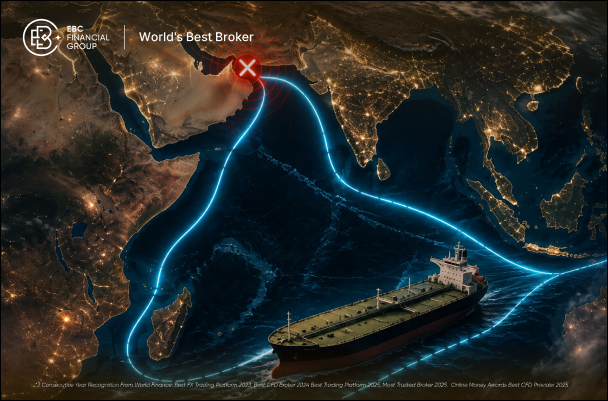
EBC Financial Group ("EBC") notes that the latest disruption around the Strait of Hormuz has changed the key question in the global oil market from how high crude can rise to which benchmark is carrying the clearer signal. Brent touched USD119.50 a barrel and West Texas Intermediate (WTI) reached USD119.48 intraday on 9 March, their highest levels since June 2022. The Strait of Hormuz handled about 20 million barrels a day in 2024, equal to roughly 20% of global petroleum liquids consumption. By 10 March, Brent had fallen to USD94.79 and WTI to USD90.96 as de-escalation signals from Washington collided with continuing Iranian threats to keep regional oil exports blocked, while G7 officials said they stood ready to support energy supply without having to release emergency reserves at this juncture. In EBC's view, that matters because the headline oil price can retreat faster than the shipping premium underneath it.
"When shipping disruptions push up freight, war-risk cover and replacement costs, Brent can show that stress more clearly because it sits closer to seaborne crude flows and global export pricing," said David Barrett, Chief Executive Officer, EBC Financial Group (UK) Ltd. "WTI can still move sharply, but it remains more exposed to inland U.S. logistics and storage. That means route stress often shows up first in Brent-linked time spreads and export premiums rather than in a simple flat-price comparison between the two benchmarks."
EBC analysts' observation is not that Brent must always outperform WTI in outright price terms during a shipping crisis. The stronger point is that shipping stress tends to show up more clearly in the oil derivatives market and in seaborne grade relationships than in a simple Brent-versus-WTI price race. By 6 March, the spread between front-month Brent and six-month Brent had widened to about USD10 a barrel, the steepest backwardation since the 2022 Russia-Ukraine shock. Over the same period, Brent's premium to Dubai swaps widened to USD10.42 from 69 cents at the start of 2026. In the physical market, Dubai's cash premium rose to USD 19.63 a barrel, while Oman reached USD 19.15 and Murban USD17.87. In EBC's assessment, those are the more revealing signals because they capture prompt seaborne availability, replacement costs and export-linked pricing, even when flat prices swing sharply on diplomatic headlines.
EBC views the current move as a repricing of delivery risk as much as supply risk. In the tanker market, the benchmark Very Large Crude Carriers (VLCC) rate from the Middle East to China rose above USD400,000 a day on 2 March, after doubling from the previous Friday and extending gains from a six-year high reached the week before. In the marine insurance market, hull war-risk premiums on some tankers rose to as much as 3% of vessel value from around 0.25% before the conflict. On a USD250 million vessel, that implies a jump from roughly USD625,000 to about USD7.5 million for a single voyage. At that point, freight and insurance stop being side costs and start becoming part of oil price discovery itself.
That pressure is already visible in physical supply. Output from Iraq's main southern oilfields fell to about 1.3 million barrels per day from roughly 4.3 million before the conflict, a drop of around 70%. Exports from the same region fell to around 800,000 barrels per day as storage filled and vessel movement through the Strait of Hormuz deteriorated. More than 200 ships were stranded in the area earlier in the crisis, underlining how quickly a shipping shock can become a storage and export problem. In EBC's evaluation, that is the clearest sign that the delivered barrel now matters more than the theoretical barrel.
The next phase of the story is no longer only about disruption but about duration. Iran has said the oil blockade will continue until attacks end. Washington, by contrast, has signalled that it expects a faster resolution and has floated measures including possible reserve use and sanctions adjustments to ease supply pressure. G7 officials have also said they are ready to support energy supply if needed but are not yet releasing reserves. That combination creates a market in which outright prices can fall on de-escalation headlines even while Brent-linked route premiums remain elevated until shipping, insurance and loading conditions genuinely improve.
"A diplomatic remedy may cool the flat price quickly, but it does not automatically lower tanker rates, widen insurance capacity or clear delayed cargoes," Barrett added. "That is why Brent-linked prompt structure can remain more informative than the outright benchmark price when the geopolitical picture is changing by the hour."
For traders, EBC believes the next markers to watch are not only Brent and WTI outright levels, but whether the front-month Brent versus six-month Brent spread narrows from around USD 10, whether the Brent-Dubai EFS retreats from USD 10.42, whether Dubai, Oman and Murban premiums come off their recent highs, and whether tanker and insurance costs start to normalise. If those measures unwind, the shipping premium is easing. If they remain stretched even while outright oil prices stay volatile, the case for using Brent as the clearer barometer of shipping-related oil risk becomes stronger.
Against that backdrop, Brent Oil, XBRUSD, offers a focused way to monitor how route disruption, freight repricing and benchmark structure are feeding into global oil price discovery, while XTIUSD remains a useful comparative read on how U.S.-linked pricing is reacting to the same shock. EBC Financial Group provides access to both instruments on its platform.
Disclaimer: This material is for information only and does not constitute a recommendation or advice from EBC Financial Group and all its entities ("EBC"). Trading Forex and Contracts for Difference (CFDs) on margin carries a high level of risk and may not be suitable for all investors. Losses can exceed your deposits. Before trading, you should carefully consider your trading objectives, level of experience, and risk appetite, and consult an independent financial advisor if necessary. Statistics or past investment performance are not a guarantee of future performance. EBC is not liable for any damages arising from reliance on this information.