Published on: 2025-12-03
Updated on: 2025-12-03
Contract size is one of the most important building blocks in trading, defining how much of an asset a trader controls and shaping risk, leverage, and position sizing across futures, options, forex, and CFDs.
For new and experienced traders, understanding contract size is essential because it determines notional exposure, tick value, margin requirements, and the overall behavior of a trade.
The term contract size refers to the standardized quantity of a stock, commodity, or financial instrument underlying a futures or options contract.
It specifies the exact amount being bought or sold, ensuring all traders operate with the same defined units. Exchanges typically determine these standardized sizes, which vary by asset class.
Contract size also influences the dollar value of each price movement, including the impact of a unit change or tick in the underlying instrument.

Contract size also determines:
Notional value: the total financial value a trader controls
Tick value: the monetary impact of the smallest price movement
Margin requirements: how much capital must be posted to enter a trade
Risk exposure: how gains and losses scale with volatility
When a price moves, even by a small amount, the contract size decides how financially meaningful that movement is. As a result, understanding contract size is essential for accurate position sizing and risk management.
| Name | Currency Units | Enter As | Pip Value (EUR/USD) |
|---|---|---|---|
| Standard Lot | 100,000 | 1 | $10 |
| Mini Lot | 10,000 | 0.1 | $1 |
| Micro Lot | 1,000 | 0.01 | $0.10 |
| Nano Lot | 100 | 0.001 | $0.01 |
Contract size is a crucial element of trading because it determines how much real exposure a trader takes on with each position. It directly affects notional value, leverage, margin requirements, and the financial impact of every price movement.
A clear understanding of contract size helps traders measure risk accurately, align position sizing with their account balance, and avoid unintentionally taking oversized positions.
It also supports disciplined risk management by allowing traders to calculate tick value, potential gains and losses, and the amount of capital needed to hold a trade.
Whether using full-size, mini, or micro contracts, knowing the contract size ensures that every position is intentional, controlled, and aligned with a trader’s strategy and risk tolerance.
Futures exchanges define contract sizes to ensure uniformity. Each commodity or financial instrument has a fixed size that does not change day-to-day.
When you trade futures, you don’t pay the full value of the contract.
Instead, you only put down a margin, which is like a deposit that lets you control a much bigger position.
Examples include:
S&P 500 E-mini (ES): $50 × index level
Micro E-mini S&P 500 (MES): $5 × index level
Natural Gas (NG): 10,000 mmBtu
This standardization allows traders to calculate notional exposure instantly.
If crude oil is priced at $78, then:
Notional value = 1,000 barrels × $78 = $78,000
Such clarity helps traders assess whether the exposure aligns with their risk tolerance.
Stock and ETF options use a simple rule:
1 option contract = 100 shares
So, a call option on a $50 stock gives the right to control $5,000 worth of stock.
Index options may follow different multipliers, but the underlying principle remains identical: contract size defines exposure and tick value.
In forex trading, contract size is closely related to what traders and brokers call lot size, which divides positions into standardized units.
Forex contract/lot sizes:
Standard Lot: 100,000 units of base currency
Mini Lot: 10,000 units
Micro Lot: 1,000 units
Nano Lot (on select platforms): 100 units
For example, if EUR/USD trades at 1.10, then:
A standard lot represents 110,000 USD of notional value.
A micro lot represents 1,100 USD of notional value.
This connection between contract size and lot size helps traders scale positions according to risk management needs.
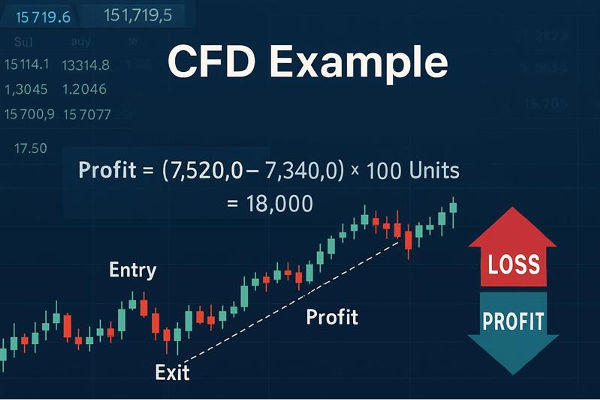
CFD (Contract for Difference) providers often mirror the underlying contract sizes of stocks or indices. They may allow flexible sizing, which offers greater granularity. For example:
1 stock CFD often equals 1 share
Index CFDs often define a monetary value per point (e.g., $1 per point)
This flexibility allows traders to fine-tune exposure much more easily than with futures.
Remember:
Bigger contracts = bigger exposure = bigger potential gains AND bigger potential losses.
Even if the margin percentage looks small, the actual dollar risk can be very large.
Understanding how contract size affects margin and leverage starts with recognizing that margin is only a deposit, but the notional value is the real amount of money your contract controls. Even if the margin requirement is the same percentage, larger contracts always create much larger exposure.
To visualize this, imagine two boxes:
*P/L = Profit/ Loss
Controls $200,000 worth of the asset
If the market moves 1%, your P/L changes by:
- 1% of $200,000 = $2,000
Controls $20,000 worth of the asset
If the market moves 1%, your P/L changes by:
- 1% of $20,000 = $200
Both boxes require the same margin, but the big box will react 10× more to market movement.
Bigger contracts look affordable because the margin requirement is small compared to the contract’s size, but the actual exposure is huge. Micros and smaller contracts give beginners much more control, because their dollar-per-point movement is smaller and easier to manage.
| Advantages of Contract Size | Disadvantages of Contract Size |
|---|---|
| Standardized sizing makes markets clear and consistent. | Large contract sizes can create excessive exposure for small accounts. |
| Helps traders calculate risk, tick value, and margin easily. | Higher margin requirements may limit participation. |
| Mini and micro versions allow flexible and controlled position sizing. | Standard contracts offer limited flexibility compared to smaller alternatives. |
| Supports accurate hedging because quantities are predictable. | Big price swings can lead to larger gains or losses than expected. |
Several structural shifts have shaped how today’s traders think about contract size:
Growth of micro futures making futures markets accessible to smaller accounts.
Fractional forex lots enabling highly flexible position sizing.
Increased volatility pushing traders toward smaller, more manageable exposures.
More retail participation, encouraging exchanges to offer diversified contract sizes.
These developments emphasize a broader industry trend: more customizable exposure, better risk control, and greater accessibility.
Contract size is the standardized quantity of an underlying asset represented by one futures, options, forex, or CFD contract.
Larger contract sizes increase notional exposure, which magnifies gains and losses. Smaller sizes allow more granular risk control.
Micro contracts often suit developing traders because they reduce exposure while allowing participation in major markets. However, suitability depends on individual objectives and risk tolerance.
Contract size is a foundational element of trading that shapes exposure, leverage, margin requirements, and risk outcomes across all major asset classes.
By understanding how contract size translates into notional value and tick impact, traders can plan effective position sizing, control volatility risk, and align strategy with capital constraints.
Futures, forex, options, and CFDs each approach contract sizing differently, but the principles remain universal: the contract’s size dictates how price movement affects your account.
Evaluating contract size carefully allows traders to build strategies that are disciplined, resilient, and adaptable to rapidly changing market conditions.
Disclaimer: This material is for general information purposes only and is not intended as (and should not be considered to be) financial, investment or other advice on which reliance should be placed. No opinion given in the material constitutes a recommendation by EBC or the author that any particular investment, security, transaction or investment strategy is suitable for any specific person.



World's Best Broker