Published on: 2026-04-30
Apple’s Q2 earnings will not be judged only by whether revenue and EPS beat estimates.
For AAPL stock, the bigger question is whether Apple can defend what investors already appear to be pricing in: solid iPhone demand, resilient Services growth, stable margins, a credible AI roadmap, continued capital returns, and a smooth transition from Tim Cook to John Ternus.
Apple is scheduled to discuss fiscal Q2 2026 results on April 30, 2026, at 2:00 p.m. PT / 5:00 p.m. ET. (1)
At the time of writing, AAPL recently traded near $270, with a market value of around $4 trillion and a P/E ratio above 34. That valuation leaves little room for vague guidance, weak AI commentary, or signs that recent iPhone strength is only temporary.
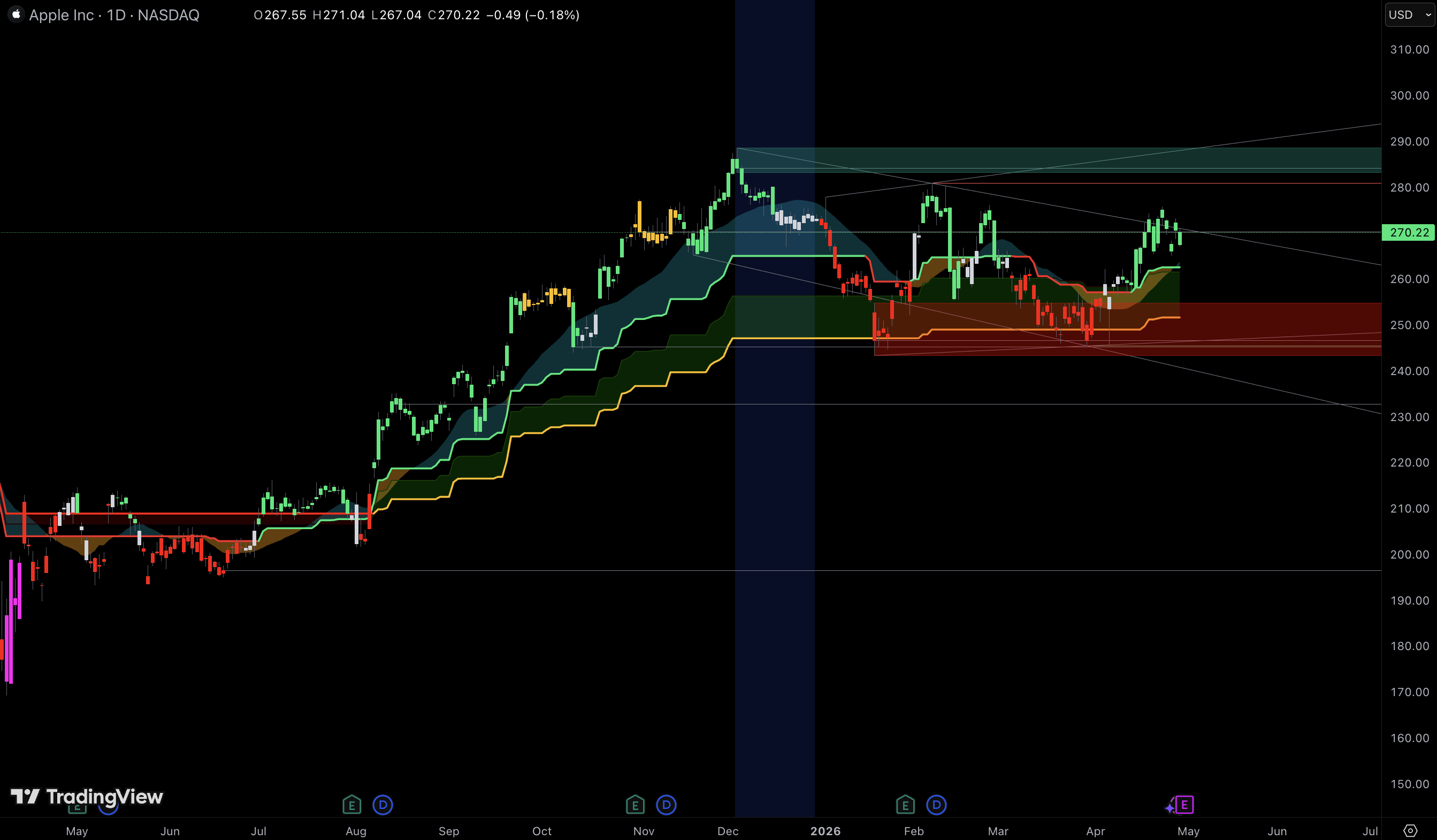
AAPL is not being priced like a struggling hardware company. It is being priced like a premium global platform with durable cash flow, high-margin Services revenue, a massive installed base, and enough product momentum to keep users upgrading.
That leaves little room for a merely acceptable quarter.
S&P Global said Visible Alpha consensus expects Apple’s fiscal Q2 revenue to be about $109.3 billion, up from earlier expectations of $102.9 billion. Analysts also expect roughly $56.5 billion in iPhone sales and around $30 billion in Services revenue. (2)
Investopedia reported that analysts expect Q2 EPS of $1.94 and that options pricing implied Apple shares could move by about 4% by the end of the week after earnings. (3)
In practical terms, AAPL’s post-earnings move may depend on whether Apple gives investors a reason to raise future expectations. A small beat may only confirm what investors already expected.
The upside case needs better-than-expected demand quality, resilient Services margins, confident guidance, and clearer AI timing. The downside case is a clean Q2 report that still leaves investors questioning the durability of growth.
Services matter because they make Apple look less like a cyclical device seller and more like a high-margin platform.
S&P Global noted that Apple’s Services gross margin is above 70%, compared with about 37% for Products. That gap is why investors care about Services margins, not just Services revenue.
If Services revenue grows and margins hold, Apple has a stronger case for its premium valuation. If Services growth slows or margins weaken, the stock’s platform-business argument becomes less convincing.
The main risk is margin pressure. App Store regulation, payment changes, legal challenges, and platform-fee scrutiny could all weaken the Services profit story over time. Even modest pressure matters because Services contributes heavily to Apple’s profit mix.
Bullish signal: Services grows near or above expectations, with resilient margins.
Bearish signal: Services growth slows, or management hints at margin pressure.
Apple’s Q1 results showed strong iPhone momentum. The company reported fiscal Q1 revenue of $143.8 billion, up 16% year over year, and diluted EPS of $2.84, up 19%. Apple also said iPhone and Services revenue reached all-time highs. (4)
For Q2, investors will care less about one strong iPhone quarter and more about whether Apple is seeing a real upgrade cycle.
The key question is simple: are customers upgrading because Apple has a durable product cycle, or did Q1 pull forward demand?
Investors should listen for commentary on older-device upgrades, U.S. and China demand, switchers, supply constraints, and whether Apple Intelligence is influencing purchases.
Bullish signal: Management suggests iPhone upgrades remain broad.
Bearish signal: iPhone numbers beat, but forward commentary sounds cautious.
Apple’s AI story is different from Nvidia’s, Microsoft’s, or Alphabet’s. Apple is not mainly selling AI infrastructure. Its AI opportunity lies in making the iPhone, Mac, iPad, Siri, and Services ecosystem more useful.
That is why investors may be impatient. Broad comments about AI's long-term potential may not move the stock unless Apple provides clearer evidence of product impact.
A useful AI update would address:
Apple Intelligence adoption
Siri improvement timing
On-device AI capabilities
Developer tools
Whether AI is helping with device upgrades or Services engagement
The market does not need Apple to become Nvidia. It needs evidence that Apple is not falling behind in consumer AI and that AI can support future upgrades, retention, or Services usage.
Bullish signal: Clearer timing, product use cases, and adoption details.
Bearish signal: Generic AI language with little evidence of adoption or monetization.
This is not a normal Q2 earnings call. It is Apple’s first major earnings update since the company announced that Tim Cook will become executive chairman and John Ternus will become CEO effective September 1, 2026. (5)
That puts more weight on how management frames continuity, product ambition, and AI execution.
Under Cook, Apple became known for operational discipline, supply-chain execution, Services growth, and capital returns. Ternus brings a hardware-engineering background, which could raise expectations for stronger product execution and a more energetic device roadmap.
But investors may not want a dramatic change. They likely want continuity in margins and capital allocation, along with greater conviction in AI and future products.
Bullish signal: Ternus is positioned as continuity plus product ambition.
Bearish signal: Management avoids strategy questions or sounds vague on AI and product direction.
The next-quarter commentary may decide whether a Q2 beat has any value for the stock.
With AAPL trading at a premium multiple, Apple needs to support the idea that revenue growth, margins, and cash returns remain durable. Investors will likely focus on revenue commentary, gross margin guidance, Services trends, iPhone demand, China, supply-chain costs, and buybacks.
Capital returns matter because Apple’s buyback program has long been part of the shareholder-return story. A strong repurchase or dividend update could reinforce confidence in free cash flow. A smaller-than-expected update would not necessarily damage the long-term story, but it could make the earnings reaction less enthusiastic.
Apple does not need aggressive guidance, but it does need guidance strong enough to support the current multiple. A clean EPS beat can still disappoint if management sounds cautious about demand, margins, or the next product cycle.
Bullish signal: Guidance supports durable revenue, margins, and cash returns.
Bearish signal: Management sounds cautious despite a clean Q2 print.
| Scenario | What it would look like | Possible stock reaction |
|---|---|---|
| Bull case | Revenue and EPS beat; Services margins hold; iPhone demand sounds durable; AI commentary gives clearer timing; guidance is confident | AAPL could move higher and defend its premium valuation |
| Base case | Modest beat; Services and iPhone are solid; AI comments remain broad; guidance is steady but not exciting | Stock reaction may be limited because much of this may already be priced in |
| Bear case | EPS beat but guidance disappoints; Services margin pressure appears; iPhone demand looks uneven; AI commentary lacks detail | AAPL could fall despite headline earnings strength |
Apple’s Q2 earnings are not just about whether the company beats revenue and EPS estimates.
AAPL already appears to reflect expectations for solid iPhone demand, roughly $30 billion in Services revenue, resilient margins, continued capital returns, credible AI progress, and an orderly Cook-to-Ternus transition.
For the stock to move meaningfully higher, Apple likely needs to show that its growth is durable and that its valuation is still justified.
For the stock to fall, Apple does not need a disastrous quarter. A modest beat with cautious guidance, weak AI detail, or Services margin pressure could be enough.
(1) https://www.apple.com/investor/earnings-call/
(3) https://www.investopedia.com/how-much-apple-stock-is-expected-to-move-after-earnings-aapl-11961343
(4) https://www.apple.com/newsroom/2026/01/apple-reports-first-quarter-results/