Published on: 2026-04-30
PSUS stock arrived on the New York Stock Exchange with the kind of name recognition most new listings struggle to achieve. Bill Ackman’s Pershing Square USA was designed to give public investors access to a concentrated, hedge-fund-style portfolio without the traditional performance fee.
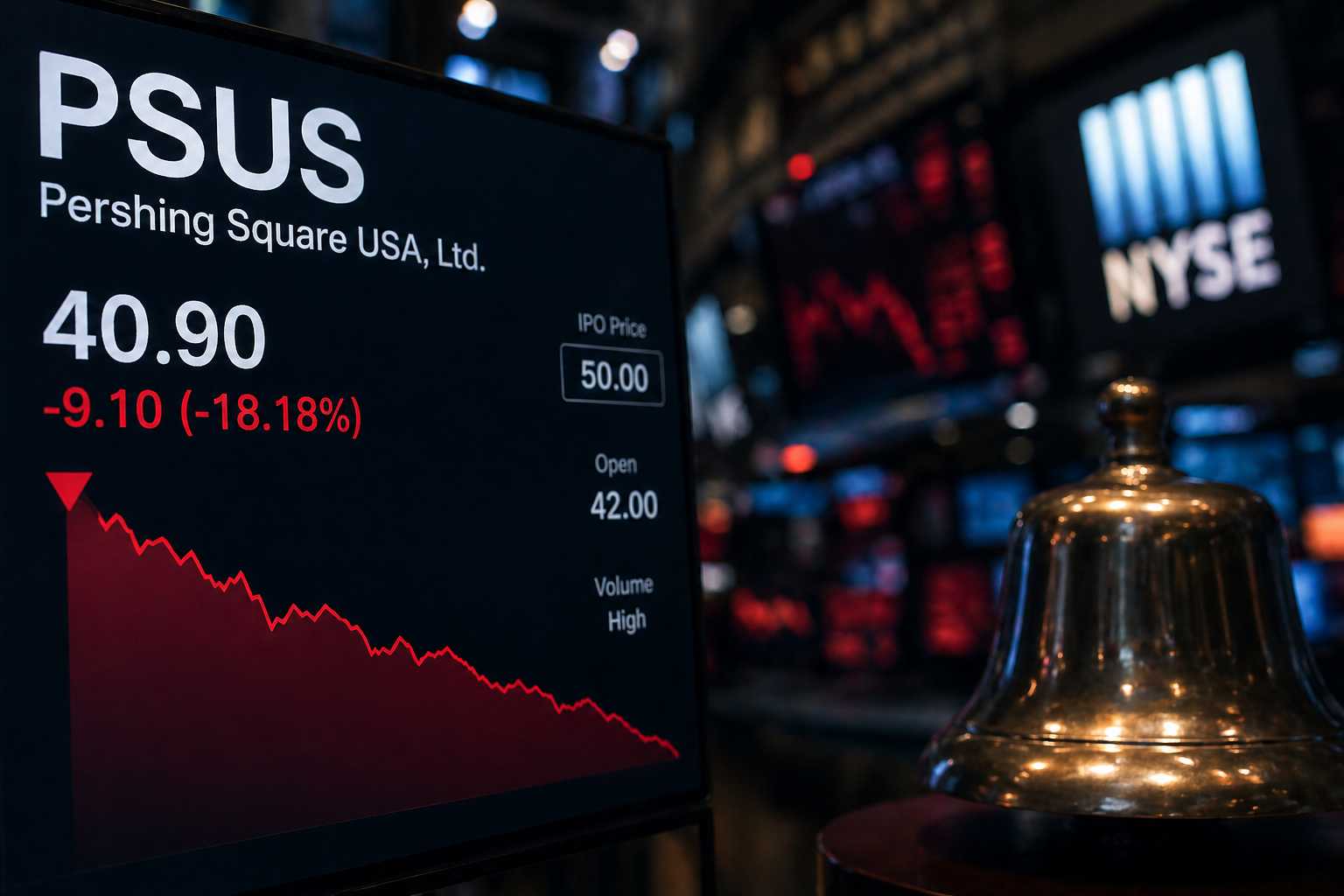
The market’s first response was blunt. Shares priced at $50, opened around $42, and closed near $40.90, roughly 18% below the IPO price on the first day of trading.
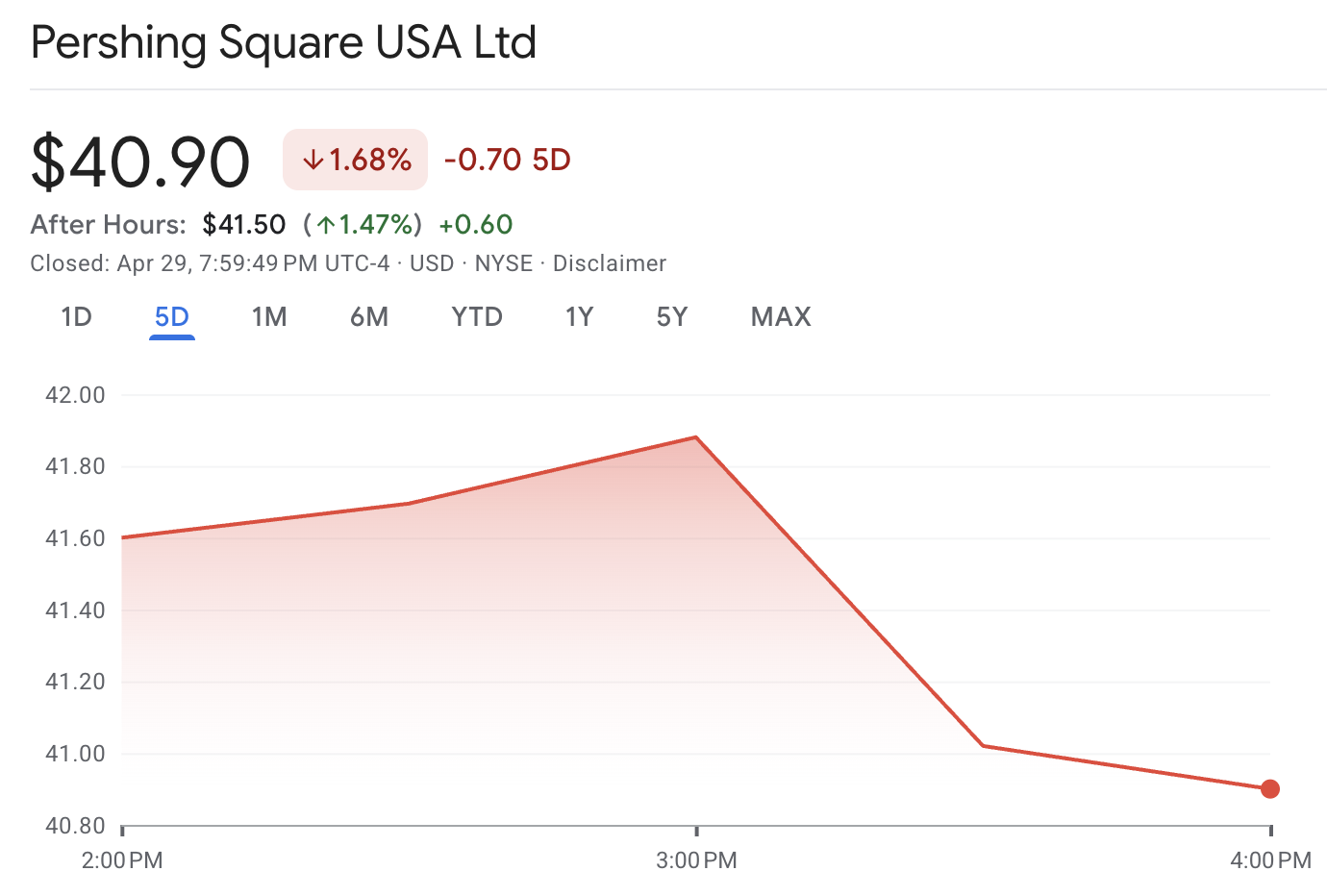
The decline turned the listing from a brand-driven launch into a live test of closed-end fund economics. Investors were immediately pricing the structure, the fee burden, the lack of direct redemption at net asset value, and the risk that PSUS could trade at a persistent discount even if its underlying portfolio performs.
PSUS priced its IPO at $50 per share, but the stock closed near $40.90 on debut, leaving early buyers with an immediate mark-to-market loss before considering the value of linked PS shares.
Pershing Square USA is a closed-end investment company, not a normal operating company or ETF. Its share price can trade above or below the value of its holdings.
The offering included a bonus structure in which public IPO buyers were set to receive 20 Pershing Square Inc. shares for every 100 PSUS shares purchased.
The weak debut showed that the bonus-share feature did not fully offset investor concern over fees, structure, liquidity, and closed-end fund discount risk.
The next phase for PSUS stock will depend less on the IPO story and more on NAV performance, discount control, portfolio transparency, and confidence in Ackman’s capital-allocation discipline.
The first-day selloff was not simply a rejection of Bill Ackman. It was a repricing of the vehicle he brought to market. PSUS is not an operating company with revenue, earnings, margins, or a conventional growth story. It is a listed investment fund whose value depends on portfolio performance and the market’s willingness to pay close to NAV for that exposure.

That distinction surfaced immediately. In a conventional IPO, investors often focus on revenue growth, profitability, addressable market, and competitive position. In PSUS, the market focused on structure. A closed-end fund raises capital, lists its shares, and then trades in the secondary market.
Investors generally cannot redeem closed-end fund shares directly at NAV. The market price therefore depends on supply, demand, investor appetite, manager reputation, and the credibility of any discount-control policy.
The IPO also carried a complex dual structure. Pershing’s launch materials said PSUS shares would be offered at $50 and that IPO buyers would receive Pershing Square Inc. shares at no additional consideration, with 20 PS shares for every 100 PSUS shares bought.
The structure was designed to make the deal more attractive, but aftermarket trading showed that investors still required a large margin of safety.
| Item | Detail |
|---|---|
| IPO price | $50.00 |
| Opening trade | Around $42.00 |
| First-day close | Around $40.90 |
| First-day move from IPO price | Roughly -18% |
| Offering size | About $5 billion |
| Fund type | Closed-end investment company |
| Public IPO bonus | 20 PS shares per 100 PSUS shares |
The table captures why the debut drew attention. A high-profile launch backed by one of Wall Street’s best-known activist investors still failed to command IPO-price support in the open market. The $5 billion raise was meaningful, but the price action showed that the market immediately distinguished between capital raised and valuation accepted.
The central issue for PSUS stock is the closed-end fund discount. A closed-end fund can own high-quality assets and still trade below the value of those assets. The discount appears when investors demand compensation for fees, illiquidity, uncertainty, weak demand, or limited confidence that the manager can keep the market price close to NAV.
This differs from an ETF. ETF shares typically have a creation and redemption mechanism that helps keep prices close to NAV. A closed-end fund does not work the same way. Once the fund is listed, investors who want out usually sell shares in the market. If buyers are scarce, the price falls.
PSUS entered the market with a famous manager, but the closed-end fund structure carried its own history. Investors know that discounts can persist for years. A fund may perform well at the portfolio level yet still frustrate shareholders if the public share price remains below NAV.
The PS share bonus was the most unusual feature of the offering. It gave IPO buyers exposure not only to the PSUS investment fund, but also to Pershing Square Inc., the asset-management business. On paper, that added value to the package.
The first trading session suggested a different market conclusion. Investors treated the bonus as helpful but not decisive. If PSUS itself trades at a deep enough discount, the value of bonus PS shares may not fully protect the buyer.
A sweetener can support demand at launch, but it cannot remove concern over the underlying fund structure. Investors still need confidence that PSUS can deliver strong after-fee returns and that management has tools to narrow any sustained discount.
Fees remain a major part of the PSUS debate. PSUS offering materials describe no management fee for the first year after the IPO, followed by a 2.0% annualised management fee and no performance fee. The absence of a performance fee is favourable compared with many hedge-fund structures, but the 2% management fee remains high compared with broad index ETFs.
For PSUS to command a premium valuation, or even narrow a discount, the portfolio must deliver returns strong enough to justify that fee. Investors are not only comparing PSUS with private funds. They are comparing it with low-cost ETFs, other listed funds, Pershing Square Holdings, and direct ownership of large-cap stocks.
A high fee can be acceptable when skill is visible and repeatable. It becomes harder to defend when the listed fund trades at a discount, the portfolio is concentrated, or shareholders face volatility before the investment thesis has had time to mature.
The next chapter for PSUS stock will not be decided by the IPO story. It will be decided by execution.
NAV performance: Pershing Square must show that the underlying portfolio can compound capital after fees.
Discount control: Buybacks, tender offers, clear communication, or other capital-management tools could help if the discount becomes persistent.
Portfolio clarity: Investors will need to understand which holdings drive risk, return, and concentration.
Fee justification: A 2% annualised management fee requires visible alpha, not only brand recognition.
Liquidity depth: Sustained trading volume matters if PSUS is meant to be a durable retail-access vehicle.
PS and PSUS separation: Investors may value the fund and the management company differently, creating separate price dynamics for each security.
Ackman’s reputation helped PSUS gain attention. It did not guarantee aftermarket support. Public markets often distinguish between a strong investor and an attractive security. The manager may have a credible long-term record, but the listed vehicle still needs the right structure, valuation, fee profile, and liquidity.
That is the more important lesson from the debut. PSUS stock is not just a wager on Bill Ackman’s investing ability. It is a wager on whether his strategy can be delivered through a public closed-end fund without allowing the discount to overwhelm the appeal of the portfolio.
PSUS fell because investors applied a discount to the closed-end fund structure. The market priced in concerns over fees, liquidity, NAV discount risk, and whether the PS share bonus was enough compensation for buying at the IPO price.
No. PSUS is the closed-end investment fund. Pershing Square Inc., trading separately under PS, represents the asset-management business. The two securities are linked by the IPO structure but trade independently.
Yes, but recovery would likely require stronger market confidence in NAV performance, discount control, portfolio execution, and liquidity. The Ackman brand may attract attention, but sustained valuation support depends on fund results.
No. PSUS is a closed-end fund. Unlike most ETFs, it does not have the same daily creation and redemption mechanism that typically keeps market prices close to NAV.
PSUS stock’s weak debut was not merely an awkward first trading session. It was the market’s first judgment on a structure that asks investors to combine confidence in Bill Ackman with tolerance for closed-end fund mechanics.
The offering raised substantial capital and brought a high-profile strategy to public investors, but the price action showed that reputation does not erase discount risk. The market wanted more than access. It wanted proof that PSUS can justify its fee structure, manage its discount, and deliver enough performance to make the vehicle compelling against cheaper and simpler alternatives.
The IPO explained the ambition. The trading debut revealed the hurdle. For PSUS stock, the real test now begins in the gap between NAV, market price, and investor patience.
Pershing Square Holdings official announcement
SEC filing: Pershing Square USA N-2 registration statement
https://www.sec.gov/Archives/edgar/data/2002660/000119312524170917/d623781dn2a.htm