Published on: 2026-04-30
A CLO ETF gives investors exchange-traded access to one of the more specialised corners of fixed income: collateralized loan obligations. These funds have gained attention as income investors look beyond traditional bond ETFs, but the structure beneath the yield is more complex than a standard portfolio of government or corporate bonds.
CLO ETFs have grown quickly as floating-rate income and structured credit move further into listed markets. LSEG noted that CLO ETF assets moved above $35 billion in early 2026 after roughly $4 billion of net inflows in the first six weeks of the year, with AAA-only strategies still attracting most capital.
The growth reflects demand for income, but it also raises a practical question: what exactly are investors buying when they buy a CLO ETF?
A CLO ETF invests in securities issued by collateralized loan obligations, which are backed mainly by pools of corporate loans.
CLOs are divided into tranches, with senior AAA tranches paid first and lower-rated tranches taking losses earlier.
Many CLO exposures are floating-rate, which can reduce duration sensitivity compared with some traditional bond funds.
CLO ETFs are not ordinary bond ETFs because returns depend on loan quality, credit spreads, tranche structure, liquidity, and manager skill.
Investors should look beyond headline yield and assess credit rating, fund liquidity, expense ratio, portfolio quality, and credit-cycle risk.
A CLO ETF is an exchange-traded fund that invests in debt securities issued by collateralized loan obligations. A CLO is a structured credit vehicle that holds a pool of corporate loans, usually senior secured loans made to below-investment-grade borrowers.
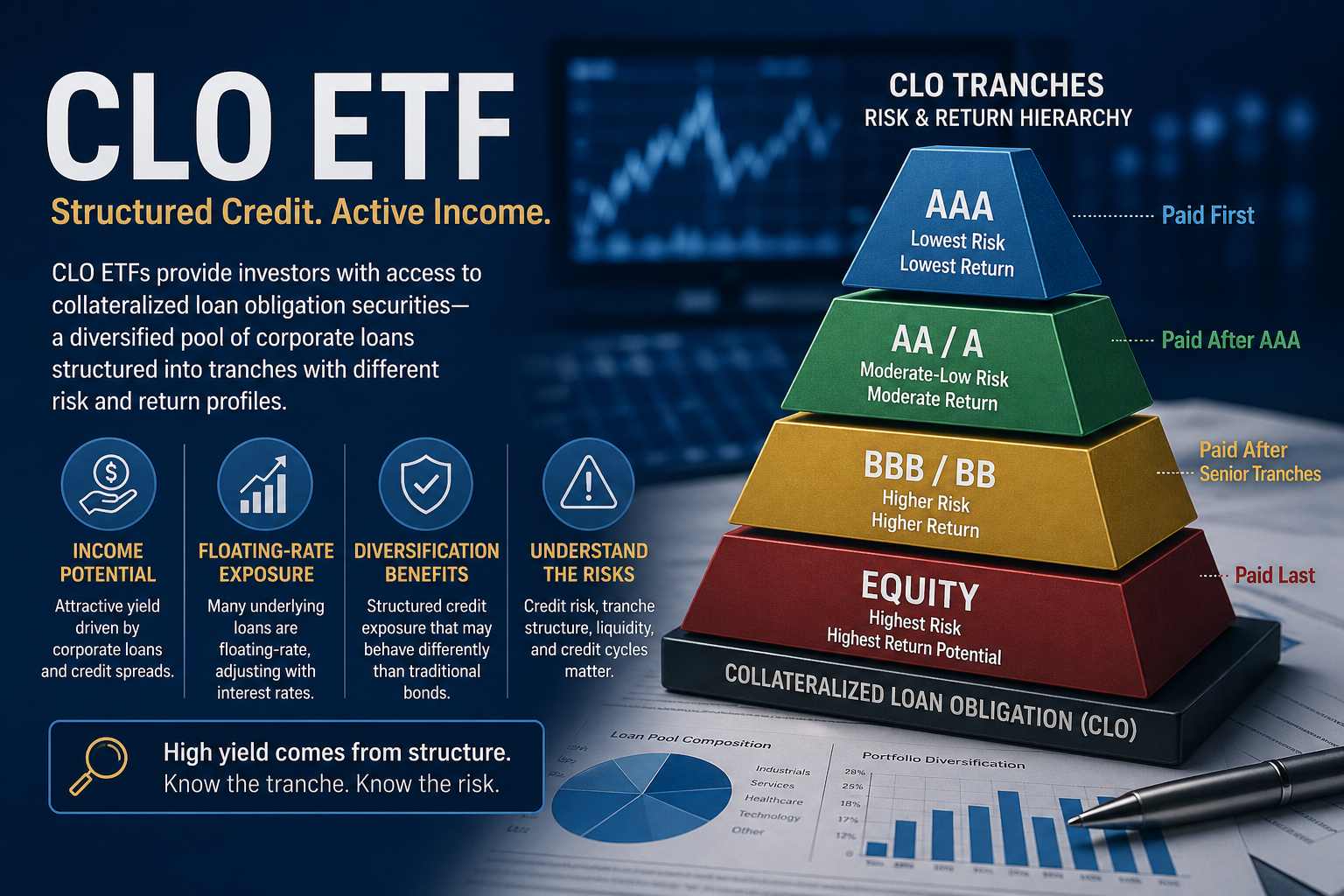
The CLO finances those loans by issuing different layers of securities to investors. These layers are called tranches. Each tranche has a different level of payment priority, credit risk, and income potential. The senior tranches receive cash flows first, while junior tranches absorb losses earlier and therefore offer higher potential returns.
The Federal Reserve describes CLO securities as being issued by special-purpose vehicles that hold diversified portfolios of leveraged loans, with rated notes and unrated equity carrying different degrees of credit risk. This is the key distinction: a CLO ETF is not simply buying ordinary corporate bonds. It is buying securities backed by loan pools and structured through a payment waterfall.
The basic structure begins with corporate loans. A CLO manager selects a diversified pool of loans, often from companies rated below investment grade. The loans generate interest payments, which flow into the CLO structure.
Those cash flows are then distributed through the capital structure. Senior tranches are paid first. Lower-rated tranches are paid later. The equity tranche sits at the bottom and receives residual cash flows after debt investors have been paid.
A CLO ETF buys selected CLO tranches and packages them into an exchange-traded fund. Investors can buy and sell the ETF on an exchange, just as they would with an equity or bond ETF. The fund wrapper improves access, but it does not remove the credit structure beneath it.
BlackRock explains that CLO risk exposures stem from the capital structure, where the CLO issues tranches with different exposure to underlying loan risk, and the lowest-risk tranche is typically rated AAA. For ETF investors, the tranche mix is one of the most important details in the fund.
| CLO Tranche | Typical Risk Level | Income Potential | Payment Priority |
|---|---|---|---|
| AAA | Lower | Lower | Paid first |
| AA / A | Moderate-low | Moderate | Paid after AAA |
| BBB / BB | Higher | Higher | Paid after senior tranches |
| Equity tranche | Highest | Highest potential | Paid last |
The table shows why two CLO ETFs can have very different risk profiles. A fund focused on AAA tranches is designed around senior payment priority and capital preservation. A fund that owns lower-rated tranches may offer higher income, but it also accepts more exposure to loan defaults, downgrades, and spread widening.
This does not mean senior CLO ETFs are risk-free. It means their risk sits higher in the capital structure than mezzanine or equity exposure. During a credit downturn, junior tranches are designed to absorb losses first, but senior tranches can still decline in price if liquidity weakens or credit spreads widen.
The main appeal is income. CLO securities can offer higher yields than many traditional investment-grade bond exposures because they are tied to leveraged loans and structured credit.
A second attraction is floating-rate exposure. Many underlying loans are floating-rate instruments, so income can adjust as benchmark rates change. That can reduce sensitivity to rising interest rates compared with longer-duration fixed-rate bonds.
A third attraction is diversification. CLO returns are influenced by corporate credit, loan spreads, tranche structure, and manager selection. They may not behave exactly like Treasuries, investment-grade corporate bonds, or high-yield bond ETFs.
Guggenheim describes CLOs as a large structured credit asset class that derives principal and interest from actively managed pools of non-investment-grade, senior-secured corporate loans. The same features that create income potential also explain why CLO ETFs need a more careful risk framework.
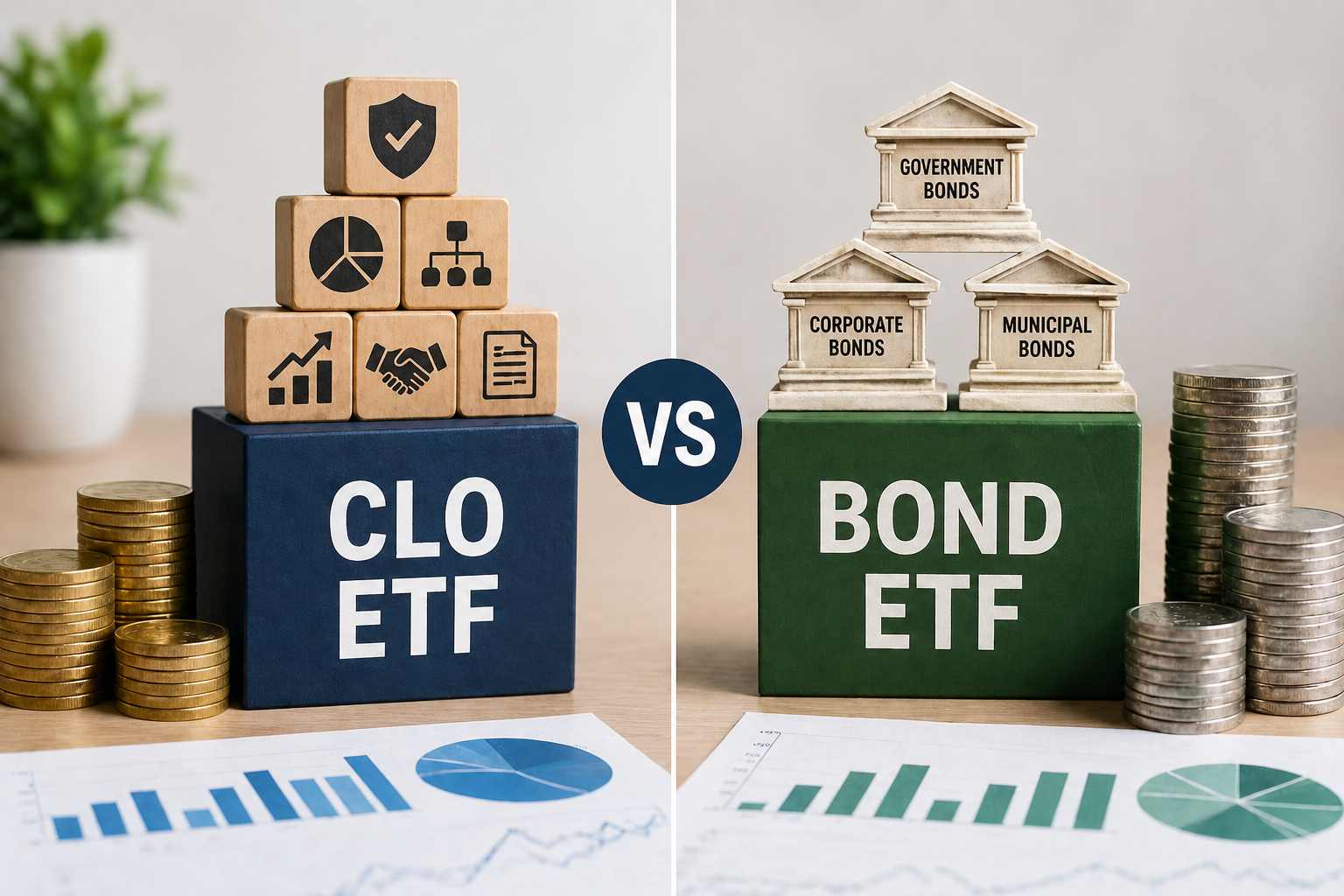
| Feature | CLO ETF | Traditional Bond ETF |
|---|---|---|
| Main exposure | Structured credit | Government, corporate, or municipal bonds |
| Income source | Loan-backed CLO securities | Bond coupon payments |
| Rate sensitivity | Often lower due to floating-rate loans | Depends on duration |
| Credit risk | Linked to leveraged loans and tranches | Linked to issuer quality |
| Complexity | Higher | Usually lower |
| Key investor question | What tranche and credit risk produces the yield? | What duration and credit rating drives returns? |
Traditional bond ETFs are usually easier to evaluate. Investors can review duration, credit rating, yield, maturity, and issuer exposure. CLO ETFs require those checks, but also demand analysis of tranche seniority, CLO manager quality, loan collateral, market liquidity, and structural protections.
Credit risk is the foundation. The loans inside CLOs are often made to below-investment-grade companies. The National Association of Insurance Commissioners notes that CLOs are predominantly backed by below-investment-grade, first-lien senior secured syndicated bank loans. If borrower quality deteriorates, CLO valuations can weaken.
Tranche risk determines how losses flow through the structure. Senior tranches receive payments first, but lower-rated tranches sit closer to the first-loss layer. A higher yield may simply reflect weaker protection.
Liquidity risk can rise during market stress. CLO securities are less liquid than US Treasuries or large corporate bonds. An ETF trades on an exchange, but the underlying assets may still become harder to price or sell in a stressed credit market.
Spread risk is also important. Even if defaults remain contained, CLO prices can fall when investors demand wider compensation for credit risk.
Manager risk matters because CLO portfolios are actively managed. Loan selection, trading discipline, sector exposure, and risk controls can influence outcomes.
Credit rating: Is the fund focused on AAA tranches, mezzanine debt, or a wider mix?
Yield source: Is income coming from senior credit exposure or from taking more credit and liquidity risk?
Expense ratio: Structured credit ETFs may charge more than plain bond ETFs.
Liquidity: Review trading volume, bid-ask spreads, and assets under management.
Portfolio composition: Check manager diversification, tranche allocation, and sector concentration.
Credit cycle: CLO ETFs may face pressure when defaults rise or leveraged-loan sentiment deteriorates.
Distribution stability: Income can change as loan coupons, spreads, and portfolio conditions shift.
CLO ETFs may appeal when investors want income, floating-rate exposure, and access to structured credit through a listed vehicle. They may also suit investors who understand that higher yield often comes with credit complexity.
The most suitable use is usually not as a cash substitute. CLO ETFs belong in a credit-risk framework, alongside high-yield bonds, leveraged loans, and other income assets. The fund’s rating profile should match the investor’s tolerance for volatility.
CLO ETFs may struggle when corporate defaults rise, credit spreads widen, liquidity weakens, or investors reduce exposure to leveraged credit. Lower-rated CLO ETFs may be more vulnerable because they sit closer to the loss-absorbing part of the structure.
Senior AAA-focused strategies may be more defensive, but they can still experience price volatility. A strong rating reduces credit risk; it does not eliminate market risk.
A CLO ETF is an exchange-traded fund that invests in collateralized loan obligation securities. These securities are backed by pools of corporate loans and divided into tranches with different payment priority and risk levels.
Yes. CLO ETFs carry credit risk, liquidity risk, tranche risk, and market risk. AAA-focused CLO ETFs are generally lower risk than funds holding lower-rated tranches, but they are not risk-free.
CLO ETFs generate income from loan-backed structured credit securities. Because the underlying loans are often floating-rate and tied to corporate credit risk, yields can be higher than many traditional fixed-income funds.
No. A bond ETF usually holds bonds directly. A CLO ETF owns structured credit securities backed by loan pools, so investors must evaluate tranche structure, loan quality, liquidity, and credit-cycle exposure.
CLO ETFs have made structured credit easier to access, but accessibility should not be confused with simplicity. The ETF wrapper allows investors to trade the exposure more easily, yet the return still comes from loan pools, tranche seniority, credit spreads, and market liquidity.
The strongest way to assess a CLO ETF is not by yield alone. A higher payout may reflect attractive floating-rate income, but it may also signal additional credit or liquidity risk. Investors should ask what type of tranche produces the income, how resilient the loan pool is, and whether the fund fits their broader fixed-income strategy.
A CLO ETF can play a useful role in an income portfolio when its structure is understood. It becomes dangerous only when investors treat structured credit as if it were ordinary fixed income.