Published on: 2026-04-29
Dollar Smile Theory explains one of the most counterintuitive patterns in global finance: the US dollar can strengthen when the world is under stress and also when the US economy outperforms. That dual behavior makes the dollar different from most currencies, which usually rise or fall more directly with domestic growth.
The framework matters in 2026 because the dollar sits between two powerful forces. The Federal Reserve is holding rates in a restrictive 3.50% to 3.75% range, while global growth is projected at only 3.1% for 2026. That combination keeps the dollar sensitive to both yield support and defensive capital flows.
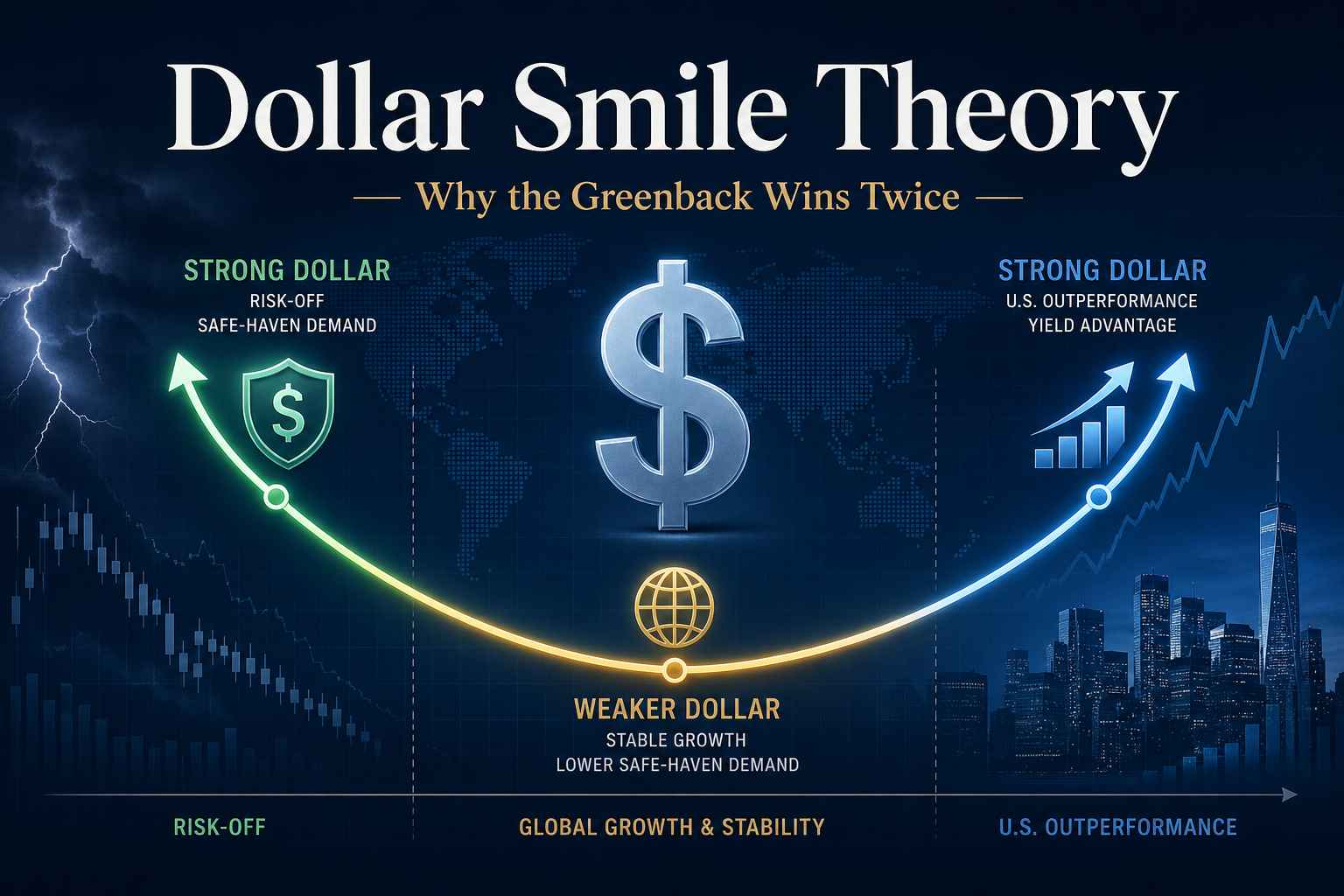
Dollar Smile Theory argues that the US dollar tends to rise at both extremes: global stress and strong US outperformance.
The “left side” of the smile reflects risk aversion, when investors seek dollar liquidity, Treasury assets and cash.
The “bottom” of the smile appears when global growth is stable, US yields are less attractive and capital rotates abroad.
The “right side” appears when stronger US growth or higher real yields pull capital into dollar assets.
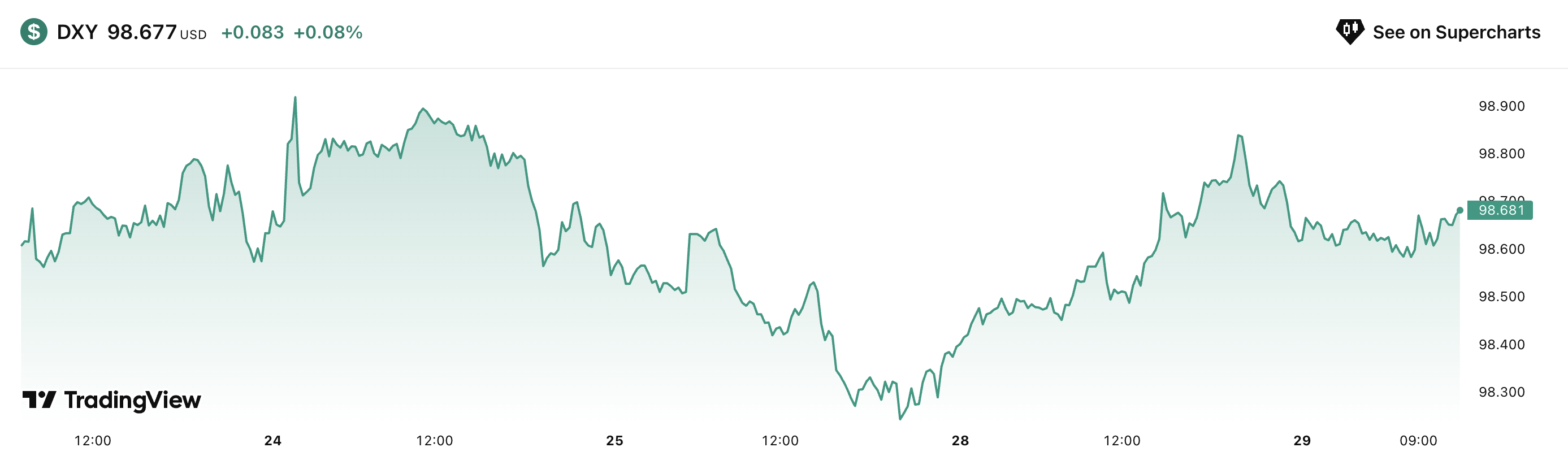
In 2026, the dollar’s position is mixed: DXY near 98.66, 10-year Treasury yields around 4.3%, and US growth slowing but not collapsing.
Dollar Smile Theory was developed by Stephen Li Jen and Fatih Yilmaz more than two decades ago to explain why the dollar does not behave in a straight line against US economic performance. The theory observes that the dollar often strengthens when the US economy performs much better than peers, but also strengthens when global fear rises sharply.
The shape resembles a smile. On the left side, the dollar rises because investors want safety. In the middle, it weakens because global risk appetite improves. On the right side, it rises again because US growth, yields and asset returns attract capital.

This is why the dollar can rally during a crisis even when US growth is weak. It is not only a domestic currency. It is the world’s main funding currency, reserve currency and collateral currency.
The left side of the smile appears when markets reduce risk quickly. Investors sell emerging-market assets, high-beta currencies and leveraged positions. Demand shifts toward US dollars, Treasury bills and highly liquid collateral.
This phase is driven less by confidence in US growth and more by the need for liquidity. In a global shock, the dollar becomes a balance-sheet asset. Corporations need dollars to repay debt. Banks need dollar funding to manage balance-sheet stress. Investors hold dollar cash and Treasury assets to reduce portfolio risk.
The dollar can therefore rise even if the US economy is slowing. The mechanism is defensive, not optimistic.
The bottom of the smile is the least dramatic but often the most important phase for investors. It appears when global growth is steady, financial volatility is contained and the US economy is neither booming nor collapsing.
In this environment, capital usually leaves the dollar in search of better returns abroad. Emerging-market currencies, commodity currencies and cyclical assets tend to benefit. US yields may be falling, while risk appetite encourages investors to diversify.
The dollar weakens because neither side of the smile is active. There is not enough fear to create safe-haven demand and not enough US exceptionalism to pull global capital back into dollar assets.
The right side of the smile reflects US economic strength. Stronger growth, higher productivity, superior equity returns or tighter Fed policy can attract foreign capital into US assets.
This phase is yield-sensitive. If US interest rates are high relative to other major economies, dollar assets become more attractive. Investors buy US bonds, equities and cash instruments, raising demand for the currency.
The right side does not require crisis conditions. It requires relative strength. The dollar rises because the US offers better returns, deeper markets or stronger nominal growth than its peers.
The dollar’s 2026 position is not clearly one-sided. It shows traits from both edges of the smile: defensive demand on the left and yield-driven support on the right.
The left side is visible through geopolitical and energy risk. Global growth has slowed, inflation pressure remains uneven and investors remain alert to commodity shocks. The IMF’s April 2026 outlook projects global growth of 3.1%in 2026 and 3.2% in 2027, below the 2000 to 2019 historical average of 3.7%.
The right side is visible through yield support. The Fed’s target range of 3.50% to 3.75% remains high enough to preserve a yield cushion for the dollar, especially if other central banks are closer to easing.
Yet the middle of the smile has not disappeared. US growth has moderated. Real GDP rose only 0.5% annualized in Q4 2025, and the Atlanta Fed’s GDPNow model estimated Q1 2026 growth at 1.2% as of 21 April. That points to resilience, not a classic boom.
| Indicator | April 2026 Reading | Dollar Smile Signal |
|---|---|---|
| Fed funds target range | 3.50% to 3.75% | Supports right-side yield demand |
| US real GDP, Q4 2025 | 0.5% annualized | Weakens exceptionalism case |
| Atlanta Fed GDPNow, Q1 2026 | 1.2% | Suggests modest resilience |
| 10-year Treasury yield | About 4.3% | Keeps dollar assets competitive |
| DXY level | Near 98.66 | Shows firm but not runaway USD demand |
| USD share of global reserves, Q4 2025 | 56.77% | Confirms dominance, with gradual erosion |
The table shows why Dollar Smile Theory is useful but not mechanical. The dollar has both defensive and yield support, yet the US growth impulse is not strong enough to confirm a decisive right-side dollar rally.
The dollar’s safe-haven role rests on market structure. The US Treasury market remains the deepest government bond market in the world. The dollar is widely used in trade invoicing, commodity pricing, offshore borrowing and central-bank reserves.
That system creates forced demand. When funding stress rises, borrowers need dollars. When global volatility increases, investors raise cash. When central banks manage reserves, the dollar remains the largest allocation.
The IMF’s COFER data show that the dollar accounted for 56.77% of disclosed global FX reserves in Q4 2025. That share has slipped from previous levels, but it remains far above any single alternative currency.
This is the structural foundation of the left side of the smile. Fear does not need to produce admiration for the US economy. It only needs to create demand for the most liquid balance-sheet asset.
Dollar Smile Theory is a framework, not a trading signal. It explains tendencies rather than exact entry points.
The biggest limitation is that the dollar’s safe-haven premium may be changing. Reserve diversification, higher US fiscal deficits, more active gold purchases by central banks and geopolitical fragmentation have made dollar demand less automatic than it was after the global financial crisis.
The second limitation is timing. The smile can describe the direction of pressure but not when it will appear. Markets may price Fed cuts before growth weakens. They may price geopolitical risk before capital actually flows into dollars.
The third limitation is relative policy. A softer Fed can weaken the dollar even when US assets remain attractive. A more hawkish European Central Bank, Bank of Japan or emerging-market central bank can narrow yield spreads and reduce the dollar’s right-side support.
Dollar Smile Theory is most useful as a macro map. It helps investors classify the dollar environment before interpreting price action.
When volatility rises and equity correlations increase, investors should ask whether the market is moving toward the left side of the smile. Dollar strength in that setting often signals liquidity demand rather than economic confidence.
When global growth stabilizes and US yields fall, investors should watch for the bottom of the smile. That environment can favor emerging-market FX, gold, commodities and non-US equities.
When US data surprise to the upside and Treasury yields rise, the right side becomes more relevant. Dollar strength then reflects return-seeking capital, not defensive cash hoarding.
The key is identifying the driver. A dollar rally caused by fear behaves differently from one driven by growth. The first can fade quickly when risk appetite recovers. The second can last longer if yield spreads, earnings momentum and relative US growth remain favorable.
Dollar Smile Theory says the US dollar tends to strengthen in two opposite environments: global crisis and strong US outperformance. It weakens most when global conditions are calm, US growth is moderate and investors seek returns outside dollar assets.
The dollar appreciates during crises because investors need liquidity, collateral and safe-haven assets. Many companies and governments borrow in dollars, so stress can create urgent demand for dollar funding even when the US economy is slowing.
A strong US economy can lift the dollar by attracting foreign capital into US stocks, bonds and cash instruments. Higher US yields and stronger asset returns increase demand for dollars, especially when other major economies lag.
It remains valid as a macro framework, but less automatic than before. The dollar still dominates reserves and funding markets, yet reserve diversification, fiscal concerns and geopolitical fragmentation may flatten parts of the smile.
The dollar usually weakens when global growth improves, volatility falls and investors feel confident enough to buy non-US assets. This is the middle of the smile, where safe-haven demand fades and US exceptionalism is not strong enough to dominate.
Dollar Smile Theory remains one of the clearest frameworks for understanding the US dollar’s unusual behavior. It explains why the greenback can strengthen during periods of fear and again during periods of US outperformance, while often weakening in the calmer middle of the global cycle.
As of April 2026, the dollar sits between defensive demand and yield support. Global growth is slower, Fed policy remains restrictive and US growth is resilient but not dominant. That mix does not guarantee a major dollar rally, but it keeps the smile highly relevant for investors assessing currency risk.
The framework’s value lies in discipline. It separates safe-haven dollar strength from growth-led dollar strength. For traders, investors and policymakers, that distinction matters because the same move in the dollar can carry very different economic messages.