Published on: 2026-06-29
Updated on: 2026-06-29
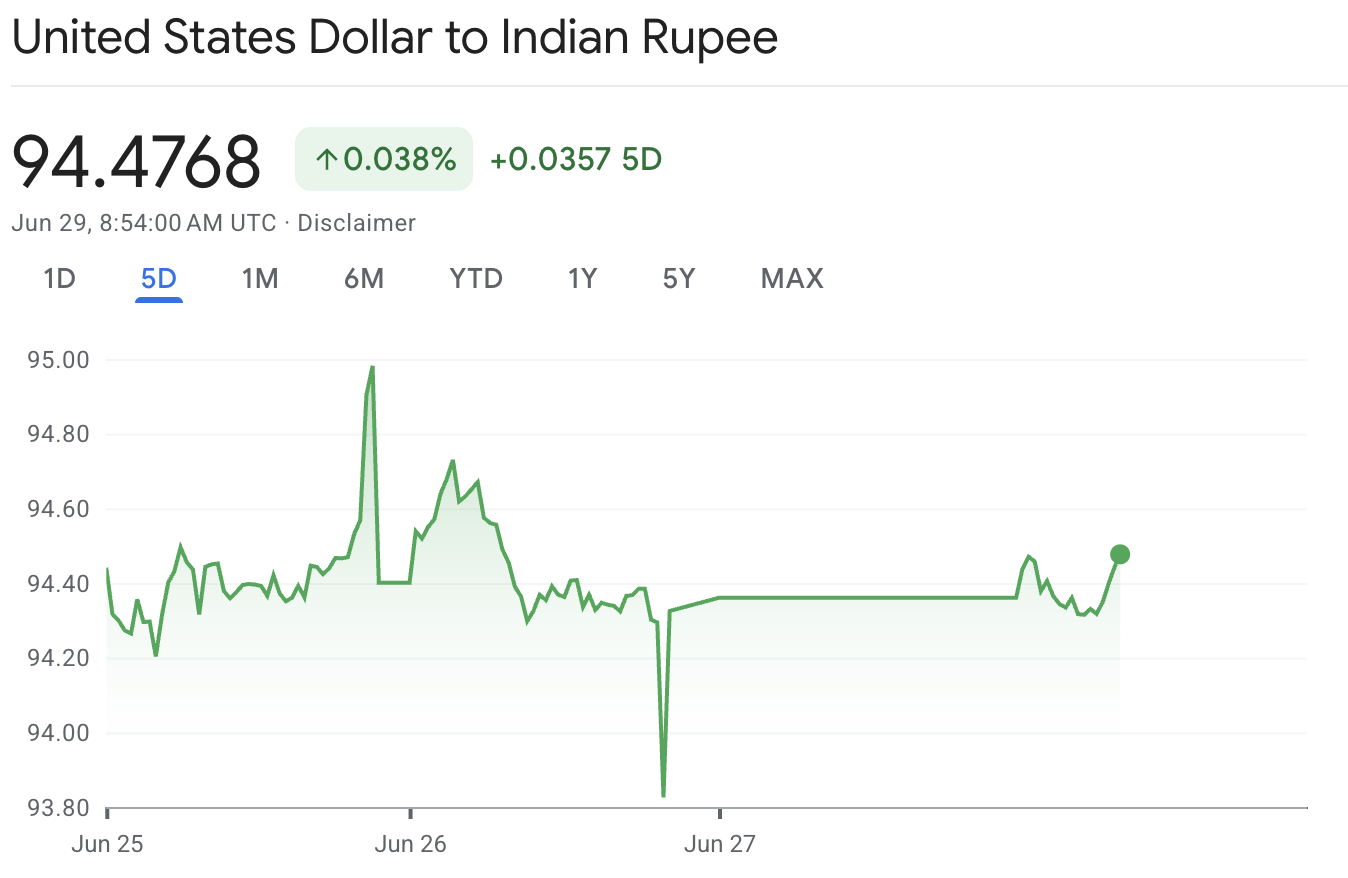
USD/INR is trading inside a narrowing range after a sharp retreat from the March 2026 record high near 99.82. The pair has moved back toward 94.36 to 94.61, where short-term momentum has improved for the rupee but has not yet confirmed a decisive breakdown in the dollar trend.

The technical structure is now defined by compression. USD/INR is no longer extending higher, but it is not falling cleanly either. Price is testing the lower half of its recent range, while resistance from moving averages sits above spot. A daily close below 94.20 to 94.30 would strengthen the rupee recovery, while acceptance above 95.00 would return control to dollar buyers.
USD/INR is consolidating near 94.36 to 94.61, below the major moving-average stack but above the key 94.20 to 94.30 breakdown zone.
The pair remains well below the March 2026 record high near 99.82, but the broader twelve-month structure still leaves the rupee historically weak.
RSI is neutral to soft, while MACD remains negative, showing that dollar momentum has faded without producing a full trend reversal.
The strongest support sits at 94.20 to 94.30. A daily close below that band opens 93.80 to 94.00, then 92.55 to 92.80.
Resistance is layered at 94.70 to 94.80, then 95.00, then 95.90 to 96.00. Dollar bulls need a close above 95.00 to rebuild upside pressure.
The setup remains sensitive to crude oil, U.S. yields, RBI liquidity management, FPI flows, and importer hedging demand.
USD/INR has pulled back meaningfully from the March 2026 extreme, but the rupee has not yet reversed the broader depreciation cycle. This is a recovery phase inside a still-elevated exchange-rate regime.
A trend reversal would require USD/INR to break support, hold below it, and form lower highs beneath former balance levels. So far, the pair has only compressed. It has stopped rising, but it has not built enough downside momentum to confirm a new rupee-led trend.
The 30-day range near 94.26 to 95.91 is the key short-term reference. Price is pressing closer to the lower edge of that band, which gives the rupee a tactical advantage. The 90-day range near 92.25 to 96.79 shows the bigger picture: USD/INR remains inside a wide consolidation channel, with neither side strong enough to force a durable break.
A brief dip below support would not be enough. USD/INR needs a daily close below 94.20 to prove that the rupee recovery has moved from relief into continuation.
| Technical signal | Latest read | Interpretation |
|---|---|---|
| Spot zone | 94.36 to 94.61 | Lower half of the short-term range |
| 30-day range | 94.2639 to 95.9124 | Compression zone with downside boundary in focus |
| 90-day range | 92.2550 to 96.7910 | Broader consolidation remains intact |
| Classic pivot | 94.498 | Balance level from the latest pivot set |
| 20-period EMA | 94.563 | Short-term resistance above spot |
| 50-period EMA | 94.623 | Confirms overhead pressure |
| 100-period EMA | 94.674 | Reinforces the 94.60 to 94.70 supply zone |
| 200-period EMA | 94.778 | Keeps 94.70 to 94.80 technically important |
| RSI 14 | 50.672 | Neutral, with no overbought pressure |
| MACD 12, 26 | -0.064 | Dollar momentum remains weak |
| ADX 14 | 28.709 | Trend strength is moderate, not extreme |
| ATR 14 | 0.1311 | Volatility is contained but able to expand |
| Major support | 94.20 to 94.30 | Breakdown zone for rupee continuation |
| Major resistance | 94.80 to 95.00 | Dollar breakout confirmation zone |
Price is below the 20-, 50-, 100-, and 200-period EMAs, meaning the market is selling rallies rather than chasing upside. The 94.60 to 94.80 area now functions as a dynamic resistance zone, not just a horizontal level.
RSI near 50.7 is neutral, with no exhaustion signal, but no support for a strong dollar breakout either. MACD at -0.064confirms that upward momentum has deteriorated. This is not a panic selloff. It is a controlled loss of dollar impulse.
ATR near 0.13 keeps the setup tradable. Volatility is not extreme, but it is sufficient for a clean range break if price closes outside the compression band.
The key support zone is 94.20 to 94.30, containing the lower boundary of the recent range and sitting close to the prior 30-day low. If USD/INR closes below that zone, the next downside target becomes 93.80 to 94.00.
Below 93.80, the measured-move projection points toward 92.55 to 92.80. It reflects the size of the recent compressed range and aligns with the lower half of the broader 90-day structure.
Resistance is equally clear. The first supply band sits around 94.60 to 94.80, where the EMA stack gathers. A move into that area may attract dollar selling unless price closes above it. The more important level is 95.00. A daily close above 95.00 would cancel the near-term rupee advantage and reopen 95.90 to 96.00.
Above 96.00, the market would begin to reprice the May stress zone. Reaching it would require a clear external trigger: higher crude, renewed FPI outflows, stronger U.S. yields, or heavier importer hedging.
USD/INR rarely moves on chart structure alone. Our prior USD/INR coverage has consistently treated the pair as a flow-sensitive exchange rate shaped by oil, U.S. yields, RBI operations, and portfolio flows.
Crude is the dominant flow driver. India imports most of its oil, so higher Brent prices raise dollar demand from refiners and importers. When oil rises at the same time as portfolio flows weaken, USD/INR can climb quickly because dollar demand rises while foreign-currency supply falls.
U.S. yields set the carry backdrop. The rupee often reacts less to domestic data than to the dollar’s global carry advantage. Higher U.S. real yields make dollar assets more attractive and reduce the appeal of emerging-market currency exposure.
The RBI caps disorderly moves rather than engineering straight-line recoveries. The central bank can smooth volatility, rebuild inflow channels, and reduce market stress, but policy support usually limits damage rather than creating a sustained rally. The chart still needs confirmation below 94.20.
While USD/INR holds between 94.20 and 95.00, the pair remains range-bound. The bias leans slightly toward the rupee because price sits below the EMA stack and MACD is negative. Still, the setup is not confirmed until support breaks.
A daily close below 94.20 confirms downside continuation. The first target is 93.80 to 94.00, followed by 92.55 to 92.80. The breakdown weakens if price quickly reclaims 94.50.
A close above 95.00 restores dollar control. That would place 95.90 to 96.00 back in view. If the move is supported by higher crude, firmer U.S. yields, or weaker FPI flows, the breakout would carry more conviction.
USD/INR is not in free fall, but the dollar has lost momentum. Price is compressed near the lower half of its recent range, trading below the major EMA stack with MACD still negative. The rupee holds a clearer short-term advantage than it had during the May stress phase.
The decisive level is 94.20. A daily close below it would confirm that the rupee recovery has another leg and would expose 93.80 to 94.00, then 92.55 to 92.80. Until that break appears, the move remains compression, not confirmation. For dollar bulls, 95.00 is the line to reclaim: a close above it would reset the chart and bring 95.90 to 96.00 back into focus.
For traders who want live exposure to the levels in this analysis, USDINR is available as a CFD through EBC’s forex product listing. Both long and short positions are accessible from the same account, and leveraged positions should be sized to the level where the setup is invalidated.