Published on: 2026-06-10
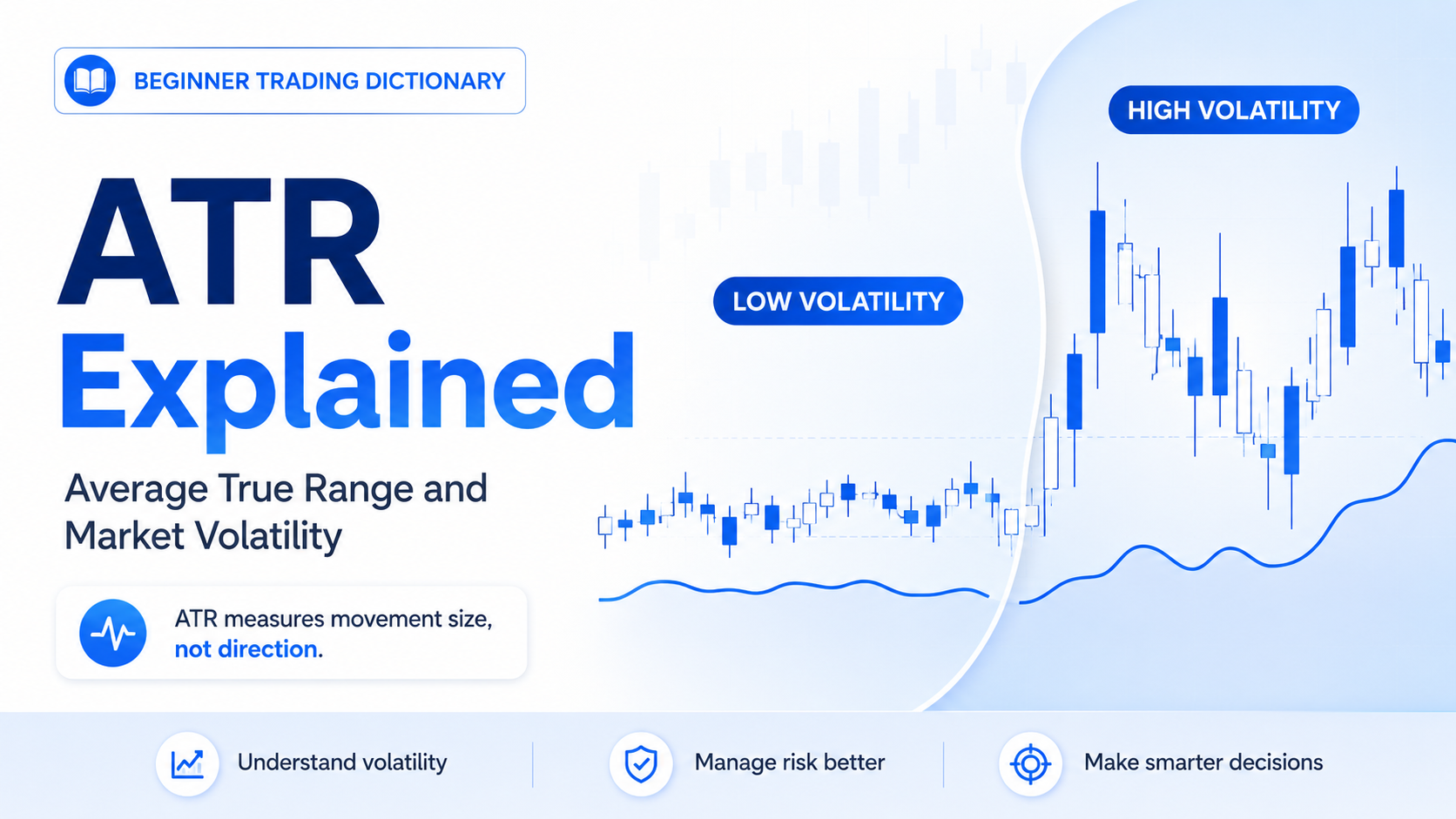
Average True Range, or ATR, is a tool traders use to measure how much prices move in the market. It tells you the typical amount an asset moves during a set time frame.
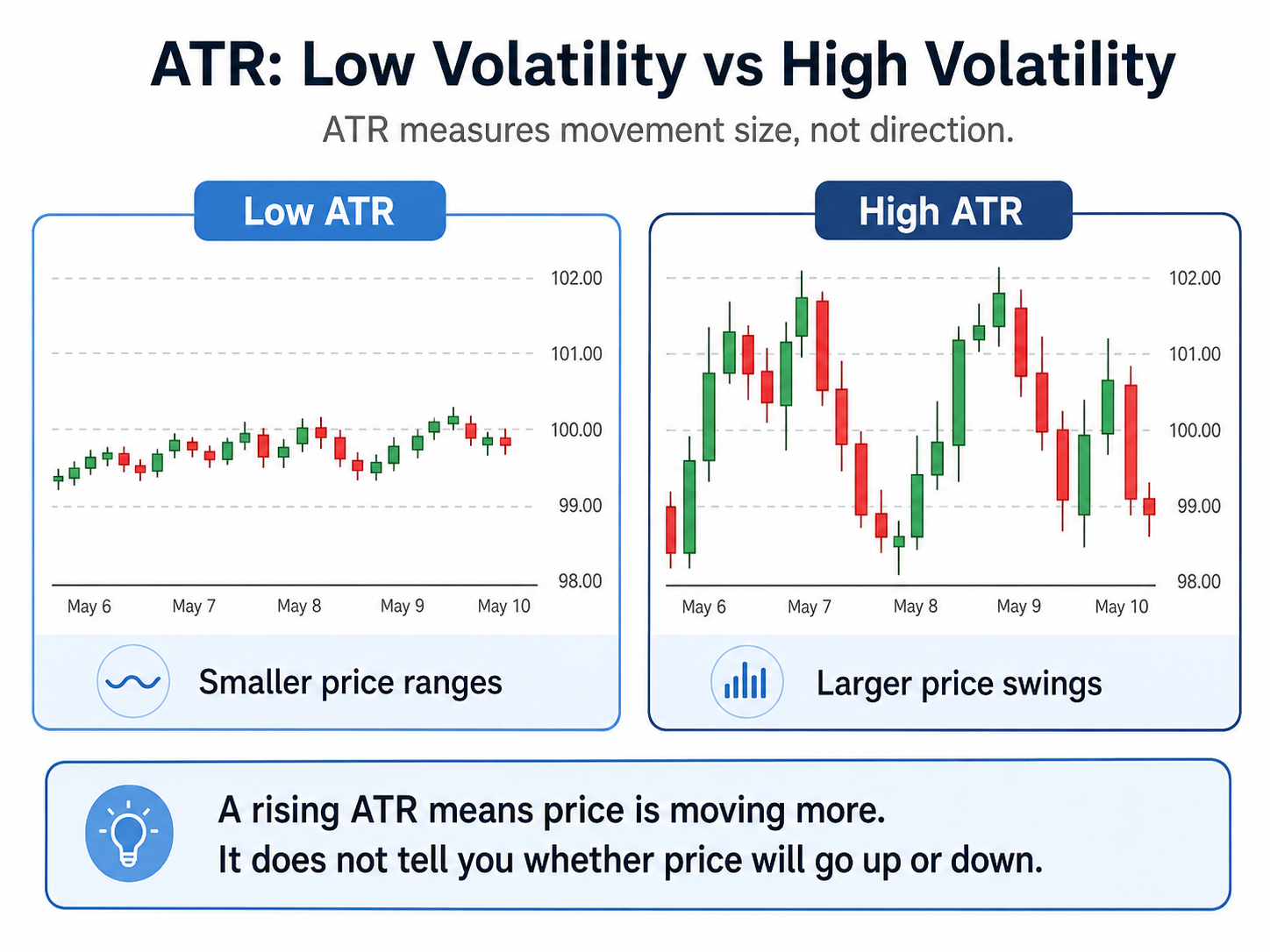
You can think of ATR like a speedometer for prices. It does not predict where prices will go, but it shows how quickly or slowly prices have been moving lately. A high ATR means the price has been moving in wider ranges. A low ATR means the price has been moving in smaller ranges.
ATR is helpful for beginners because it puts price moves in perspective. For example, a 50-point move might be big in one market but normal in another. ATR helps you determine whether the current movement is calm, active, or highly volatile.
ATR is based on True Range. True Range measures the largest price movement by comparing:
The current high minus the current low
The current high minus the previous close
The current low minus the previous close
This lets ATR include price gaps. If the market opens much higher or lower than it closed the previous day, a regular high-low range might miss some of the movement.
For example, suppose a stock closed yesterday at $100. Today, it reached a high of $108 and a low of $103. The normal daily range is $5, from $103 to $108. But compared with yesterday’s close, the full movement is $8. True Range captures the larger move.
Most trading platforms set ATR to 14 periods by default. On a daily chart, this means ATR looks at the average True Range from the past 14 days. On an hourly chart, it uses the last 14 hours.
ATR is shown in the same unit as the asset price. If a stock’s daily ATR is $3, it means the price has moved about $3 per day on average. For a forex pair with a daily ATR of 80 pips, it has moved about 80 pips per day recently.
ATR does not tell you which way the price is going. If ATR is rising, it just means price swings are getting bigger. The market could be going up, down, or moving both ways.
A high ATR shows stronger price movement. This may happen during earnings, economic data releases, central bank decisions, strong trends, breakouts, or periods of market stress. High ATR can mean more trading opportunities, but it also brings more risk. Prices might move quickly, stop-losses could be triggered sooner, and traders might need to use smaller trade sizes.
A low ATR shows quieter price movement. This often appears during sideways markets, low-volume sessions, or consolidation before a possible breakout.
Low ATR might seem safer, but it often means there are fewer chances to trade. Smaller price moves do not remove risk; they just show that prices have stayed in a tighter range lately.
One of the most common uses of ATR is stop-loss planning. If a market typically moves widely, a stop-loss set too close to the entry price may be triggered by normal price fluctuations. ATR helps traders avoid setting stops that are too tight for current market conditions.
For example, if a stock trades at $50 and has a daily ATR of $2, a stop-loss only $0.50 away may not give the trade enough room. Some traders use 1.5 or 2 times ATR to create a wider volatility-based stop.
ATR can also help with position sizing. If volatility is high, a trader may reduce the trade size to keep risk under control. If volatility is lower, the trader may use a normal position size, depending on their strategy.
This is where ATR becomes practical. It helps traders adapt to the market rather than using the same stop-loss or position size for every trade.
ATR can be tricky to compare between different assets because it is just a number, not a percentage. For example, a $5 ATR is big for a $30 stock but small for a $500 stock. To compare volatility more fairly, traders sometimes use ATR as a percentage:
ATR percentage = ATR ÷ price × 100
If a stock trades at $100 and its ATR is $5, the ATR percentage is 5%. This makes it easier for traders to compare volatility between different markets.
ATR is helpful, but it is not a full trading strategy on its own. It does not predict whether the price will rise or fall. It does not show trend strength on its own. It also uses past price movement, so it may react after volatility has already changed.
ATR works best when you use it alongside other tools, such as market structure, support and resistance, trend analysis, and sound risk management.
Volatility: The size and speed of price movement in a market.
Stop-Loss Order: An order that closes a trade when the price reaches a selected loss level.
Technical Indicator: A tool that uses market data to help traders analyse price conditions.
Support and Resistance: Price areas where buying or selling pressure may appear.
Position Sizing: The process of deciding how large a trade should be based on risk.
Breakout: A move above resistance or below support that may signal stronger momentum.
No. ATR is not a buy or sell signal. It measures volatility only. A rising ATR indicates that price ranges are widening, but the price can still move up, down, or sideways.
Many platforms use a 14-period ATR by default. This setting is common because it gives a balanced view of recent volatility. Short-term traders may use fewer periods, while longer-term traders may use more periods.
ATR helps traders avoid stops that are too close to the entry price. If an asset usually moves widely, a tight stop may be hit by normal volatility. Traders may use ATR as a guide for wider, more realistic stops.
High ATR means the price has been moving in wider ranges. This can increase trading risk because gains and losses may occur more quickly. Traders often adjust position size when ATR rises to keep risk under control.
Average True Range, or ATR, shows how much a market typically moves over a certain period. It helps traders understand volatility, set stop-loss levels, and choose the right trade size.
ATR does not predict price direction, but its main value lies in helping you stay aware of risk. For beginners, ATR is a good reminder that every market moves differently, and every trade needs enough room and careful risk control.