Published on: 2026-06-11
USD/INR has moved into a policy-sensitive range as the Reserve Bank of India’s new dollar swap windows give the rupee a fresh line of defence against foreign outflows, high crude prices, and a still-firm US dollar.
This is not a defence of any fixed level, but a targeted attempt to rebuild dollar inflows through banks, public-sector borrowers, and non-resident deposit channels before spot-market pressure turns disorderly.
The FBIL reference rate put USD/INR at 95.1855 on June 10, with instruments trading in the mid-95s early on June 11. That sits below the May stress zone, when the USD/INR touched 96.8441 on May 20, but still near historically weak levels, leaving the swap architecture central to the currency outlook.
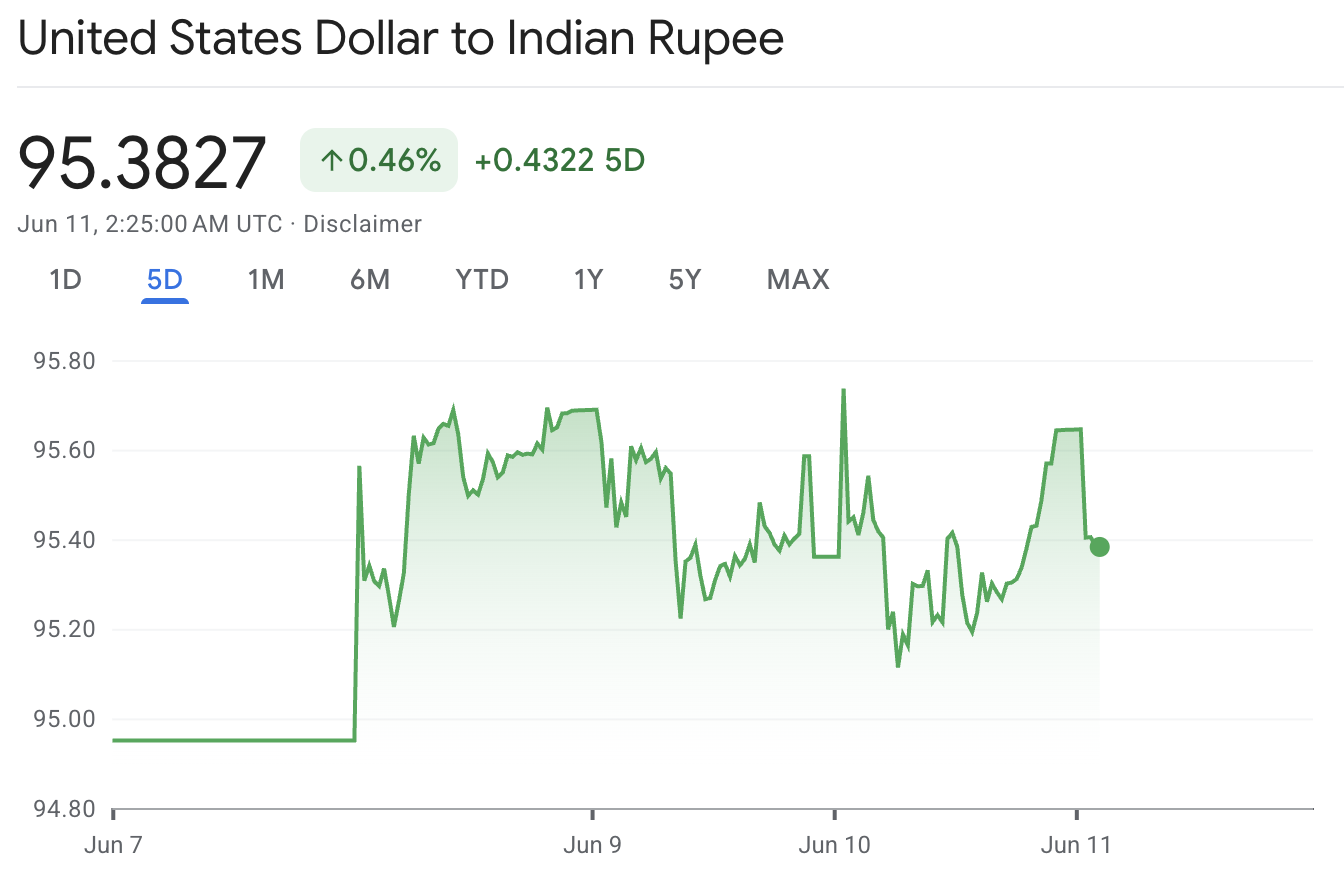
USD/INR remains near the 95 handle, keeping rupee sentiment vulnerable despite the RBI’s support.
The June 8 FCNR(B) swap window covers fresh three-to-five-year deposits and stays open until October 16, 2026, for deposits mobilised by September 30.
The ECB and OFCB window applies to eligible PSU borrowings and banks’ overseas borrowings at a fixed 1.5% per year, with access until January 15, 2027.
The RBI has exempted eligible swap positions from banks’ NOP-INR limits, removing a balance-sheet constraint.
Analysts see the package drawing roughly $40 billion to $50 billion, with higher-end estimates toward $60 billion if all channels align, against the about $34 billion raised in 2013.
The June 8 circulars operationalised measures first signalled in the Governor’s June 5 policy statement, built around three operational channels that each open a different dollar pathway:
FCNR(B) deposits. Authorised dealer banks mobilise fresh foreign-currency non-resident deposits of three to five years, sell those dollars to the RBI, and buy them back at the same rate at maturity. The RBI bears the hedging cost, removing the forward-premium burden that usually makes such deposits expensive to fund. Deposits are exempt from cash reserve ratio and statutory liquidity ratio maintenance and carry a one-year lock-in; the swaps cannot be cancelled.
ECB and OFCB borrowings. Eligible external commercial borrowings by public-sector undertakings and overseas borrowings by banks can be swapped at a fixed 1.5% annual cost, compounded semi-annually, covering flows received up to December 31, 2026, with access until January 15, 2027.
NOP-INR exemption. The RBI excluded positions arising from the swap facilities from banks’ net overnight open position in rupee. Quieter but pivotal: without it, an internal risk ceiling would have throttled how much banks could take on.
Together, these measures change the economics of NRI deposit mobilisation, letting banks offer sharper foreign-currency rates without carrying open currency risk and shifting dollar supply from episodic intervention toward structured inflows. The urgency is in the data: FCNR(B) inflows had collapsed from $7.08 billion in FY25 to just $946 million in FY26.
The rupee’s weakness reflects a layered external shock. The RBI’s June statement flagged $13.7 billion of net foreign portfolio outflows through June 2, mainly from equities, while reserves stood at $682.3 billion as of May 29, about eleven months of import cover.
That buffer is strong, but it does not erase pressure from oil imports, outflows, and global dollar strength. The pair had reached a record-stress zone near 96.8 in May before recovering.

The domestic backdrop is comparatively resilient, which shaped the choice of tool. The RBI held the repo rate at 5.25%, kept a neutral stance, trimmed its FY27 GDP forecast to 6.6% from 6.9%, and raised inflation to 5.1% from 4.6%, a mix that argues against rate cuts and explains why it reached for inflow tools rather than tightening.
Swap windows can raise dollars without immediately depleting reserves. Rather than sell its own holdings, the RBI underwrites the currency risk on eligible private inflows, so if the money arrives, reserves may rise rather than fall.
| Indicator | Latest reading | Market signal |
|---|---|---|
| USD/INR FBIL reference rate | 95.1855 on June 10 | Rupee stabilised but still weak |
| USDINR June futures | 95.4400 early June 11 | Forward market still prices pressure |
| Policy repo rate | 5.25% | No rate defence of the rupee |
| FY27 GDP forecast | 6.6% | Growth cushion intact |
| FY27 CPI forecast | 5.1% | Inflation risk limits easing room |
| Net FPI flows through June 2 | -$13.7 billion | Portfolio drag remains material |
| FX reserves on May 29 | $682.3 billion | Strong intervention buffer |
| ECB/OFCB swap cost | 1.5% per year | Direct incentive to borrow dollars |
The 2013 precedent matters because it worked. During the taper tantrum, the RBI’s concessional swap windows helped banks mobilise about $34 billion, rebuilding reserves and steadying the rupee through a sharp external-financing squeeze.
The 2026 scheme is broader, but the rate environment is less favourable. The 2013 swap paired a concessional 3.5% cost with near-zero US rates, a double advantage that no longer exists. With US 10-year Treasury yields around 4.5%, the gap between holding dollars in India and in US government paper is far narrower, so non-resident savers need sharper pricing to move funds.
Even so, the structure is powerful: the RBI absorbs the hedge cost, banks gain regulatory flexibility, and the window is time-bound. Business Standard reported banks could lift FCNR(B) rates by 150 to 200 basis points, with SBI Research seeing inflows that could exceed 2013, and some lenders are already quoting rates above 7%.
The realistic base case clusters around $40 billion to $50 billion across FCNR(B), ECB and OFCB swaps, and bond-market changes. Higher estimates near $60 billion would need aggressive bank mobilisation, stable risk appetite, and real foreign demand for longer-tenor Indian bonds.
The windows are unlikely to spark a straight-line rally. Their effect is to cap disorderly depreciation by raising expected dollar supply, which could keep USD/INR contained below the May stress zone if banks mobilise deposits quickly and PSUs tap overseas borrowing.
The catch is timing. Deposits take weeks to build, while oil shocks and equity outflows hit immediately, leaving the pair exposed to renewed volatility if crude rises, US yields harden, or foreign selling persists. A sustained move below 95 would signal the package is gaining traction; a return toward 96.5 would show external pressure is again outrunning policy support.
They are USD/INR swap facilities that let banks bring in foreign currency through FCNR(B) deposits, eligible PSU external commercial borrowings, and bank overseas borrowings, then swap those dollars with the RBI to lift dollar supply and cut hedging friction.
They bring foreign currency directly into India’s banking system. Because the deposits are held in currencies such as the US dollar, they improve dollar availability without forcing non-resident savers to take rupee-depreciation risk.
It can, but the bar is higher. The 2013 windows raised about $34 billion when US yields were near zero; in 2026, with yields around 4.5%, India’s relative appeal is weaker unless banks offer materially higher rates.
No. The RBI has reiterated that it does not target a fixed level or band, aiming only to curb excessive volatility while allowing market-driven adjustment.
The pace of FCNR(B) and ECB inflows, how far banks pass the hedging subsidy through to deposit rates, the US yield path, and whether USD/INR holds the mid-90s or slips toward 96.5.
The RBI’s swap windows give the rupee a credible policy lifeline, not an outright shield. The central bank has shifted from reactive spot defence toward a more durable inflow strategy that lowers hedging costs, improves bank incentives, and broadens foreign-currency supply.
USD/INR may still face pressure from oil, outflows, and US yields, but the balance of risk has changed. If banks mobilise deposits aggressively and PSUs use the ECB window, the rupee’s next move may turn less on panic than on whether that inflow engineering can rebuild confidence before external stress returns.