Published on: 2026-06-04
Updated on: 2026-06-04
NVTS stock has become one of the clearest small-cap expressions of the AI power infrastructure trade. Navitas Semiconductor jumped 19.3% on June 3, touched an intraday high above $34, and closed at $30.84 on more than 112 million shares after confirming a collaboration with NVIDIA’s MGX ecosystem on 800 VDC AI data-center power delivery.
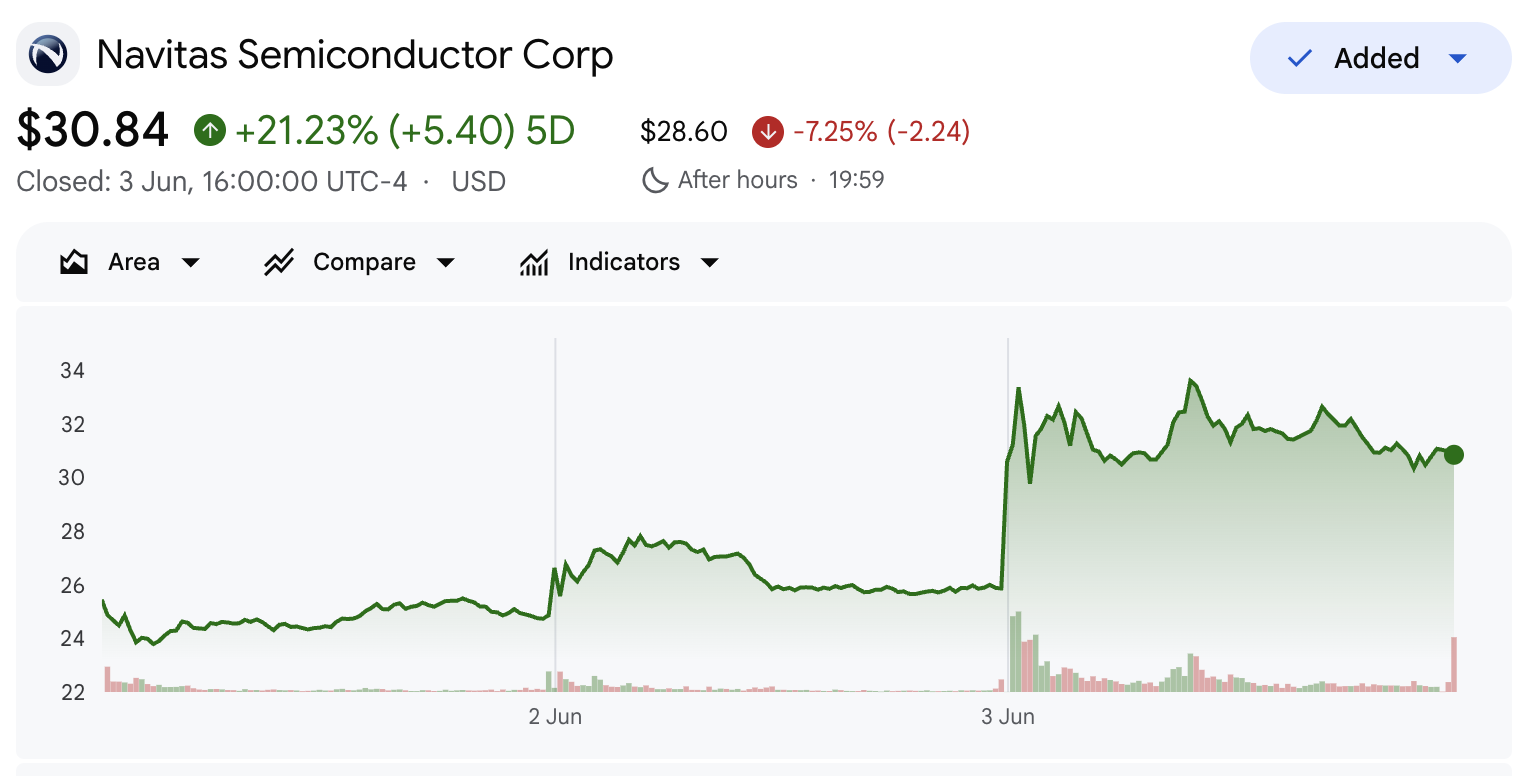
The rally gives Navitas a stronger position in the AI infrastructure conversation, but it also raises the burden of proof. Q1 revenue was $8.6 million. The market cap moved near $7.1 billion. After the rally, NVTS traded at roughly 137 times projected next-12-month sales. The gap between technical credibility and revenue scale is now the central issue for the stock.
NVTS stock gained 19.3% on June 3, closing at $30.84 after reaching an intraday high above $34.
Navitas is collaborating with NVIDIA’s MGX ecosystem on 800 VDC AI infrastructure and showcased an 800 V-to-6 V DC-DC power board at COMPUTEX.
The board targets 97.5% peak efficiency, 1 MHz switching frequency, and 2,100 W/in³ power density.
Q1 2026 revenue rose 18% sequentially to $8.6 million, but fell from $14.0 million a year earlier.
The company reported a Q1 net loss of $33.8 million, leaving current financials well behind the valuation.
The next phase depends on customer wins, backlog conversion, margin durability, and clearer 2027 revenue visibility.
NVTS stock already rallied earlier this year on interest in 800 VDC power architecture. The June move has a firmer foundation because it is tied to a named ecosystem collaboration rather than broad speculation.
Navitas said it is collaborating with NVIDIA’s MGX ecosystem to accelerate 800 VDC AI infrastructure. The company participated in NVIDIA’s Partner Ceremony in Taipei on May 29 and showcased its 800 V-to-6 V DC-DC power delivery board at NVIDIA’s AI Factory MGX Ecosystem Showcase during COMPUTEX from June 2 to June 5.
NVIDIA MGX is a modular reference architecture used by server makers, ODMs, and system integrators building accelerated AI systems. Visibility inside that framework places Navitas closer to the evaluation process for next-generation AI factory hardware, although it does not confirm a volume supply agreement.
For Navitas, the commercial value is not only the NVIDIA association. It is the chance to present a specific power-conversion solution in the ecosystem where future AI rack designs are being tested.
AI data centers are becoming power-constrained as rack density rises. Traditional power chains step voltage down in several stages, moving from grid-level input to rack power, then through an intermediate bus before reaching processor-level voltages. Each stage adds thermal load, occupies board space, and reduces efficiency.
Navitas’ board removes the traditional 48 V intermediate bus converter and converts directly from 800 VDC input to the 6 V range required near processors. The company says the design uses 650 V GaNFast FETs and targets 97.5% peak efficiency across the conversion range.
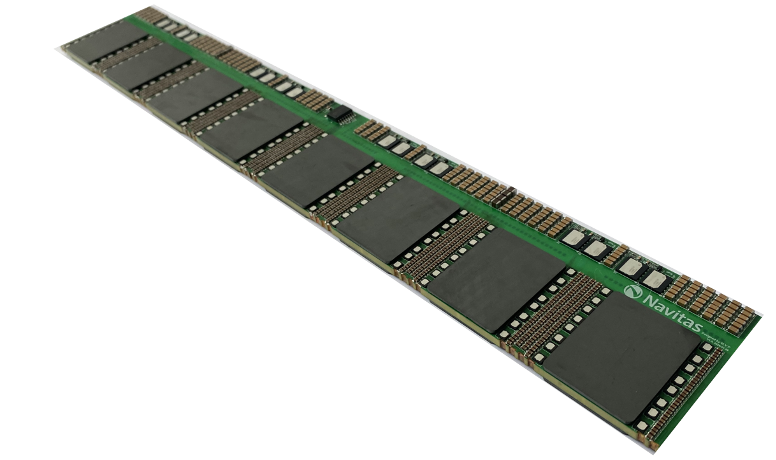
The board also operates at 1 MHz switching frequency and reaches 2,100 W/in³ power density. These specifications point to the same commercial objective: move more power through less space while reducing losses.
For hyperscale data centers, small efficiency gains can translate into lower electricity consumption, reduced cooling needs, and less physical infrastructure. As AI workloads push racks toward much higher power levels, power delivery becomes part of the core architecture rather than a secondary component.
Legacy 48 V/54 V-class rack power was built for lower-density environments. AI factories require far more power per rack, and delivering higher wattage at lower voltage means higher current, thicker copper, and greater heat management challenges.
Higher-voltage distribution reduces current for the same power level. That can improve efficiency, lower copper intensity, and support more compact power systems. NVIDIA’s 800 VDC architecture reflects this shift toward high-voltage distribution for future AI data centers.
Navitas is trying to position its GaN and SiC portfolio across this transition. GaNFast products address high-frequency conversion close to the processor. GeneSiC silicon carbide products target higher-voltage parts of the power path, from grid-side infrastructure toward the rack.
This is why the market is valuing Navitas differently. NVTS stock is no longer being treated mainly as a charger, EV, or industrial power-chip story. It is increasingly viewed as an AI data-center power-delivery trade.
Navitas’ Q1 2026 results show both the opportunity and the strain. Revenue rose 18% sequentially to $8.6 million, helped by high-power markets including AI data centers, grid and energy infrastructure, performance computing, and industrial electrification.
The year-over-year comparison is weaker. Revenue fell from $14.0 million in Q1 2025, a decline of roughly 39%. Navitas is still moving from earlier growth drivers toward higher-power applications, while the market is already valuing the company as if the transition is near commercial scale.
| Metric | Q1 2026 | Q1 2025 | Signal |
|---|---|---|---|
| Revenue | $8.6M | $14.0M | Down about 39% year over year |
| Sequential revenue growth | +18% | N/A | Recovery from Q4 weakness |
| Net loss | $33.8M | $16.8M | Losses widened materially |
| GAAP operating loss | $27.8M | $25.3M | Spending remains elevated |
| Non-GAAP gross margin | 39.0% | 38.1% | Modest mix improvement |
The margin signal is constructive but not decisive. Non-GAAP gross margin improved to 39.0%, suggesting a better mix as high-power markets become more important. The net loss of $33.8 million against $8.6 million in quarterly revenue shows how much operating leverage still depends on future scale.
Navitas is investing for a larger revenue base than it currently has. The stock is now valued as though that revenue base is approaching, which leaves little room for delays in customer conversion.
At roughly 137 times projected next-12-month sales, NVTS stock is not being valued on current earnings power. It is being valued on a specific path: 800 VDC adoption accelerates, Navitas secures meaningful design wins, and those wins convert into volume production.
That path is possible, but it is not guaranteed. Data-center hardware qualification cycles can be long. Customers often evaluate multiple suppliers. Larger GaN and SiC competitors are also targeting high-voltage AI infrastructure.
Current expectations point to 2026 revenue near $42 million, below the 2025 level, followed by stronger growth in 2027 and 2028. Those projections frame the bull case, but the stock has already pulled forward much of that optimism.
The main risk is timing. If customer programs move slower than expected, the valuation can compress before the revenue ramp becomes visible.
The June announcement gives Navitas stronger ecosystem credibility. The market now needs evidence of commercial conversion.
Named customer engagements inside the MGX ecosystem would be the strongest signal. Confirmed design wins, production timelines, backlog commentary, and clearer data-center pipeline disclosures would help bridge the gap between product visibility and revenue certainty.
Gross margin also needs close attention. If AI data-center revenue scales while non-GAAP gross margin holds near or above current levels, the long-term case improves. If growth arrives with weaker unit economics, the valuation becomes harder to defend.
The other key marker is 2027 visibility. NVTS stock has already priced in a major AI power infrastructure opportunity. Management now needs to show a credible bridge from today’s quarterly revenue base to a materially larger run rate.
Navitas has repositioned itself as an AI data-center power-delivery company. The NVIDIA MGX collaboration is its strongest validation point so far, and the technical case for 800 VDC power conversion is specific enough to deserve market attention.
NVTS is no longer a simple AI infrastructure discovery story; it is a revenue-conversion story with a demanding valuation.
The NVIDIA connection places Navitas in front of the right ecosystem, but it does not remove execution risk. From here, the stock needs customer wins, volume orders, margin durability, and evidence that 800 VDC visibility can become meaningful sales.
Ecosystem credibility gave NVTS stock its June rerating. Revenue conversion will determine whether that rerating can hold.
Navitas: NVIDIA MGX / 800 VDC collaboration announcement
(Navitas Semiconductor)
Navitas: Q1 2026 financial results
(Navitas Semiconductor)
NVIDIA: 800 VDC architecture for AI factories
(developer.nvidia.com)