Published on: 2026-06-04
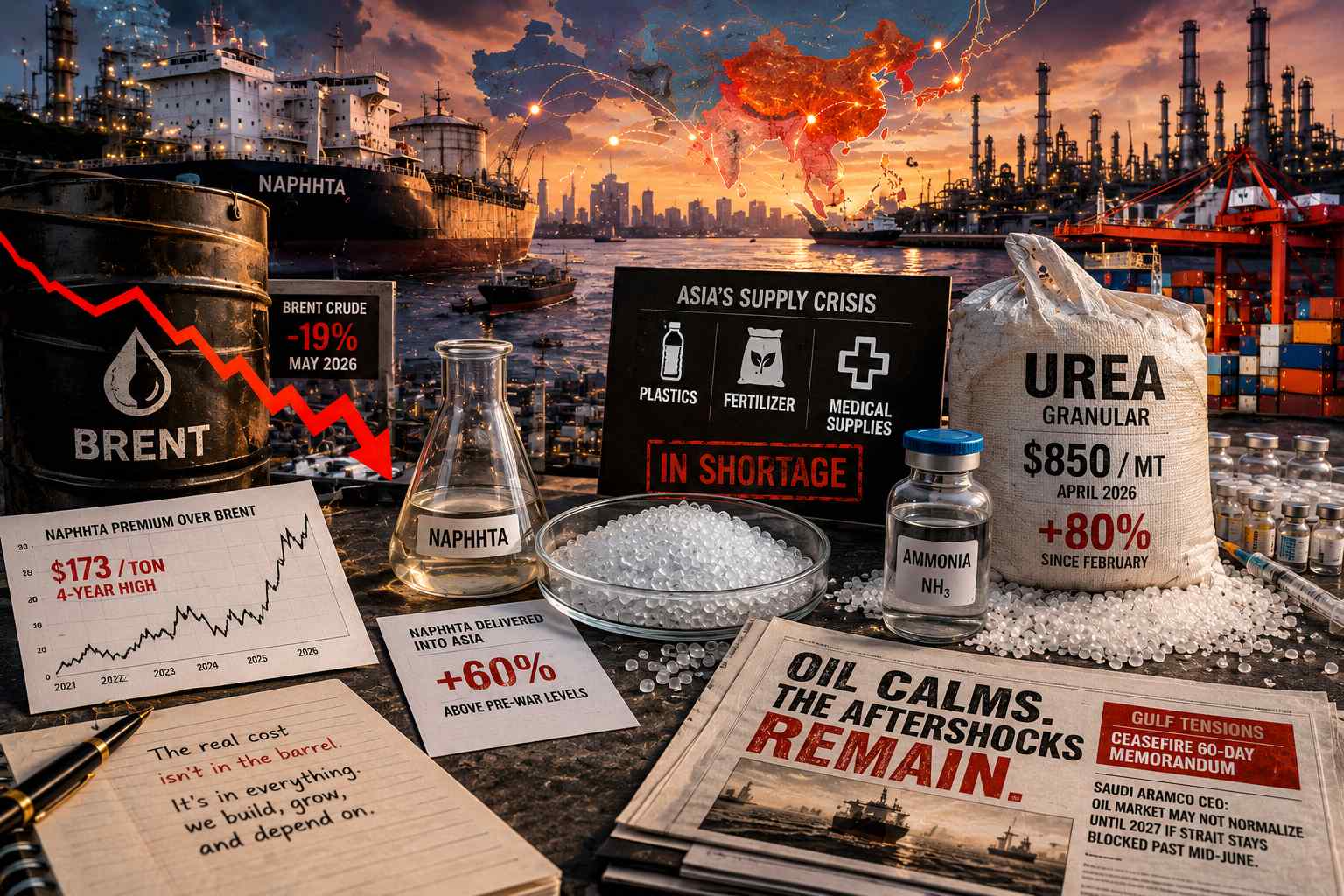
Brent crude fell by approximately 19% in May 2026, marking its worst monthly performance since the pandemic. However, naphtha delivered into Asia traded about 60% above pre-war levels, and the naphtha premium over Brent reached a four-year high of nearly $173 per ton. The costs of crude oil and its derivatives have diverged significantly.
Asia sources more than half its seaborne naphtha and 70% to 80% of its steam-cracker feedstock from the Gulf. LG Chem idled an 800,000-ton ethylene cracker at Yeosu, producers across the region declared force majeure, and plastics, packaging, and medical-grade resins moved into shortage.
Gulf producers supply close to a quarter of globally traded urea, and the war forced ammonia and urea plants across the region to halt. Urea climbed past $850 a metric ton in April, up about 80% since February and the highest since 2022, threatening crop yields across import-dependent Asia and Africa.
A 60-day US-Iran ceasefire memorandum has pulled crude off its highs, but Saudi Aramco’s chief executive has warned the oil market may not normalize until 2027 if the strait stays blocked past mid-June. The repricing of plastics, fertilizer, and medical supplies will outlast the conflict.
Brent crude has spent early June trading around $94 a barrel, after falling nearly 19% in May, its worst month since the pandemic. The same war that is dragging the crude price down has pushed naphtha into Asia roughly 60% above its pre-war level, lifted urea fertilizer past $850 a metric ton, and left clinics in South Korea short of syringes.
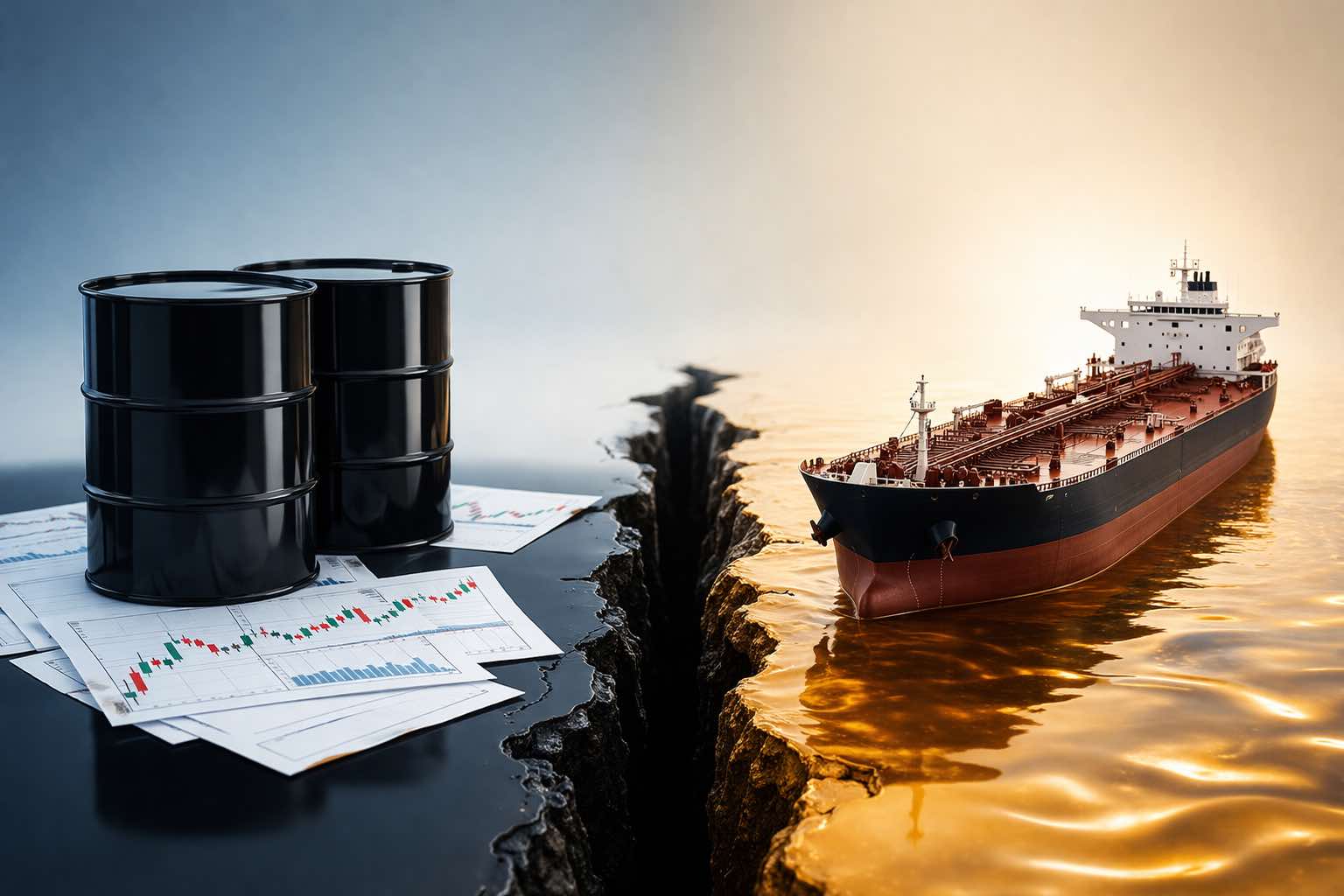
The price of crude is falling. The price of everything crude turns into keeps climbing, and that divergence is the part of this war that the oil screens do not show.
The market has spent more than three months watching one number. How many barrels clear the Strait of Hormuz, how high Brent trades, and whether the latest ceasefire holds have driven every headline since US and Israeli forces struck Iran on February 28. A fragile 60-day ceasefire, still under negotiation, has let crude unwind much of its war premium, pulling Brent down from the $140 it touched on dated cargoes in April.
The barrel count was always the visible part of the problem. The harder damage is caused by molecules that refiners pull out of those barrels before they ever reach a fuel tank.
Goldman Sachs flagged the mechanism directly in early May, noting that the easily accessible buffers of refined products were draining fastest in petrochemical feedstocks such as naphtha and LPG, as well as in jet fuel.
Saudi Aramco’s chief executive, Amin Nasser, put a date on the consequence. If the strait stays blocked past mid-June, he warned, the oil market will not normalize until 2027. Around 13 million barrels per day of Gulf production has been shut in, and tanker traffic through the chokepoint has been running more than 90% below normal for most of the conflict.
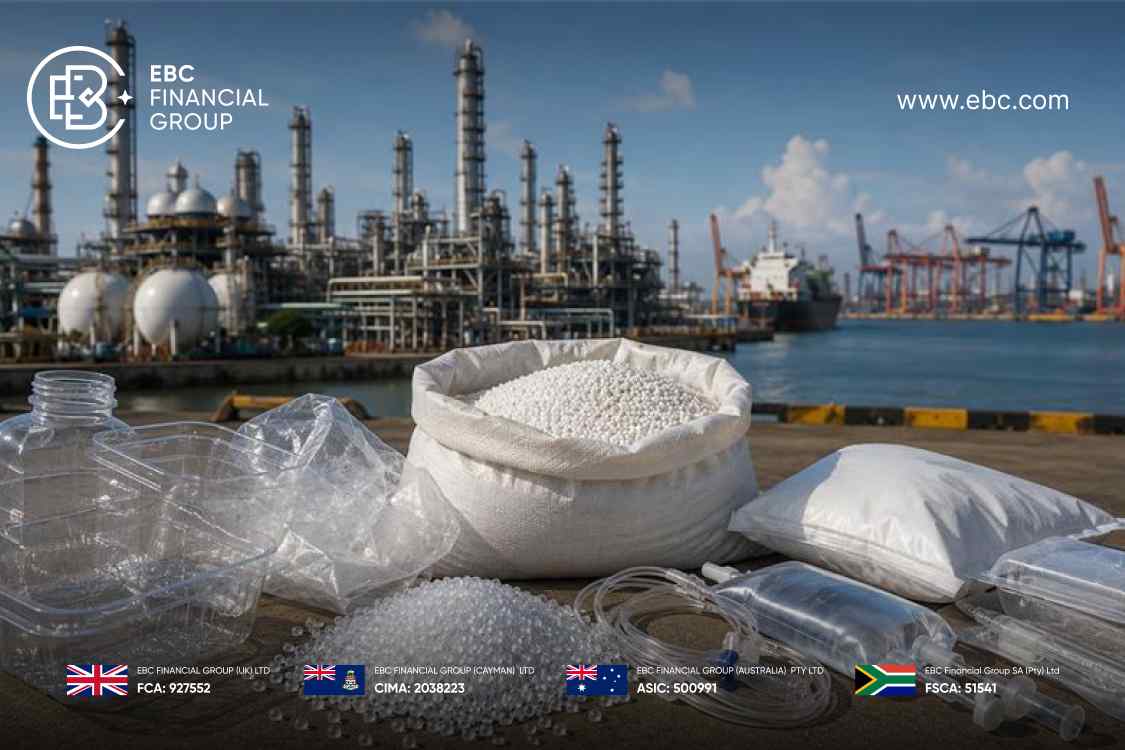
Naphtha is the feedstock that the Asian industry cannot easily replace. It is the liquid that steam crackers break down into ethylene, propylene, and the aromatics that become almost every plastic, fiber, and synthetic material in the regional economy.
Asia imports more than half of its seaborne naphtha from the Middle East, and individual crackers across the region rely on Gulf supply for 70% to 80% of their input.
The pricing has moved accordingly. Naphtha shipped into Asia has risen by about 60% since the war began, and the naphtha premium over Brent reached a four-year high of near $173 per ton. The region’s naphtha-based producers import roughly 86.6 million tonnes a year, and that volume now competes for a sharply reduced pool of cargoes.
The plants responded by slowing down or stopping. LG Chem idled its 800,000-ton No. 2 cracker at Yeosu on March 23, saying it would restart only when feedstock supply normalized. Mitsubishi Chemical cut ethylene output at Kashima and Mizushima, a Shell and CNOOC venture shut its Huizhou cracker and suspended polyethylene shipments, and Wanhua Chemical declared force majeure on two major polyurethane intermediates.
The shortage does not stay inside a chemical plant. Polypropylene and PVC are the base materials for syringes, intravenous bags, and sterile packaging, and both tightened as cracker runs fell. A mid-March survey by the Korea Federation of Plastics Industry Cooperatives found that more than 70% of polled firms had received notices of resin reductions or suspensions, and 92% had been warned of price increases.
South Korea opened a nationwide investigation on April 20 into firms suspected of hoarding syringes, needles, and gloves, a step that brought the pressure on the hospital floor into the open.
NHS England’s chief executive warned in late March that certain medical supplies could run out within days, since syringes, gloves, and IV bags all depend on petrochemical-derived materials the system cannot stockpile indefinitely. India, which manufactures a large share of the world’s generic medicines and carries the label “the pharmacy of the world,” sits directly in the transmission path.
Humanitarian supply chains absorbed the same shock. Medical and nutritional cargoes bound for clinics across Asia and Africa have been stranded at Dubai’s Jebel Ali port, and the cost of air-freighting drugs around the blockage roughly doubled inside a month. Plastic goods prices across several regional markets have already climbed by as much as 40%.
China is navigating the same disruption from a position of unusual strength. Only about 40% of China’s naphtha imports come from the Middle East, and those imports represent just 7% of total domestic demand. A deep domestic production base allows its integrated producers to maintain high operating rates while naphtha-dependent crackers elsewhere throttle back.
The result is a shift in market share toward Chinese manufacturing. As regional competitors cut runs, China’s vertically integrated chemical and plastics sector has been able to hold output and step into the supply gap. Beijing also moved early to protect domestic energy security, directing its refiners to prioritize the home market.
That resilience is the quiet structural story inside the crisis. A producer that controls its feedstock, refining, and downstream conversion under one roof can keep factories running through a shock that would idle less integrated rivals. The 2026 disruption is accelerating a “Middle East plus one” rethink across global supply chains, and China’s scale and integration leave it well placed as that reordering plays out.
Across the rest of Asia, the squeeze landed first on the products closest to households. India, the world’s second-largest importer of liquefied petroleum gas, began diverting cooking gas away from hotels and restaurants to keep household stoves lit, and the National Restaurant Association of India warned the move risked a wave of closures. In Tamil Nadu, the Chennai Hotel Association estimated that around 10,000 establishments faced shutdown, and some kitchens shifted their fryers and idli steamers to electric induction to stay open.
The Philippines went further and declared a national energy emergency, the first country to do so over the war, when President Marcos signed Executive Order 110 on March 24.
Energy Secretary Sharon Garin put national reserves at 53 days of gasoline, 46 days of diesel, 39 days of jet fuel, and 24 days of LPG, and the country’s flag carrier said it had fuel visibility only through the end of June. Pakistan moved its government offices to a four-day work week, shifted schools online, and halved official fuel allowances, with national petroleum stocks covering roughly 28 days of demand.
The same lever appeared across the region. Vietnam urged employers to allow remote work, Bangladesh moved its Eid holiday forward to close campuses early, and Sri Lanka declared Wednesdays public holidays to ration petrol. Crude itself is fungible, and its price is now falling, yet the cooking gas, jet fuel, and diesel that crude becomes are exactly what households and airlines cannot replace on short notice.
The disruption hit gas as hard as it hit oil. QatarEnergy declared force majeure on all liquefied natural gas shipments on March 4 after attacks on its Ras Laffan facilities, removing roughly 20% of global LNG supply in a single move. Around 5 million barrels per day of refined oil products normally pass through Hormuz, and that stream is the direct feedstock and fuel for the downstream industry across Asia.
Natural gas is where the cascade widens. Gas is the raw input for ammonia, urea, and a large share of petrochemical output, so a Qatari shutdown affects fertilizer plants and chemical crackers well beyond the buyers of Qatari cargoes.
Logistics group DHL has told customers that shipping through the Strait will take at least four to six months to normalize even after hostilities end, which means the feedstock shortfall has a longer half-life than the headline oil price.
The Gulf is one of the world’s great fertilizer factories, and the war switched a large part of it off. The region accounts for close to a quarter of globally traded urea, and the conflict halted production at several Gulf plants simultaneously. QatarEnergy suspended production of urea, ammonia, and sulfur after damage to its facilities, and Iran halted ammonia output.
The price response has been fast and broad. Urea climbed above $850 a metric ton in April, up about 80% since February and the highest level since 2022, according to the World Bank. The squeeze then jumped to producers far from the conflict, as fertilizer plants in India, Bangladesh, and Pakistan cut output once their Qatari gas supply disappeared.
The cost lands on the next planting season, with the FAO describing the conflict as a fertilizer crisis layered on an energy crisis and projecting global fertilizer prices 15% to 20% higher through the first half of 2026 if the disruption continues. How that squeeze transmits into grain yields and food prices is a chain EBC has traced separately, from oil to fertilizer to food and through the sulfur pincer on fertilizer and food security.
The table below traces the chain from a single feedstock disruption to the finished goods that consumers and hospitals actually buy. Each row shows the petroleum input, the disruption signal, and the corresponding verified data point.
| Downstream sector | Petroleum input | Disruption signal | Data points |
|---|---|---|---|
| Plastics and packaging | Naphtha to PE, PP, PET | Crackers idled, force majeure declared | Asian naphtha +60%; naphtha premium near $173/ton over Brent, a 4-year high |
| Medical consumables | Polypropylene, PVC | Syringe and IV-bag rationing | South Korea opened hoarding probe April 20; NHS warned of shortages within days |
| Fertilizer and food | Natural gas, LPG to urea, ammonia | Plants shut across the Gulf and South Asia | Urea above $850/ton, up ~80% since February, according to World Bank data |
| Industrial chemicals | Aromatics, toluene | Polyurethane intermediates under force majeure | Wanhua declared force majeure on TDI and MDI |
| Air and sea freight | Diesel, bunker fuel, jet fuel | Gulf cargo capacity collapsed | Gulf air-cargo capacity fell 79% in early March; ~2,000 ships stranded |
The pattern across the rows is consistent. A disruption priced first as an energy event reaches the real economy as a materials event, and the materials it touches are found in food, medicine, construction, and almost every manufactured good.
The strait has been targeted before without disrupting global supply. During the 1980 to 1988 Iran-Iraq War, hundreds of tankers were attacked in and around Hormuz, yet the waterway never fully closed and oil kept flowing through the fighting. That episode is the historical benchmark traders reach for, and it understates what is happening now.
The 2026 closure operates on a different scale. Commercial transits fell by more than 90%, major carriers, including Maersk, MSC, and Hapag-Lloyd, suspended service, and roughly 2,000 ships have been left stranded in the Gulf. War-risk insurance that sat near 0.125% of vessel value before the conflict spiked above 10% at the peak, a repricing of trade cost that the tanker war of the 1980s never approached.
The reason the downstream effect is larger today is structural. Asia’s petrochemical and plastics complex is several times the size it was four decades ago, and its dependence on Gulf naphtha and gas has deepened as the region became the world’s manufacturing core.
A chokepoint that once disrupted oil cargoes now disrupts the feedstock for a continent of factories.
The forward picture separates cleanly into two timelines. Crude can reprice in days once tankers move, because the barrel is fungible and the market is liquid. The feedstock chain repairs on a longer clock, since idled crackers take weeks to restart, force-majeure contracts must be renegotiated, and depleted inventories of resin and fertilizer have to be rebuilt before prices ease.
The structural costs are already being locked in. Should the disruption extend into the second half of 2026, analysts project naphtha holding 35% to 50% above pre-crisis levels, with downstream plastics and chemicals climbing a further 15% to 25%.
Governments are treating the exposure as a security problem rather than a market one, with Japan establishing a $10 billion fund to help Southeast Asian economies secure crude and medical supply chains, and Seoul reclassifying naphtha as a supply-chain security item.
The deeper lesson is a map of concentration risk that few balance sheets had priced. Asia built the world’s largest petrochemical, plastics, and pharmaceutical manufacturing base on a feedstock system routed through a single 34-kilometer waterway.
The “Middle East plus one” diversification now beginning is a multi-year capital cycle, and the structural shifts it sets in motion will shape industrial policy long after the shooting stops.
The crude price will keep moving every screen because it trades every second and resolves with the next ceasefire headline. The more durable damage sits one layer down, in the naphtha, ammonia, and resins that crude becomes, where a falling barrel offers no quick relief to a clinic short of syringes or a farmer facing urea above $850 a ton.
For traders, the actionable read is to stop watching only Brent and start tracking the spread between crude and its derivatives, because that spread is where the cost of this war is now being paid. For policymakers across Asia, the conflict has changed the central question, from how to secure the next cargo of oil to how to secure the next decade of everything oil makes.