Published on: 2026-05-26
A forward rate is an exchange rate agreed today for a currency transaction that will settle on a future date. Businesses, banks, and financial institutions use forward rates to lock in future exchange costs before market prices change. This reduces exposure to currency volatility and gives companies greater certainty when planning international payments or receipts.
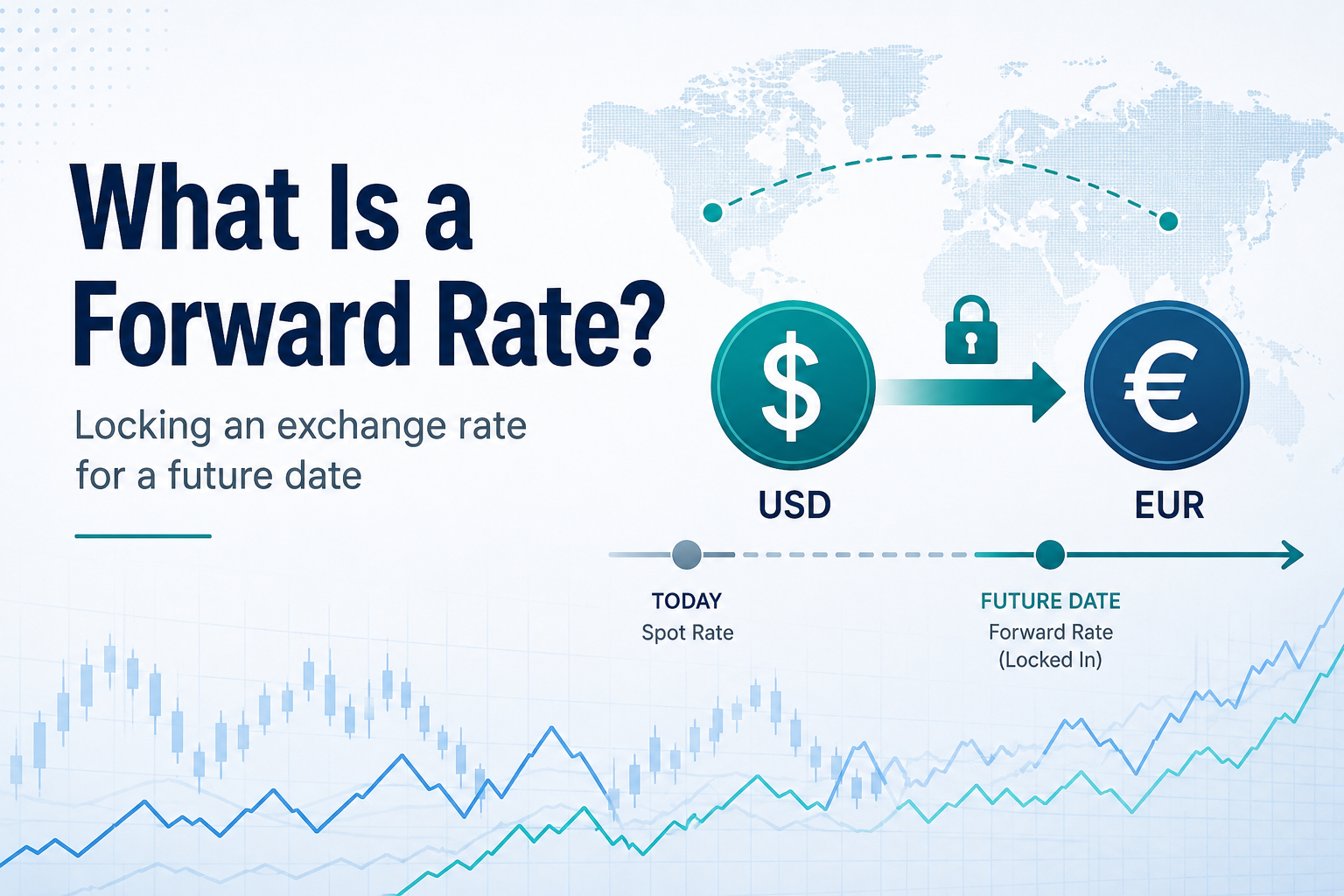
A forward rate is agreed in advance between two parties, usually through a bank, broker, or financial institution. It is used in a forward contract, a private agreement to exchange one currency for another on a specified future date.
For example, a US importer expects to pay a European supplier €2 million in three months. The current EUR/USD spot rate is 1.08, but the company is concerned that the euro could strengthen before the payment is due.
To reduce that risk, the company locks in a forward rate of 1.10 for 90 days. This means:
If EUR/USD rises to 1.15, the company avoids the higher exchange cost.
If EUR/USD falls to 1.05, the company still exchanges at 1.10 and does not benefit from the cheaper market rate.
The objective is to remove uncertainty over a future exchange rate.
In forex markets, a forward rate is usually based on the current spot rate plus or minus forward points. Forward points reflect the interest rate difference between the two currencies over the contract period. They can also be affected by liquidity, market conditions, and the counterparty's pricing terms.
In simple terms:
The spot rate shows the current exchange rate.
The forward rate shows the exchange rate agreed for a future settlement date.
The difference between them is mainly linked to interest rate differentials.
Therefore, a forward rate should not be treated as a guaranteed forecast of where a currency pair will trade in the future.
Forward rates are important because they show the cost of exchanging currencies at a future date. Companies that import, export, borrow, invest, or receive revenue in foreign currencies widely use them.
Businesses monitor forward rates to:
Fix future payment or receipt values.
Protect profit margins from currency swings.
Improve budgeting and cash flow planning.
Reduce uncertainty in cross-border transactions.
Traders and analysts watch forward rates because they reflect changes in interest rate expectations, central bank policy outlooks, and demand for a currency in the forward market.
A forward rate is not a guaranteed forecast. It is the agreed rate for a future transaction based mainly on the current spot rate and interest rate differentials.
Forward contracts are private, over-the-counter agreements between counterparties. Futures contracts are standardised agreements traded on exchanges. This makes forwards more flexible but can also create counterparty risk. Futures are more standardised and usually offer greater transparency and easier trading access.
A forward rate can reduce downside risk but also limit upside potential. If the exchange rate later moves in the company’s favour, the company may still have to transact at the agreed forward rate.
Spot rates apply to near-term currency transactions. Companies with future international payments or receipts often use forward rates to lock in exchange rates in advance.
No. Forward pricing also exists in commodity, bond, and other financial markets. However, the term is most commonly used in foreign exchange.
Forward rates are mainly affected by the spot exchange rate, interest rate differentials, contract length, currency liquidity, and market conditions.
Forward contracts are mainly used by businesses, banks, and institutions. Retail traders may access similar market exposure through forex futures, options, contracts for difference, or broker-specific products, depending on the market and local regulations.
Neither is automatically better. A spot rate is used for near-term exchange, while a forward rate is used to manage exchange rate risk for a future date. The better choice depends on timing, risk tolerance, and whether certainty is more important than potential upside.
A forward rate is an exchange rate agreed today for a currency transaction that will take place in the future. This lets businesses and investors lock in a rate in advance, helping them manage currency risk and avoid surprises from market movements. Companies can better control costs, protect profits, and plan international payments or investments with greater confidence when locking in a future rate early.



World's Best Broker