Published on: 2025-12-18
Updated on: 2025-12-18
Oil is heading into 2026 with a rare mix of forces pulling in opposite directions. On one side, there is clear evidence of oversupply and rising inventories. On the other side, the market is one headline away from a sudden supply shock, especially if sanctions tighten around Russia or Venezuelan exports get disrupted.
The clean way to think about 2026 is this: The first half resembles a balance-sheet market, focusing on inventory builds and funding costs. In contrast, the second half is influenced by geopolitics and OPEC+ discipline, which can shift the tone.
That divergence is why Brent and WTI can trade within a broad range, even if the annual average appears unexciting.
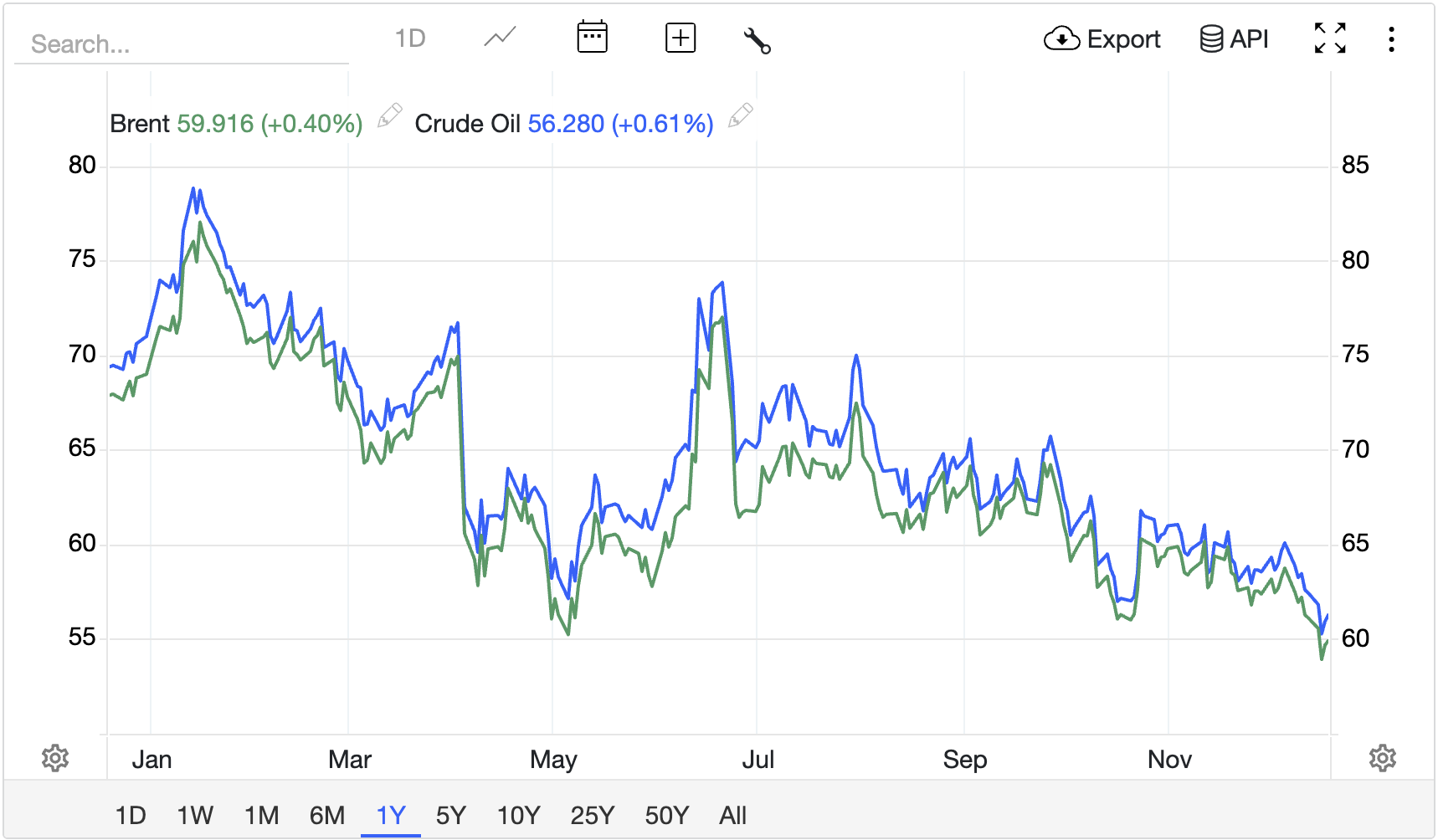
Brent and WTI are coming off their weakest stretch in years. WTI recently settled at $55.27 and Brent at $58.92, marking the lowest prices since February 2021.
This decline was driven by concerns about oversupply and renewed hopes for a peace deal between Russia and Ukraine, which could lead to the loosening of sanctions.
In the latest session (18 December 2025), WTI was trading around $56.38 and Brent around $60.10 as the market reacted to reports of potential new U.S. sanctions on Russia's energy sector, alongside ongoing Venezuela-related supply risks.
This is significant because when crude oil starts a new year near multi-year lows, the market's default expectation shifts towards a range and mean reversion instead of a straightforward bull trend.
| 2026 path | What drives it | Brent range | WTI range | What you would see first |
|---|---|---|---|---|
| Base case (most likely) | Inventory builds persist; cuts are gradual | $52–$62 | $48–$58 | Range trade, rallies fade near resistance |
| Bear case | Surplus grows; sanctions ease; demand disappoints | $45–$55 | $40–$50 | Break and hold below key supports; curve stays weak |
| Bull case | Supply disruption + discipline from producers | $62–$80 | $58–$75 | Sharp backwardation, strong bid in front months |
The U.S. Energy Information Administration (EIA) predicts that global oil inventories will continue to rise through 2026.
Consequently, it projects that Brent crude oil will average $55 per barrel in the first quarter of 2026 and will maintain that rate for the remainder of the year.
In the EIA's December STEO tables, WTI spot averages $51.42 in 2026, with quarterly prints around $50.93 (Q1), $50.68 (Q2), and $52.00 (Q3–Q4).
The International Energy Agency (IEA) has also flagged a large oversupply for 2026, with a cited surplus of around 3.84 million barrels per day and global observed inventories rising to four-year highs.
Base-Case Range for 2026:
Brent: $52 to $62, with $55 acting like a magnet in the first half
WTI: $48 to $58, with rallies capped unless supply tightens
We lean towards the base case, with a bias that H1 2026 is heavier than H2 2026. This corresponds with the pricing model of the EIA and the usual operations of surplus markets.

When inventories rise, the market is telling you one thing: supply is outrunning demand at the margin.
The U.S. Energy Information Administration (EIA) expects global oil inventories to continue rising through 2026, which it says will keep downward pressure on prices.
Goldman Sachs anticipates a significant increase in supply as long-delayed projects are finally completed and as OPEC begins to unwind its production cuts. The firm is forecasting lower average oil prices through 2026.
The International Energy Agency (IEA) continues to expect a considerable surplus in 2026, even after making adjustments to its projections. It emphasises the presence of "parallel markets," where crude oil supply may be abundant, but product markets could face tightness due to refining limitations and ongoing sanctions.
Additionally, sanctions and enforcement actions related to Russia and Venezuela could temporarily tighten supply. However, the general expectation is that supply capacity exists and can be quickly restored if geopolitical constraints are lifted.
The IEA's December 2025 Oil Market Report forecasts world oil demand growth of 860,000 barrels per day in 2026.
That is growth, but it is not the kind of demand pulse that naturally lifts prices in a world where non-OPEC supply and long-cycle project barrels are rising.
A factor contributing to oil's volatility is the disagreement among major agencies regarding the balance of supply and demand.
OPEC's Monthly Oil Market Report still suggest robust demand growth in 2026, forecasting an increase of roughly 1.4 million barrels per day (mb/d). This supports their argument that the oil market could become more balanced.
On the other hand, the International Energy Agency (IEA) maintains that the world is heading toward a significant surplus, even after lowering its surplus estimates.
Traders should view this as a practical warning: if the balance is truly loose, prices may remain capped; if OPEC's assessment is more accurate and supply falls short, the market could quickly adjust to higher prices.
Treat $55 Brent and the low-$50s WTI zone as mean-reversion territory, not "cheap forever".
Use a simple rule: buy only after a daily close back above a broken level, then place the stop below the swing low.
For Longer-Term Investors
Do not anchor to one forecast. Use a range and size positions so you can survive a 15% adverse move.
If you invest in oil equities, keep in mind that they act like leveraged oil exposure, and their prices can fluctuate significantly in both directions.
If you want to stay aligned with the real drivers rather than headlines, focus on:
EIA weekly U.S. inventories (crude, gasoline, distillates) and whether draws are real or seasonal.
OPEC+ compliance signals and any change in guidance on voluntary cuts.
China's import and demand indicators are crucial, as marginal demand often determines whether a surplus is mild or oppressive.
Sanctions and enforcement risks related to Russia and Venezuela can lead to short-term supply interruptions that cause sharp price spikes, even in years of surplus.
Because the market is focused on a supply surplus and rising inventories.
Yes. Oil rallies when barrels get removed fast.
Not automatically. In late 2025, oversupply and geopolitical factors were major drivers, indicating that the oil signal requires confirmation from employment, credit, and industrial data.
For WTI, $55 is the key near-term floor, and $60 is the first serious ceiling. For Brent, $58–$59 is the near-term floor zone, and $62–$65 is the first resistance band that needs a fundamental catalyst to clear.
In conclusion, 2026 appears poised to be a surplus-focused year, characterised by ongoing volatility instead of a clear, steady trend.
Inventory builds should keep Brent hovering around $55 and WTI anchored in the low $50s on average, unless supply is forcibly taken off the market.
The trade for 2026 is timing and discipline. If you treat oil as a range market until proven otherwise, respect the $55 area, and only press risk when the curve and price action confirm a tighter balance, you will avoid the most common mistake: buying a bounce too early and calling it a new bull market.
Disclaimer: This material is for general information purposes only and is not intended as (and should not be considered to be) financial, investment or other advice on which reliance should be placed. No opinion given in the material constitutes a recommendation by EBC or the author that any particular investment, security, transaction or investment strategy is suitable for any specific person.