Published on: 2026-03-19
Updated on: 2026-03-19
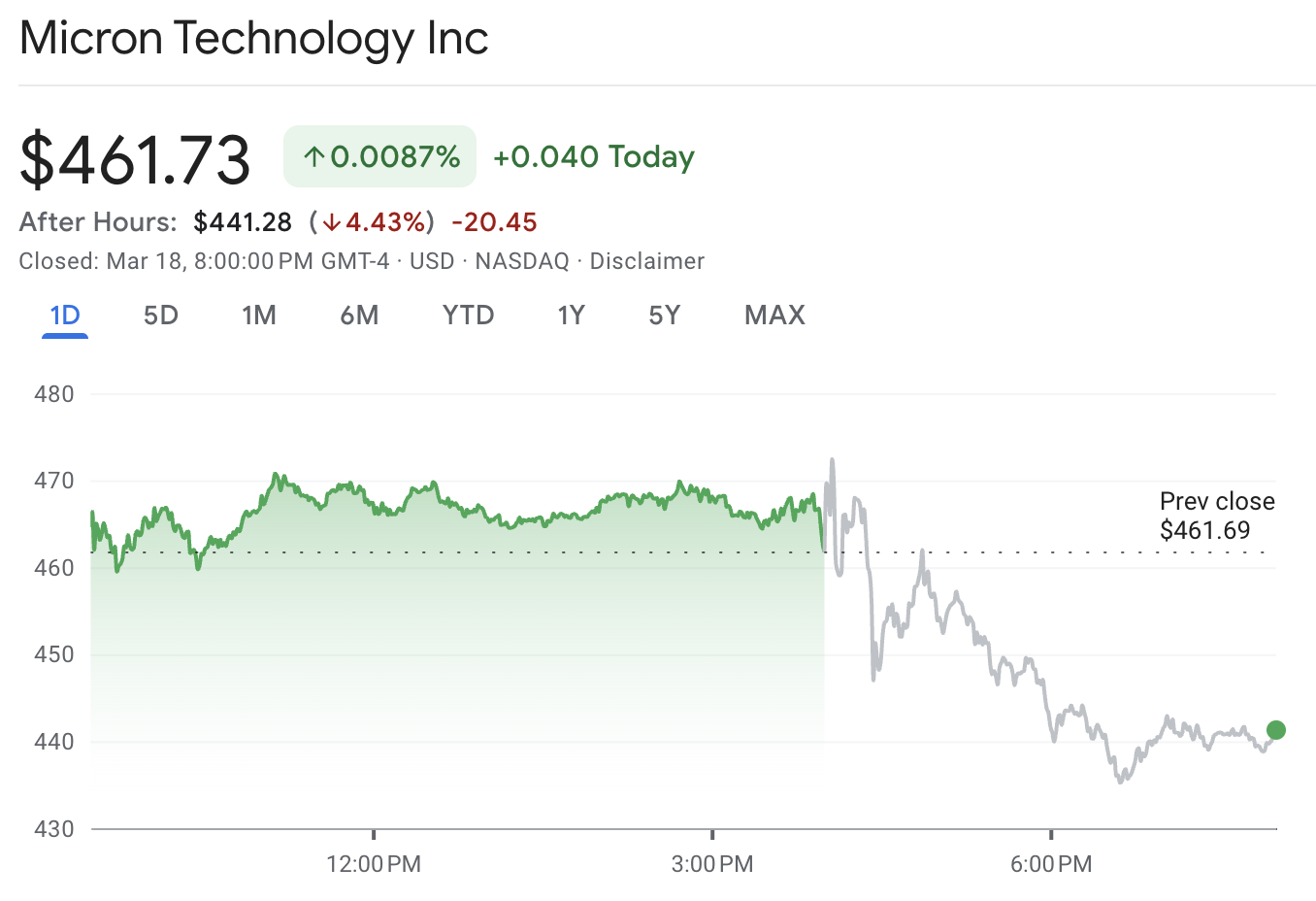
Micron delivered a huge earnings beat, but MU stock still fell after the report. After closing the regular session at $461.73 on March 18, 2026, Micron shares dropped to $441.28 in after-hours trading, a decline of about 4.4%
That came despite the company reporting fiscal Q2 revenue of $23.86 billion, non-GAAP EPS of $12.20, and a fiscal Q3 outlook that also came in significantly above Wall Street expectations.
The simplest explanation is that Micron did not disappoint on fundamentals. It disappointed a market that had already priced in something close to perfection.
It is the biggest reason. Micron approached its earnings report as one of the strongest companies in the AI market.
For context, MU stock had surged nearly 65% since the start of the year before the release, and options pricing suggested traders expected a move of about 7% in either direction. That meant investors were already braced for outstanding numbers.
In such a scenario, a single point won does not always lead to a winning streak. Sometimes it simply confirms what investors had already paid for.
Micron's after-hours decline of about 4.4% was also smaller than the move the options market had priced in, which supports the view that this was more of a reset in expectations than a collapse in the story.
Micron did not enter this report at a discounted level. On the day of earnings, the stock traded near a fresh high, and Stock Analysis showed a 52-week range topping at $471.34.
By the close on March 18, MU stock had surged approximately 46% year-to-date and was up 347.8% over the past 52 weeks. When a stock runs that far that fast, even an excellent report can trigger profit-taking, peak-cycle fears, and a "sell the news" reaction.
This is the second big reason. Micron stated in its prepared remarks that it now anticipates fiscal 2026 capital expenditures (capex) to exceed $25 billion, with about $7 billion expected for fiscal Q3 alone.
The company has projected a significant increase in capital expenditures for fiscal 2027, expecting construction-related spending to grow by over $10 billion compared to the previous year.
Long term, that can be bullish. Micron believes that the demand for its products is strong enough to warrant a significant expansion. In the short term, however, larger spending can make investors pause.
The memory business has a long history of boom-and-bust cycles, so when a company ramps up capital spending aggressively, some in the market start to worry that future supply could catch up with demand too quickly.
That concern does not cancel Micron's strong outlook, but it can limit immediate upside after a sharp rally.
Micron's management was very clear that demand is strong. The company stated that supply-demand conditions for both DRAM and NAND are expected to remain tight beyond 2026, as AI and traditional server demand are limited by insufficient memory supply.
That sounds positive, and it is. Tight supply is a major reason prices and margins are rising. But there is another side to that story. Micron also stated that PC and smartphone units could decline in the low double digits in calendar 2026 due to supply constraints and other factors.
In other words, Micron is benefiting from a shortage, but it still cannot fully meet demand everywhere, and some end markets are not as clean as the data center story.
Micron's quarter was not just good, it was exceptional. Revenue nearly tripled from a year earlier, gross margin jumped sharply, free cash flow hit a record, and the company guided for another major step up next quarter.
| Metric | Micron reported | Wall Street expected | Read-through |
|---|---|---|---|
| Fiscal Q2 revenue | $23.86B | $19.97B | Strong beat |
| Fiscal Q2 non-GAAP EPS | $12.20 | $9.19 | Strong beat |
| Fiscal Q2 non-GAAP gross margin | 74.9% | Not the main preprint focus, but far above Micron’s prior Q2 guide of 68.0% ± 1.0% | Margin surprise |
| Fiscal Q3 revenue guide | $33.5B ± $0.75B | $24.29B | Huge upside guide |
| Fiscal Q3 non-GAAP EPS guide | $19.15 ± $0.40 | $12.03 | Huge upside guide |
On the surface, that table makes the stock drop look strange. But markets do not trade only on whether a company beats. They also trade on how much of the good news was already in the price.
Not necessarily. The most important point is that nothing in Micron's report suggested the business is weakening. In fact, the opposite is true. The company reported record revenue, record free cash flow, a 30% dividend increase, and another quarter of expected margin expansion.
The drop looks more like a valuation and positioning reaction than a fundamental break. MU had become crowded on the bullish side, and after a move like that, even excellent results can trigger profit-taking.
That does not mean the longer-term AI memory story is over; the stock may require some time to consolidate after a significant increase.
Micron's chart remains strong, but the next two sessions will likely focus on whether post-earnings sellers can push the stock below the first support zone.
| Level | Type | Why it matters |
|---|---|---|
| $441 to $445 | Immediate support | After-hours price zone following earnings |
| $434 to $438 | Stronger support | March 19 extended-hours low and recent demand area |
| $426 to $429 | Deeper support | March 13 close and breakout zone before earnings |
| $461 to $465 | First resistance | March 18 close and opening area |
| $471 to $476 | Major resistance | March 18 high and current peak zone |
Micron remains well above its 50-day moving average of $396.92 and its 200-day moving average of $228.38, while the RSI sits near 64.25, suggesting momentum remains bullish even after the after-hours drop.
If MU stock remains within the $441 to $445 range, buyers may quickly retest the $461 to $465 levels.
If that support fails, the next likely magnet is the mid-$430s, followed by the $426 to $429 breakout shelf.
MU stock is down because investors had already priced in a very strong report. The stock had rallied sharply before earnings, and the market reacted with profit-taking even after Micron beat on both results and guidance.
Yes. Micron guided fiscal Q3 revenue to $33.5 billion plus or minus $750 million and non-GAAP EPS to $19.15 plus or minus $0.40, both well above the consensus figures from the market.
Capex is not the only reason, but it is part of the story. Micron now anticipates fiscal 2026 capital expenditures exceeding $25 billion, with an additional increase expected in fiscal 2027. This outlook may lead investors to be more cautious following a significant rise in the stock.
In conclusion, Micron achieved impressive earnings that surpassed expectations. MU stock is dropping because the market had already become very optimistic, and management also paired the blowout report with a much heavier investment plan.
Currently, this appears less as a failed quarter and more like a typical sell-the-news reaction following a significant rally.
Disclaimer: This material is for general information purposes only and is not intended as (and should not be considered to be) financial, investment or other advice on which reliance should be placed. No opinion given in the material constitutes a recommendation by EBC or the author that any particular investment, security, transaction or investment strategy is suitable for any specific person.