Published on: 2026-02-25
Search interest in whether the Iraqi Dinar revalue tends to spike whenever Iraq changes a published exchange rate, tightens dollar access, or signals a new budget assumption.
In early 2026, interest in Iraq's economic situation resurfaced, as the Central Bank informed the Finance Ministry that it would set the exchange rate at 1,300 Iraqi dinars per $1 in the 2026 federal budget. [1]
Many readers view the "1,300" figure as a sign that a sudden and dramatic "revaluation" is on the horizon. However, a more realistic interpretation suggests that Iraq is prioritizing stability and seeking to narrow the gap between the official exchange rate and the informal street market rate.
The "1,300" number is best understood as the budget and fiscal accounting rate, not a promise that every customer will buy $1 at IQD 1,300 with zero friction.
In practice, Iraq's system includes a policy channel that moves $ flows through the banking system, adding compliance and transaction costs.
The mechanics are as follows:
The Ministry of Finance sells $ to the state at IQD 1,300 per $1.
The central bank sells $ to commercial banks at IQD 1,310 per $1.
End users ultimately face around IQD 1,320 per $1 once regulated banking and compliance costs are included.
| Layer | Rate (IQD per $1) | What it represents |
|---|---|---|
| Budget / fiscal rate | 1,300 | The reference rate used for government budget calculations. |
| Bank supply rate (illustrated) | 1,310 | The bank-level distribution step described in budget-related reporting. |
| Official peg reference (IMF description) | 1,320 | The official exchange rate level the IMF cites as the peg. |
In short, it is a message of continuity intended to anchor expectations for inflation and public spending.
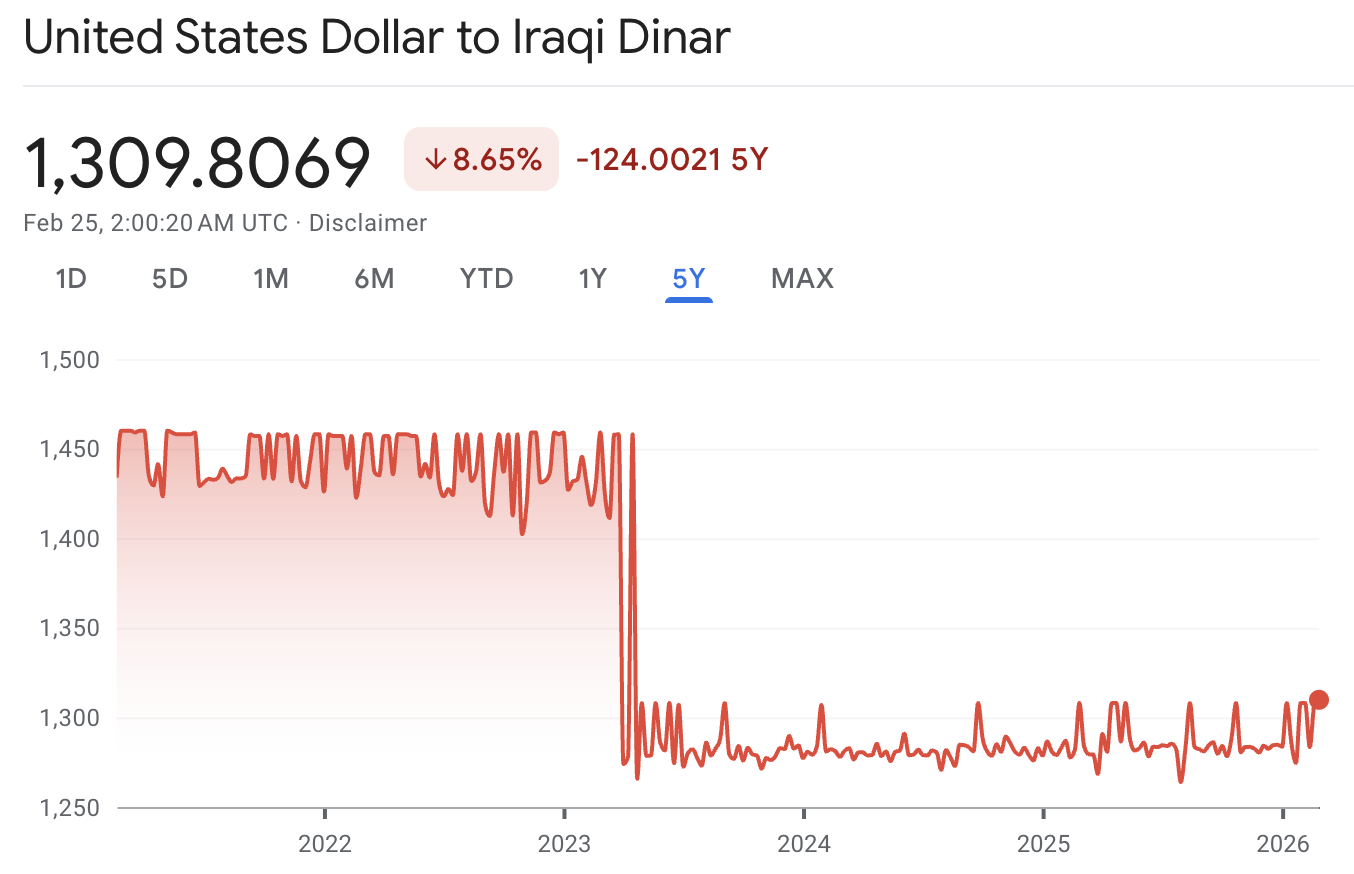
Because Iraq has adjusted the peg before.
In February 2023, Iraq adjusted the exchange rate to IQD 1,300 per $1, up from around IQD 1,450 per $1, reflecting a significant strengthening of the currency.
That move created a lasting impression that another sharp change could happen again.
However, that does not mean another major adjustment is likely in 2026. A peg can be adjusted, but it is usually adjusted when policymakers believe the benefits outweigh the risks to reserves, fiscal stability, and the banking system.
It is normal in managed systems for different official rates to exist for different uses, especially when fees, compliance costs, or banking channels are involved.
The International Monetary Fund (IMF) characterizes Iraq's exchange rate regime as a conventional peg. According to the IMF, as of February 8, 2023, officials established the official exchange rate at 1,320 dinars per U.S. dollar.
In the 2026 budget, officials use a rate of 1,300 dinars per dollar for budgeting purposes. However, banking costs subject end-users to a higher rate.
| Rate type | Approximate level | What it is used for | Why it matters |
|---|---|---|---|
| Budget anchor rate | 1,300 IQD per $1 |
Budget planning and official fiscal coordination. |
It signals a preference for stability and a slightly stronger planning rate. |
| Official bulletin / banking system rate | 1,320 IQD per $1 | Official bulletin reference and regulated banking channels, as described by the IMF. |
It reflects how the peg is implemented through the formal system. |
| Parallel ("street") market rate | ~1,470–1,480 IQD per $1 | Cash exchange shops and informal demand. | It measures trust, access to dollars, and compliance friction. |
This table explains why you can read "1,300" in one headline and still see "1,470" in the street on the same day.
The gap is not only about economics. The gap is also about plumbing.
The IMF has stated that starting in January 2025, international transactions will be processed through commercial banks using their correspondent banking relationships.
The Central Bank of Iraq (CBI) will replenish balances and conduct audits to ensure compliance with anti-money laundering (AML) and counter-terrorism financing (CFT) regulations.
This change can reduce leakage and improve transparency; however, it also creates short-term challenges if importers struggle to meet timely documentation standards.
The new CBI requirements for provisioning dollars to importers increased demand for dollars in the parallel market, and it said the gap widened in late January 2026 before easing somewhat.
If oil revenue slows or spending rises too fast, the market tests the system.
In its 2025 Article IV report, the IMF projected that Iraq's gross reserves would fall from $100.3 billion (2024) to $91.0 billion (2025) and $79.2 billion (2026) under its baseline assumptions. [2]
The same table shows the IMF projecting the exchange rate (period average) to remain at 1,300 across 2024–2026, a strong signal that the IMF expects policy continuity, not a dramatic revaluation.
The IMF's baseline is not a guarantee; however, it serves as a high-quality reference point because it is based on discussions with Iraqi officials and macroeconomic accounting.
| Indicator (IMF, 2024–2026) | 2024 (est.) | 2025 (proj.) | 2026 (proj.) | Why traders care |
|---|---|---|---|---|
| Exchange rate (IQD per $1, period average) | 1,300 | 1,300 | 1,300 | It implies "steady peg" as the base case. |
| Fiscal balance (% of GDP) | -4.2 | -7.5 | -9.2 | Wider deficits tend to pressure reserves over time. |
| Gross reserves ($ billions) | 100.3 | 91.0 | 79.2 | Falling reserves reduce comfort in defending a peg. |
| Average crude export price ($/barrel) | 80.6 | 65.9 | 62.0 | Oil is the engine of dollar inflows and fiscal space. |
The overall message from this table is cautious: Iraq can keep the peg, but the country needs stronger fiscal discipline to keep buffers large.
| Scenario | What happens | What would need to be true |
What it means for revaluation |
|---|---|---|---|
| Base case: 1,300 stays the anchor |
The budget uses 1,300 and the peg remains managed, while the street gap fluctuates. |
Oil revenue is adequate, and the banking channel keeps improving compliance and supply. |
It is a stability story, not a sudden wealth event. |
| Modest strengthening |
The official system gradually narrows spreads and the effective rate improves slightly. |
Dollar access becomes smoother, and confidence rises as the gap compresses. |
It is still a managed adjustment, not an overnight reset. |
| Renewed weakening |
The parallel market stays much weaker, and the official anchor comes under pressure |
Reserves fall faster, fiscal deficits widen, or compliance bottlenecks trigger persistent dollar shortages. |
"Revaluation" talk becomes irrelevant |
| Redenomination without real gain | Notes are reissued with fewer zeros, but purchasing power is designed to remain the same. | Authorities want easier cash handling and better accounting, and they choose a calm moment to do it. | This is often misunderstood online, but redenomination is mainly a unit change, not a free profit machine. |
This scenario table aims for clarity rather than hype, and each scenario represents a realistic path policymakers can choose.
If you want a disciplined answer to "Will the Iraqi dinar revalue in 2026?" you should watch the things policymakers and institutions actually track.
It is essential to monitor whether the budget rate remains at IQD 1,300 per $1 and if the banking system continues to operate near the official peg.
Additionally, you should observe whether the gap between official and parallel rates continues to narrow, as this serves as a practical indicator of confidence in official channels.
Furthermore, monitor reserve trends, as reserves play a crucial role in supporting the peg in real time.
Lastly, you should monitor fiscal stress signals tied to oil prices, because Iraq's budget sensitivity is a recurring constraint.
If you are researching the revaluation of the Iraqi Dinar, you will inevitably run into aggressive marketing that promises guaranteed gains, secret dates, or "locked" exchange programs.
U.S. authorities have documented fraud cases and issued consumer alerts tied to dinar promotion schemes.
Thus, if someone is promising guaranteed dates, guaranteed rates, or "secret codes", you should treat that as a red flag.
A large, sudden revaluation is unlikely based on current signals. The 2026 budget rate is set around IQD 1,300 per $1, and the IMF continues to describe a conventional peg with an official rate around IQD 1,320 per $1.
A move from 1,300 to 1 would be an extreme shift that would require a completely different monetary system, and not supported by official baseline assumptions that keep the peg near current levels.
The gap usually reflects how easily the economy can access $ through official channels. When demand leaks to the parallel market, the street rate weakens.
A modest strengthening is possible if the official–parallel spread stays narrow and reserves remain strong. However, the baseline projections and policy messaging currently emphasize stability rather than a major adjustment.
In conclusion, a significant and sudden revaluation of the Iraqi Dinar in 2026 is not supported by the key policy signals.
The Central Bank of Iraq (CBI) has provided budget guidance indicating an exchange rate of around IQD 1,300 per $1, which suggests stability. Additionally, the IMF continues to describe Iraq's currency system as a conventional peg, with an official rate of IQD 1,320 per $1.
If the Dinar appreciates in 2026, it is likely to be gradual. It would depend on reducing the gap between official and parallel exchange rates, strengthening banking channels, and maintaining comfortable reserves and fiscal conditions.
Disclaimer: This material is for general information purposes only and is not intended as (and should not be considered to be) financial, investment or other advice on which reliance should be placed. No opinion given in the material constitutes a recommendation by EBC or the author that any particular investment, security, transaction or investment strategy is suitable for any specific person.
[1] https://shafaq.com/en/Economy/Iraq-fixes-2026-budget-at-1-300-dinars-per-dollar
[2] https://www.imf.org/-/media/files/publications/cr/2025/english/1irqea2025001-source-pdf.pdf



World's Best Broker