Published on: 2026-03-18
Uber stock rose over 5% after Nvidia confirmed a multi-partner plan to launch Level 4 robotaxis on the Uber app in 28 cities by 2028.
This development is significant as Uber enters this phase with strong financials. The latest quarterly results showed 22% year-over-year growth in trips and gross bookings, adjusted EBITDA of $2.5 billion, and operating cash flow of $2.9 billion.
Uber’s rally reflects a more credible robotaxi roadmap rather than a general AI-driven increase.
Nvidia enhances Uber’s autonomous strategy by providing the software and development stack, while Uber retains control of the customer, marketplace, and operations.
Robotaxis are already operating on parts of the Uber network, making the initiative commercially active rather than purely theoretical.
The stock story still rests on execution, approvals, and rollout pace rather than immediate earnings uplift.
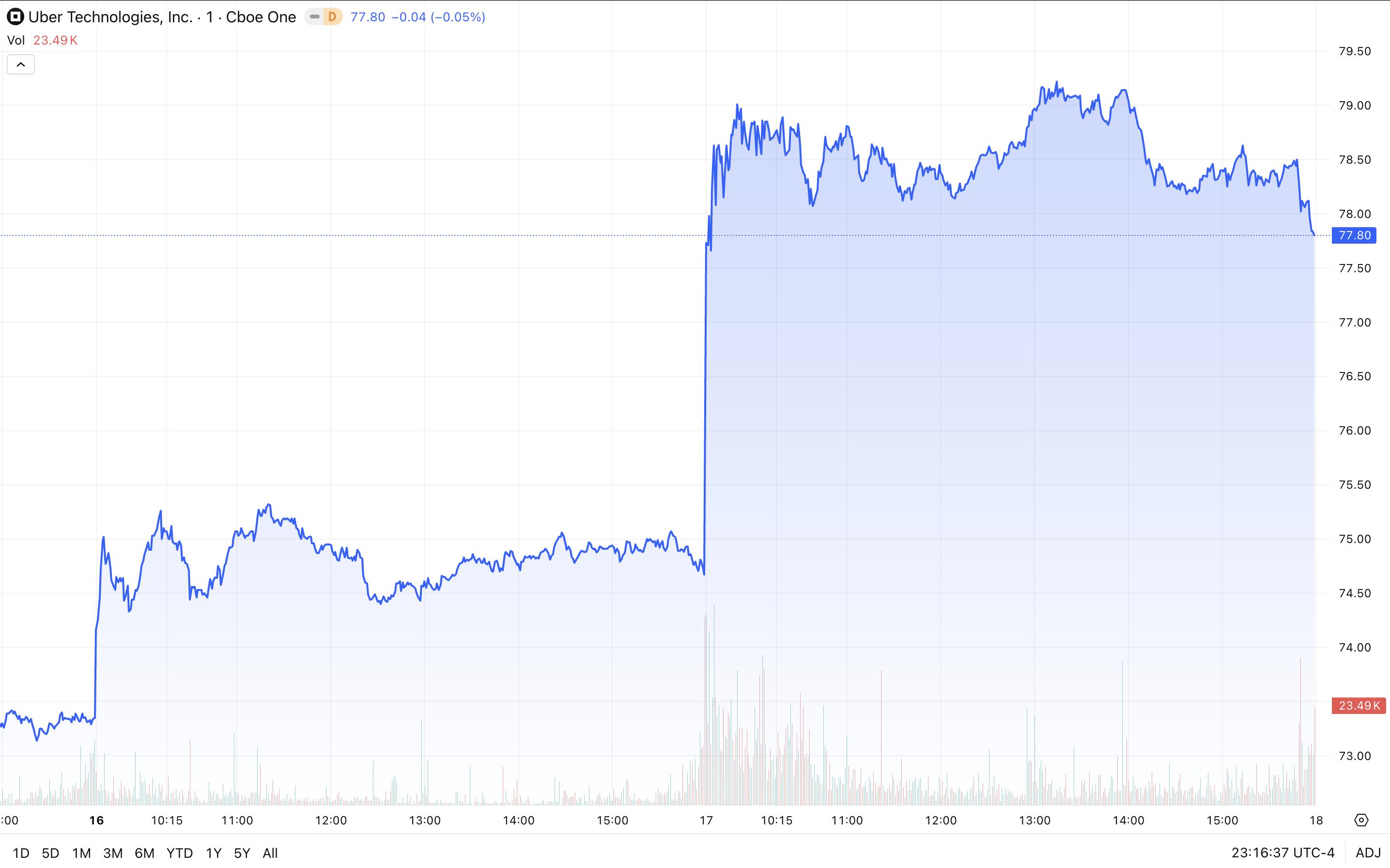
UBER shares closed at $74.66 on March 16 before the Nvidia announcement, then rose to over $78 by Tuesday morning, representing a gain of approximately 5% for the session. This marks one of the sharpest single-session moves for the stock in 2026.
| Period | Performance |
|---|---|
| 1D | +5.63% |
| 1W | +8.29% |
| 6M | -15.70% |
The stock’s 52-week range is $60.63 to $101.99, so it remains below its highs despite the current catalyst.
The six-month decline reflects challenges including guidance concerns after Q4 earnings, pressure on growth stocks, and concerns about Waymo’s commercial lead in the US robotaxi market.
Today's move is a recovery with a real catalyst, not a breakout to new highs.
Uber shares rose over 4% on March 17 after Nvidia’s GTC conference highlighted the Uber partnership.
Market coverage attributed the increase to plans for Nvidia-powered robotaxis on Uber in Los Angeles and San Francisco in early 2027, with broader rollout to 28 markets by 2028.
The market response reflected not just new headlines, but increased confidence in Uber’s autonomous strategy.
Analysts view the development positively, as it reduces the risk of a single robotaxi operator excluding Uber and reinforces Uber’s role as the distribution platform for multiple autonomous vehicle suppliers.

Uber and Nvidia first announced their partnership in October 2025, with Uber stating that Stellantis would be among the first automakers to supply at least 5,000 Level 4 vehicles built on Nvidia’s DRIVE Hyperion platform.
The short answer is yes; robotaxis have been in play for Uber longer than many realize.
Uber already offers autonomous rides in Atlanta, Austin, Dallas, Las Vegas, and Phoenix, where riders can opt in through the app when an eligible vehicle is available.
The company notes that some rides may include a specialist in the front seat during early deployment phases, and operations are limited to approved areas. This approach reflects responsible autonomous vehicle scaling, not a limitation.
What differentiates the current moment is the depth of the supply pipeline supporting Uber’s autonomous strategy:
| Program | What Is Happening | Why It Matters |
|---|---|---|
| Nvidia + Uber | Uber is using DRIVE software and a shared AI data factory to support large-scale robotaxi deployment, with Stellantis supplying at least 5,000 Level 4 vehicles. | Creates a common technical backbone across Uber’s AV ecosystem. |
| Lucid + Nuro + Uber | A production-intent robotaxi was unveiled at CES, on-road testing is underway, and a Bay Area launch is targeted for 2026. Uber plans to deploy at least 20,000 of these vehicles over several years. | Moves Uber closer to scaled, purpose-built robotaxi deployment. |
| Zoox + Uber | Zoox is targeting Las Vegas by summer 2026 and Los Angeles by mid-2027, with Zoox covering insurance and fleet costs. | Gives Uber robotaxi exposure without taking on the full capital burden of fleet ownership. |
| Wayve + Nissan + Uber | A Tokyo robotaxi pilot is planned for late 2026, subject to regulatory discussions, using the all-electric Nissan LEAF with Wayve’s embodied AI software. | Extends Uber’s AV roadmap into one of the world’s most complex urban markets. |
| WeRide + Uber | At least 1,200 robotaxis are planned across Abu Dhabi, Dubai, and Riyadh, with rollout targeted as soon as 2027. | Confirms Uber’s robotaxi strategy is global infrastructure, not just a US experiment. |
What stands out across all five programs is not the scale alone, but the consistency of the model.
Different vehicles, different cities, different regulatory environments, yet every single ride routes through the same Uber app, reinforcing the same consumer habit and feeding the same data flywheel.
Understanding why investors reacted the way they did requires understanding how Uber actually makes money from a robotaxi ride, because it is structurally different from a standard UberX fare.
Uber’s take rate on Zoox rides will be lower than for standard UberX fares, but BofA Securities notes that the impact on overall profitability through 2027 is minimal. Near-term contributions are small, while the medium-term outlook supports the bullish case.
For standard human-driven rides, Uber’s take rate covers driver earnings, incentives, and retention costs. For robotaxi rides, these costs are borne by the autonomous vehicle operator, not Uber.
Uber does not build vehicles, maintain fleets, or pay for insurance. It collects a fee each time a robotaxi uses its network, and as the network scales, the economics improve without proportional cost increases.
The bullish outlook is compelling, but investors should be aware of significant risks before acting on today’s movement.
The Q4 earnings miss remains relevant: Uber reported Q4 FY2025 EPS of $0.14, well below the consensus estimate of $0.77. The robotaxi narrative does not eliminate near-term execution concerns in the core business.
Take rate compression is a significant risk: Robotaxis could increase trip supply and lower prices, but may also compress take rates depending on how bargaining power between Uber and fleet operators evolves. This dynamic remains unresolved.
Competition remains active: Tesla plans to begin Cybercab production in Q2 at its Gigafactory Texas facility, and Waymo aims to expand to over 20 cities by the end of 2026, including London and Tokyo, targeting 1 million weekly rides.
Autonomous vehicle timelines have often slipped due to city permit approvals, safety certifications, and regulatory clearances. Each milestone depends on factors outside Uber’s full control.
The Nvidia deal is already reflected in the Uber stock price. The key factor now is whether subsequent milestones are achieved on schedule. Near-term catalysts to monitor:
Motional Las Vegas
Zoox Las Vegas (Summer 2026)
Q1 2026 Earnings on May 6, 2026
15-city robotaxi target by the end of 2026.
Los Angeles and San Francisco commercial launch in H1 2027
Because investors viewed Nvidia’s GTC spotlight as evidence that Uber’s robotaxi strategy is moving closer to scaled commercial rollout, not just remaining a long-term concept.
The average analyst price target of $105.59 suggests approximately 41% upside from current levels, with a consensus rating of Strong Buy. However, execution risk for the robotaxi rollout is significant, and take-rate dynamics remain unproven.
The Uber partnership positions Nvidia’s DRIVE Hyperion platform as the standard for global Level 4 deployment, reinforcing Nvidia’s transition from chipmaker to full-stack AI infrastructure provider.
Key risks include take rate compression and timeline delays. Autonomous fleet operators will seek a significant share of trip economics, and analysts note that robotaxis could lower prices and compress Uber’s margins, depending on how bargaining power evolves.
Uber stock rose after the Nvidia deal because the announcement included specifics such as named automakers, mapped cities, phased deployment plans, and commercial rides already operating in Las Vegas.
Robotaxis are now a viable opportunity for Uber, but the outcome will depend on execution rather than anticipation. For traders, the stock movement reflects a stronger narrative and clearer milestones.
For long-term investors, the key question is whether Uber can convert this narrative into a lasting economic advantage before competitors succeed.
Disclaimer: This material is for general information purposes only and is not intended as (and should not be considered to be) financial, investment or other advice on which reliance should be placed. No opinion given in the material constitutes a recommendation by EBC or the author that any particular investment, security, transaction or investment strategy is suitable for any specific person.