Published on: 2025-12-31
Updated on: 2026-01-29
The Australian dollar to Indian rupee (AUD to INR) exchange rate is trading around ₹60.1 per 1 AUD in the latest market quotes, placing AUD/INR close to the upper end of its 52-week range. This matters because currency pairs behave differently near range extremes: liquidity thins, positioning becomes more sensitive to surprises, and even small changes in expectations can produce outsized moves.
A credible AUD to INR Forecast for 2026 needs to do more than sketch a direction. It should explain what could keep AUD/INR near current levels, what would justify a sustained breakout above the recent ceiling, and what would trigger a reversal.
The answer lies at the intersection of monetary policy, inflation dynamics, commodities, and India’s external balance sheet, with technical levels serving as the market’s scoreboard.
At roughly ₹60.1, AUD/INR is near the top of the band it has respected over the last year, with quoted data showing a 52-week low near 50.7 and a 52-week high near 60.6. Separate daily histories also show a peak at approximately 60.37 during the year, reinforcing that the 60.3-60.6 range has behaved as a meaningful ceiling.
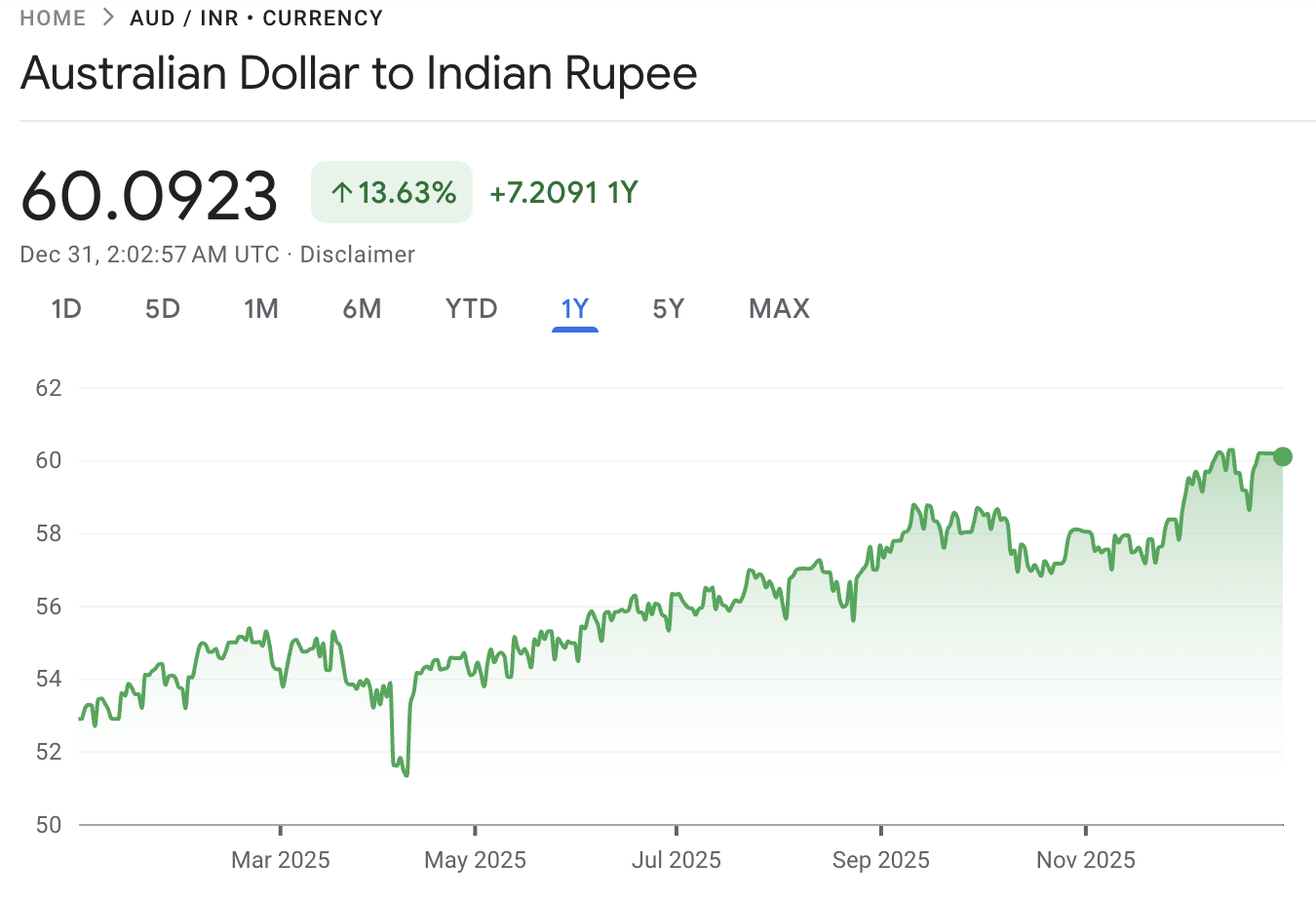
For 2026, that starting point is important for two reasons.
Valuation is no longer cheap for AUD versus INR in recent history. Further upside in AUD will need to be supported by fundamentals, not just momentum.
INR resilience has to be explained, not assumed. India has maintained sizeable external buffers and actively managed liquidity conditions, so AUD strength usually requires a supportive global backdrop, not merely local Australian news.
The most direct mechanical driver of AUD/INR is the expected interest rate path in Australia versus India.
The Reserve Bank of Australia (RBA) cash rate target is 3.60% (accessed 29 Jan 2026).
The Reserve Bank of India's policy repo rate is 5.25%, with official communication indicating a neutral stance as policy balances growth support and inflation control.
This puts India at a higher headline policy rate, which often supports INR via carry and domestic bond demand. But the exchange rate responds to changes in expectations, not just to levels.
The key question for 2026 is whether India continues easing more quickly than Australia, narrowing the differential, or whether Australia is forced to keep rates restrictive for longer because inflation progress stalls.
Inflation determines whether nominal rates translate into real support for a currency.
Australia’s monthly CPI indicator showed headline inflation at 3.8% year on year in the 12 months to December 2025, with trimmed mean inflation at 3.3% (accessed 29 Jan 2026)
India’s latest CPI inflation print is 0.71% year on year, reflecting a markedly softer inflation environment.
Implication for the AUD To INR Forecast:
India has more room to cut without immediately destabilising inflation, which can support growth but may reduce INR’s carry appeal if easing accelerates.
Australia has less room for fast cuts if inflation remains sticky, which can support AUD through rate expectations, even if growth is only moderate.
AUD is unusually sensitive to commodity prices and export receipts because commodities dominate Australia’s external income.
Official trade composition data show iron ore accounting for roughly one-fifth of Australia’s exports, with coal and natural gas also major contributors, and services such as education and travel rising in importance.
The problem for 2026 is not volume. It is the price and terms of trade.
Australia’s government resources outlook expects iron ore export earnings to ease from about $116 billion in 2024-25 to about $103 billion by 2026-27, largely due to lower prices and ore grade dynamics. It also expects total resources and energy export earnings to edge down over the forecast horizon, even if volumes improve.
That forecast profile typically produces an AUD that rallies in bursts but struggles to sustain long uptrends unless global growth is stronger than expected.
India is one of the world’s largest net crude importers; therefore, the direction of oil prices influences inflation, the trade deficit, and the current account. The IEA highlights India’s status as a leading net crude importer and the structural reliance on imported crude to meet rising demand.
The global oil market setup into 2026 has credible downside risk in many mainstream projections:
Australia’s resources outlook expects Brent to fall from around US$70 per barrel toward US$59 over its forecast horizon as supply surplus materialises.
The US EIA’s short-term outlook also points to inventories rising and Brent averaging near US$55 per barrel early in the year and staying around that level.
If oil prices are generally lower:
India’s import bill pressures ease, which tends to support INR at the margin through improved external balance and softer inflation pass-through.
Australia does not automatically benefit. Lower energy prices can coincide with weaker global growth or oversupply, which is often negative for broader commodity sentiment and, by extension, for AUD.
INR behaviour is strongly shaped by the credibility of its external buffer.
RBI weekly data put India’s foreign exchange reserves at about US$701.36 billion in the week ended 16 January 2026 (accessed 29 Jan 2026).
The latest current account data show a deficit of about US$12.3 billion, around 1.3% of GDP, improved from the year prior and not extreme for an economy of India’s size.
India’s central bank has also used tools such as FX swaps to manage liquidity conditions and market functioning, which in turn influence forward pricing and short-term flows.
This combination reduces tail risk for INR. It does not guarantee appreciation, but it makes sustained INR weakness more likely to reflect a genuine macro shock rather than just routine policy easing.

Policy flexibility: With inflation very low on recent prints, India has room to support demand if global conditions weaken.
External resilience: Large reserves and a moderate current account deficit reduce vulnerability to sudden stops in capital flows.
Improving transmission tools: Active liquidity management improves monetary transmission, supporting domestic financial stability and credit conditions.
Rate differential risk: Faster rate cuts can compress carry advantage, especially if global yields remain elevated.
Oil and import sensitivity: Even if oil trends lower, sudden spikes still transmit quickly into India’s trade balance and inflation, and markets price that optionality.
Diversifying exports: Services exports, including education-related travel, are a growing component of external earnings and can cushion commodity downcycles.
Labour market resilience: Australia’s unemployment rate has been steady at 4.3% in the latest labour data, signalling an economy that is slowing but not collapsing.
Policy credibility: A central bank constrained by inflation often keeps real rates higher than markets expect, which can support the currency through expectations.
Commodity earnings outlook: Official projections show export earnings easing over the forecast horizon, reducing the terms-of-trade tailwind that often powers sustained AUD rallies.
China and global growth linkage: AUD tends to underperform when global industrial demand softens, even if domestic data are stable. This sensitivity often first shows up in iron ore pricing, then in broader risk sentiment.
Because AUD/INR is trading near the top of its 52-week range, technical analysis should focus less on indicator folklore and more on market structure: where supply has repeatedly emerged, and where buyers have defended pullbacks.
This area contains the yearly highs and the 52-week peak near 60.6. A clean break and hold above 60.6 would be a meaningful regime change because it would put the pair into price discovery above the prior ceiling.
Round numbers matter in FX because corporate hedging, importer demand, and discretionary positioning often cluster there. Sustained trading above 60.0 typically indicates the market is comfortable pricing a higher band.
Recent week ranges have repeatedly rotated through the high 59s, making this the most practical “trend support” zone for near-term positioning.
If risk sentiment turns defensive or commodities sell off, AUD/INR can retrace into the high 50s without breaking the longer-term structure. This zone aligns with the pair’s broader yearly distribution around the mid- to high-50s.
This is the lower boundary of the 52-week range. Revisiting it would likely require a combination of global risk-off, commodity weakness, and a relatively stable INR backdrop.
No single-point forecast survives contact with macro shocks. A stronger approach is to define ranges tied to observable conditions.
This assumes:
India continues easing gradually but retains external stability and reserve strength.
Australia’s inflation slows only gradually, keeping the RBA cautious.
Commodity export earnings soften as forecast, but do not collapse.
In this base case, AUD/INR spends most of 2026 oscillating around the 60 pivot, with breaks above 60.6 failing without a strong external catalyst.
This requires at least two of the following:
Global growth and industrial demand surprised to the upside, supporting iron ore and risk appetite.
India cuts rates faster than expected, narrowing the INR yield advantage.
Australia keeps rates higher for longer due to persistent inflation.
The tell on the chart would be a sustained hold above the 60.6 ceiling.
This becomes likely if:
Commodity sentiment weakens materially, consistent with declining export earnings and softer prices.
Global risk appetite deteriorates, which historically weighs on AUD crosses first.
India’s external buffer stays strong, limiting INR downside.
In this scenario, 60 becomes a confirmed top, and rallies are sold into resistance.
RBA inflation and wage signals: These will decide whether 3.60% remains a floor or starts to fall.
RBI policy path and liquidity operations: Easing pace and money market conditions influence INR carry and forward pricing.
Iron ore and energy pricing: Australia’s terms of trade are the long lever on AUD.
Oil prices and India’s import bill: Lower oil is structurally INR supportive; spikes are an INR risk.
India’s external accounts: Current account and reserves trends influence how confidently markets hold INR risk.
The forecast anchors to the latest market quotes near ₹60.1 per 1 AUD, which is close to the top of the pair’s 52-week range.
A sustained rise is plausible but not automatic. With the pair already near its yearly highs, further gains require either stronger global growth and commodities or a meaningful narrowing of India’s rate advantage via faster RBI easing.
Over the course of weeks, rate expectations can dominate. Over quarters, Australia’s export receipts and commodity-linked terms of trade often exert the larger force on AUD, while India’s external buffer helps stabilise INR.
Because resilience depends on external financing needs as much as on policy rates. India’s reserve stock and a moderate current account deficit reduce vulnerability to sudden capital outflows.
The upper band around 60.6 is the key ceiling. A sustained break above it would signal a higher trading regime, while repeated failures there keep the pair range-bound.
The AUD to INR Forecast for 2026 starts from a clear fact: AUD/INR is trading near ₹60.1, close to the top of its recent distribution. From here, the balance of probabilities favours a two-way market unless fundamentals shift decisively.
The most robust base case is a 58.50 to 61.50 range, supported by India’s external buffers and policy flexibility on one side, and Australia’s still-elevated inflation and commodity-linked earnings profile on the other.
The upside case depends on a durable breakout above the 60.6 ceiling, typically requiring stronger global growth and a supportive commodity backdrop. The downside case requires a risk-off environment that compresses commodity prices and pushes investors away from cyclical currencies, while INR stability holds.
Disclaimer: This material is for general information purposes only and is not intended as (and should not be considered to be) financial, investment or other advice on which reliance should be placed. No opinion given in the material constitutes a recommendation by EBC or the author that any particular investment, security, transaction or investment strategy is suitable for any specific person.