Published on: 2025-12-17
Updated on: 2025-12-17
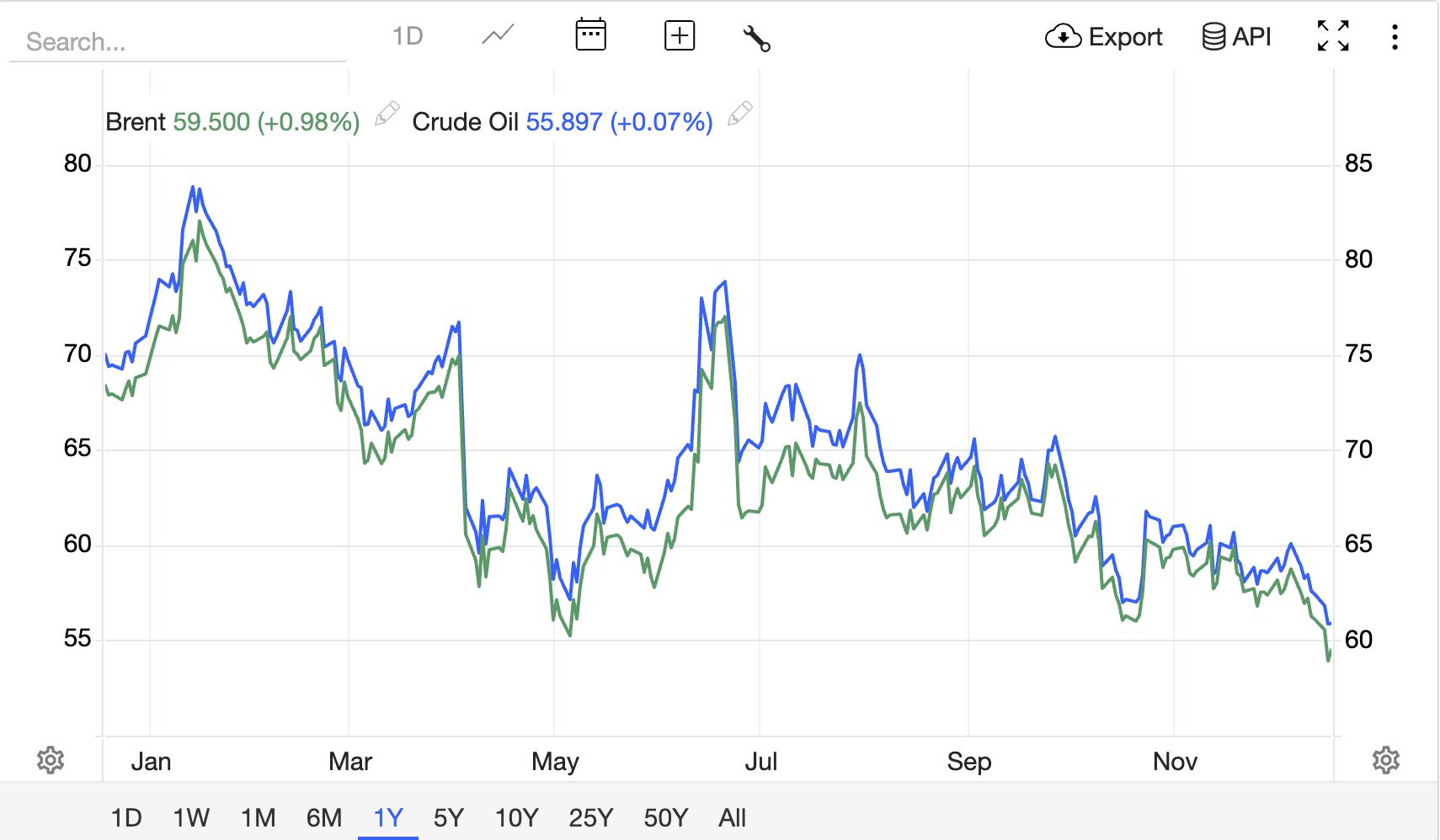
Crude oil hasn't merely slipped; it has broken down into territory the market hasn't seen since February 2021, with Brent settling near $58.92 and WTI around $55.27 this week. When oil slides toward a 58-month low, recession chatter tends to flare up, because sharp oil sell-offs have often coincided with demand shocks.
The honest answer is that oil can fall hard for two very different reasons. One is weak demand, which is where recession warnings come from. The other is excess supply, which appears recessionary on a chart while the actual economy continues to progress. This sell-off shows elements of both, but the balance of evidence still points first to supply.
This article breaks down what is driving crude to multi-year lows, which recession signals are genuinely flashing, and what traders should watch next across spreads, inventory data, and key chart levels.
| Benchmark | Recent level (mid-Dec 2025) | Recent milestone | What traders are hearing |
|---|---|---|---|
| WTI (CL) | ~$55/bbl | Lowest settlement since Feb 2021 | "Supply glut" is the dominant narrative. |
| Brent (LCO) | ~$59/bbl | Trading below $60 | Hopes of easing geopolitical friction have pressured risk premium. |
As mentioned above, Brent and WTI have fallen to their lowest settlements since February 2021, with Brent near $58.92 and WTI near $55.27.
On the chart, that is not a normal pullback. It is a return to the last "pre-inflation shock" energy regime, before the 2022 supply crisis repriced almost every barrel on the planet.
This area matters for three reasons.
It is a long memory zone for funds that trade crude trends. February 2021 was the last time oil traded sustainably below $60.
It pressures energy producers' cash flows and capex plans, especially outside the Middle East, where fiscal breakevens are higher.
It reshapes the inflation-and-rates narrative, because energy prices remain the fastest lever on headline inflation expectations.
A major factor behind the latest decline is renewed optimism concerning Russia–Ukraine talks, which markets interpret as a sign of reduced logistical disruptions and, over time, potentially less pressure from sanctions on energy flows.
Even if a deal is not imminent, oil prices trade on marginal changes in perceived risk. When traders see disruption risk fading, prices often fall first, well before any physical barrels actually move.
The supply side is the heavier force.
The US EIA anticipates that global oil inventories will continue to rise through 2026, with Brent crude averaging around $55 in the first quarter of 2026 and remaining near that level thereafter.
The IEA projects a sizeable 2026 surplus, with estimates around 3.84 million barrels per day.
That is the core bear case: it is difficult for crude to rally when inventories are building and the forward balance looks heavy.
Oversupply is not just a theory. The US is producing at record levels even with weaker prices.
US crude output also reached a record 13.84 million bpd in September 2025 based on EIA data. That keeps barrels flowing into the global system at the worst possible time for price support.
OPEC's own view is less bearish than the IEA's. OPEC argues the 2026 market looks closer to balance, contrasting the IEA's surplus call.
OPEC+ decided to maintain a steady output policy in Q1 2026 due to concerns about a supply glut.
This indicates that the producer group also recognises the risk: demand is insufficient to absorb aggressive supply increases.
China is not collapsing, but it is not pulling the market higher either. Reuters reported China accelerated stockpiling in November 2025, with a surplus of 1.88 million bpd as imports outpaced refinery runs.
That is a key nuance. Import strength is not the same as demand strength. Stockpiling may provide temporary support to the physical market, but it does not address a weak consumption profile.
| Question | What it usually means | What we see now |
|---|---|---|
| Is supply rising faster than demand? | Supply-led bear market, not necessarily recession | IEA warns of a large 2026 surplus; EIA sees inventories building. |
| Are producers pumping at records? | Price pressure can persist even with steady growth | US output hit a record 13.84m bpd (Sept). |
| Is China importing but storing? | Weak burn rate; demand is not tight | China stockpiling surged as imports beat runs. |
| Is geopolitics reducing risk premium? | Lower prices without recession | Russia–Ukraine peace expectations are cited as a key driver. |
Oil is a good recession signal only when it is falling, mainly because end-demand is rolling over. This drop looks more supply-led than demand-led, which reduces the "automatic recession" message.
Treat oil as a recession red flag if you see confirmation outside crude, such as:
Broad declines in global PMIs and freight indicators.
There has been a significant decline in corporate earnings expectations, particularly outside the energy sector.
Credit stress that forces widespread demand destruction.
Relying solely on crude can be misleading, especially during times when supply is increasing and producers are trying to maintain their market share.
| Metric | Brent (ICE) | WTI (NYMEX) | Why it matters |
|---|---|---|---|
| Latest price area | ~$58.9 | ~$55.3 | Both are at the lowest settlements since Feb 2021. |
| Trend read (daily) | Strong Sell | Neutral / mixed | Brent remains more technically damaged than WTI on indicator summaries. |
| RSI (14) | 44.77 (Sell) | 50.36 (Neutral) | Momentum is weak, but not “panic-oversold” on these readings. |
| MACD (12,26) | -0.40 (Sell) | -0.24 (Sell) | Trend momentum is still negative on both benchmarks. |
| ADX (14) | 51.59 (Sell) | 38.53 (Buy) | Brent shows a stronger established trend; WTI trend strength is less dominant. |
| Key moving averages | MA50 ~60.31, MA200 ~61.92 | MA50 ~56.30, MA200 ~58.09 | Price is below mid/long averages, which keeps rallies capped. |
| Near-term pivots | Pivot ~58.84 | Pivot ~55.60 | Useful for short-term traders; they show where intraday supply often sits. |
The technical picture is consistent with a market that is weak, volatile, and struggling to reclaim its moving averages.
WTI: $55 is the psychological level. Traders are beginning to discuss the possibility of $50 becoming the next major target.
Brent: $60 was the key shelf. Losing it puts focus on $58–$59 (current base) and then the mid-$50s if the breakdown accelerates.
In a market like this, the cleanest signal of a durable bottom is not one strong day. It is a reclaim of the 50-day average followed by higher lows.
The EIA's view that inventories rise through 2026 is a strong anchor for bears. If the forward curve remains heavy and stockpiles increase, rallies often fail quickly because traders sell off the bounce.
OPEC+ holding steady for Q1 2026 is not bullish by itself. The market will determine if OPEC+ indicates deeper restraint or continues to prioritise market share.
Oil prices react strongly to the possibility of relaxed sanctions if diplomatic efforts progress. If talks stall, crude could rebound, but any upside should be weighed against still-ample supply.
WTI and Brent settled at their lowest levels since February 2021 (a 58-month low), with Brent near $58.92 and WTI around $55.27.
No. Oil prices can drop due to weakening demand or additional supply. In late 2025, the evidence is leaning towards an oversupply and inventory build story rather than a pure demand collapse.
OPEC can stem the decline by tightening supply, but it must balance supporting prices against protecting market share.
The EIA expects Brent to average around $55 in Q1 2026 and to hover near that level through 2026, as global inventories continue to build.
In conclusion, Crude oil near a five-year low is a serious signal, but it is not a verdict. The current evidence leans toward a supply-led bear phase rather than a pure recession signal. Furthermore, the EIA explicitly discusses rising inventories through 2026, the IEA is modelling a significant surplus for next year, and US production continues to set records.
However, that does not mean recession risk is irrelevant. If oil prices remain low while growth indicators remain positive, this signals a supply issue and acts as a disinflationary force.
If oil breaks down further and global demand data turns, crude becomes a louder warning. For now, the message is not "recession is here." The message is "the barrel is oversupplied, and the market believes it."
Disclaimer: This material is for general information purposes only and is not intended as (and should not be considered to be) financial, investment or other advice on which reliance should be placed. No opinion given in the material constitutes a recommendation by EBC or the author that any particular investment, security, transaction or investment strategy is suitable for any specific person.