Published on: 2025-12-26
Updated on: 2025-12-29
MSFT heads into 2026 in an unusual spot. The company continues to experience robust growth in cloud and AI-related demand, yet Microsoft stock isn't reaching new peaks.
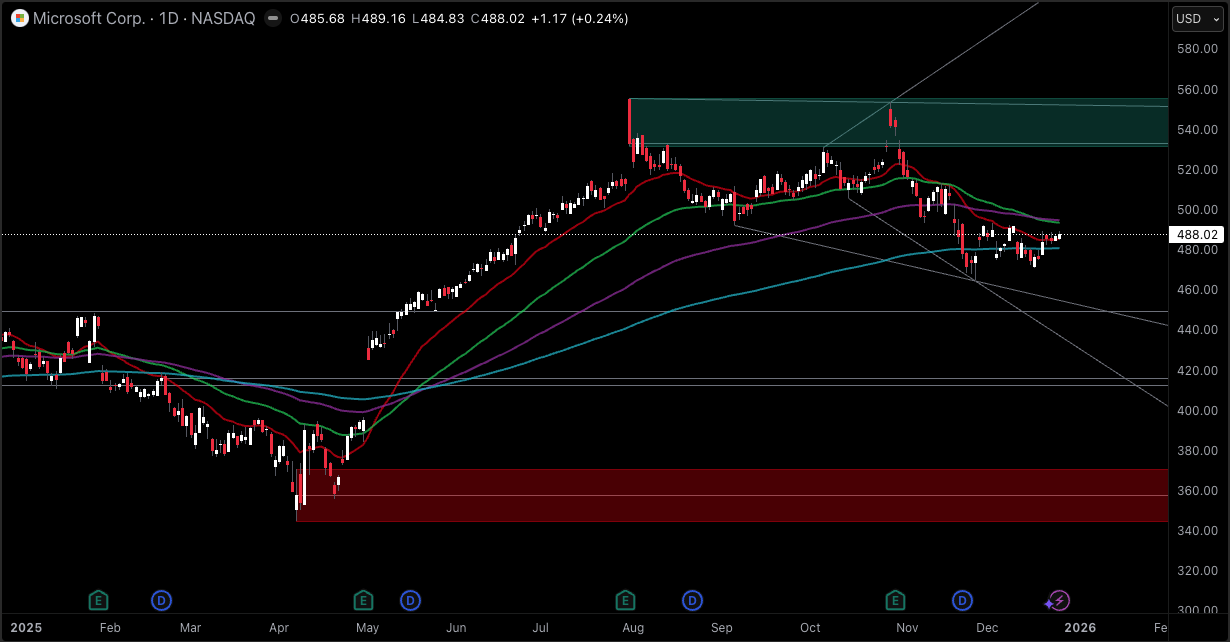
As of the latest available close (December 24, 2025), MSFT finished at $488.02, with a market value of around $3.63 trillion. That price is still below its 2025 peak of $555, suggesting investors are encouraged but increasingly focused on valuation, spending discipline, and how long profits can compound at a high rate.
The real question for traders is simple: does Microsoft turn today's AI spending into higher margins and faster earnings growth by 2026, or does valuation cool off before the payoff arrives?
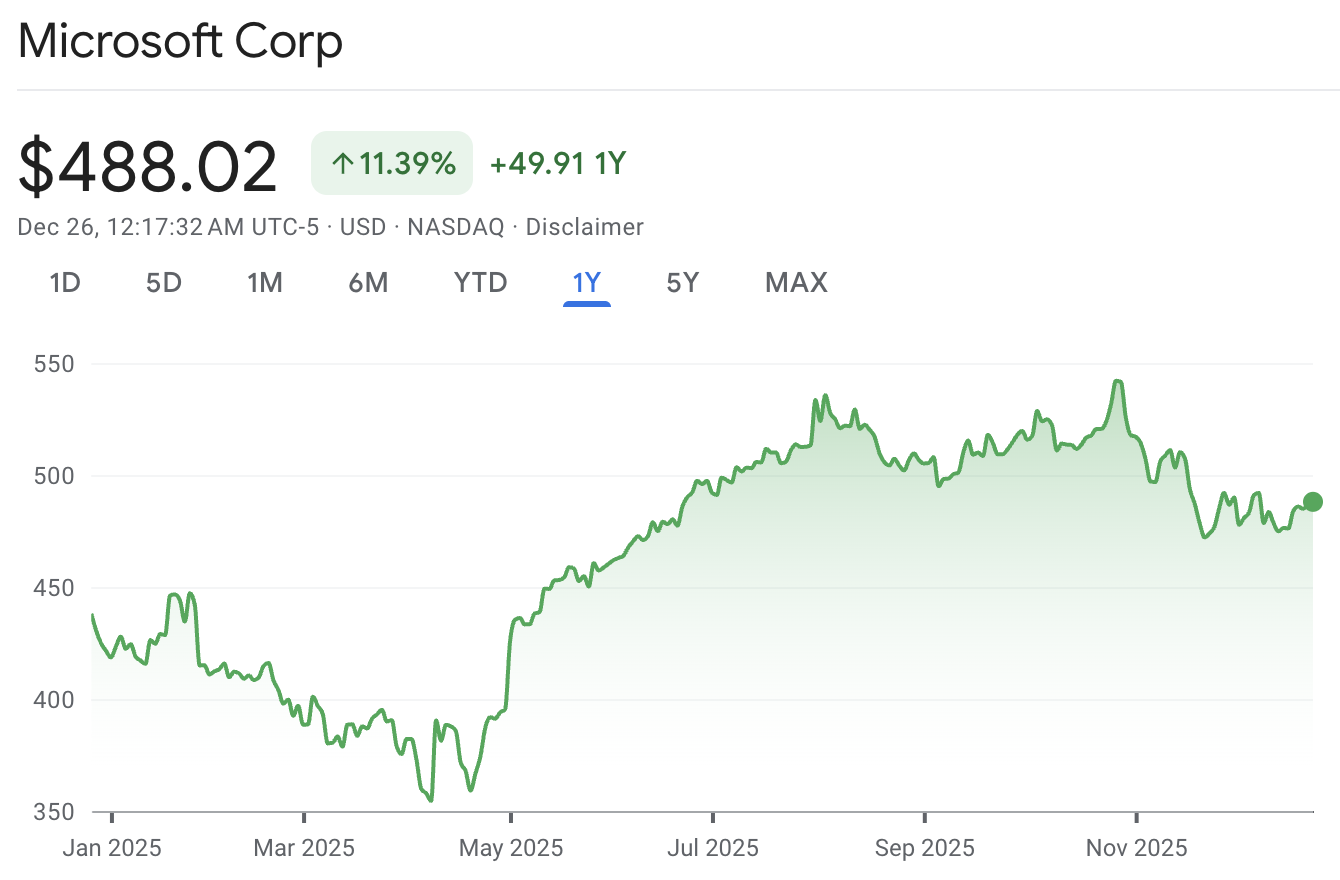
Microsoft has been involved in numerous areas lately. The stock traded between a 52-week high of $555.45 and a 52-week low near $344.79.
Listed are the short-term reads using the latest close and recent daily history:
Last week (5 sessions): about +2.5% (bounce off mid-range support into the holiday week)
Last month (20 sessions): about +2.3% (grindy, not explosive)
YTD: +15.78%
1-year: +11.08%

The latest quarterly results show momentum where it counts.
Microsoft's fiscal 2025 results were substantial: $281.7B in revenue, $128.5B in operating income, and $13.64 in diluted EPS.
Momentum carried into fiscal Q1 2026, with revenue up 18% year over year to $77.673B and operating income rising 24% to $37.961B.
That's the "engine" bull's point: growth plus strong operating leverage.
MSFT continues to return meaningful cash to shareholders. In the fiscal 2025 Q4 quarter, it returned $9.4 billion through dividends and repurchases, and in fiscal 2026 Q1, it returned $10.7 billion.
When steady buybacks support a large, liquid stock, shorter drawdowns often occur along with a "two steps down, three steps up" pattern, unless macro conditions turn sharply risk-off.
Heading into 2026, the market narrative still rests on three pillars:
Sustained AI infrastructure investment
Steady earnings growth
The prospect of a more supportive policy backdrop as inflation eases
That combination typically benefits high-quality large-cap stocks, which can self-fund growth initiatives and defend margins more consistently.
That said, the main tension is that investors want AI-driven revenue to show up faster than AI-driven spending.
| Indicator | Value | What it suggests |
|---|---|---|
| Last close | $488.02 | Mid-range price action |
| 52-week range | $344.79 – $555.45 | Wide band, room for both outcomes |
| RSI (14) | 49.44 | Neutral momentum |
| MACD (12/25) | -3.48 (bearish) | Trend still healing, not "clean" yet |
| SMA 10 / 50 / 100 / 250 | 480.96 / 499.19 / 506.22 / 463.30 | Below 50/100 = overhead supply; above 250 = longer trend still up |
| ATR (14) | ~$8.29 | Normal daily swing about $8 (useful for stops/targets) |
The above is a technical overview created from the latest closing price, commonly used indicators, and updated support/resistance levels based on the recent swing structure.
Support Zones:
$475–$477: repeated closes and reactions in Dec/Nov
~$465: a clear recent swing low area (a key "line in the sand")
~$450: major Fibonacci mid-level and a common "decision zone" for longer swings
Resistance Zones:
$493–$500: recent tops and the 50-day area overhead
~$510: Fibonacci level and prior supply zone
$553–$555: the recent 52-week high zone (breakout level)
Classic Pivot Levels (Based on Last Session High/Low/Close):
Pivot: $487.34
Resistance: $489.85 / $491.67 / $494.18
Support: $485.51 / $483.01 / $481.18
Fibonacci Retracement Levels (52-Week Low to High):
61.8%: $474.98
78.6%: $510.37
Extension targets if a fresh breakout sticks:
1.272: $612.75
1.618: $685.64
In short, MSFT's technical picture leans bullish, but it is not a runaway breakout. Momentum is positive, and most moving averages are supportive, while the stock remains below its 2025 peak.
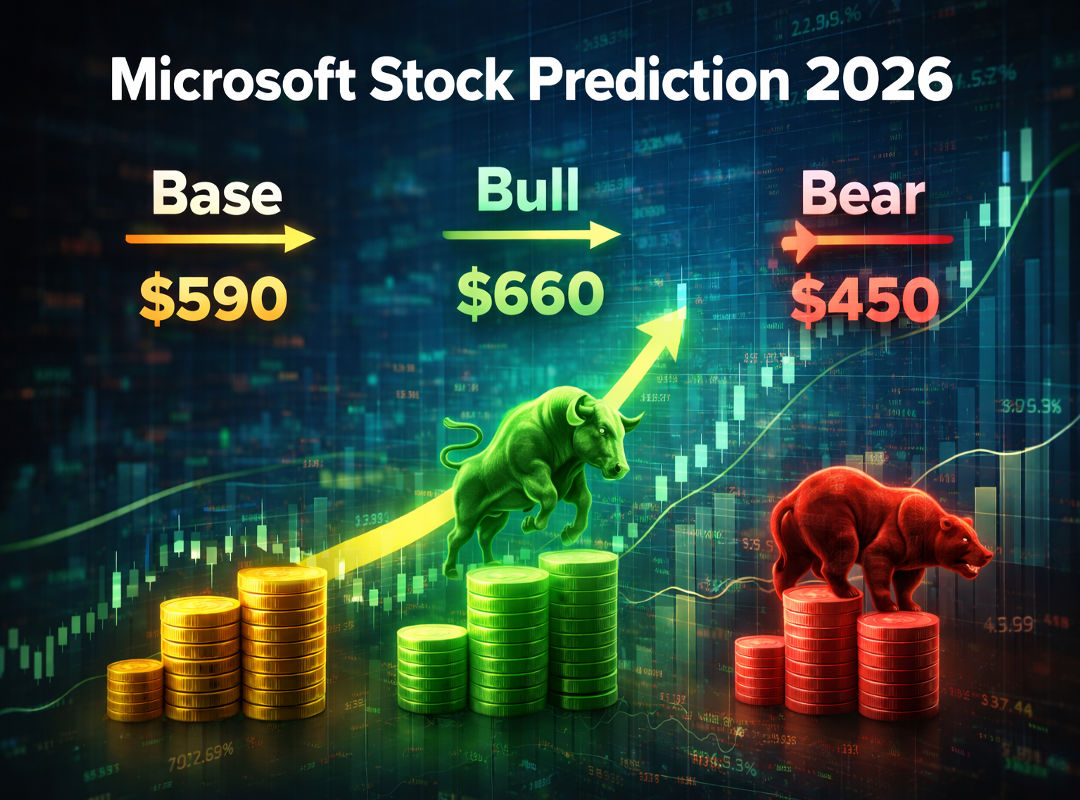
These are not promises. These are scenario ranges that utilise the most recent full-year EPS base ($13.64 for FY2025) and implement plausible growth rates, followed by valuation ranges that reflect how MSFT typically performs during positive versus cautious sentiment.
| Scenario | What has to go right (or wrong) | Illustrative 2026 range |
|---|---|---|
| Bear case | Growth cools and valuation compresses | $450–$490 |
| Base case | Mid-teens earnings growth, valuation steady | $520–$590 |
| Bull case | AI monetisation stays strong, market pays up | $610–$660 |
In short, a trader's way to connect this to the chart:
Base case becomes more believable if MSFT regains the $500–$510 zone and holds it on normal volume.
Bull case requires a clean break above $555 with follow-through.
Bear case is more likely if the price loses $465 and can't recover quickly.
Consider $555 as the threshold that shifts the long-term chart.
Treat the $475–$450 band as the area where the trend is tested, not broken.
Re-check the story each quarter using cloud growth and operating margin direction.
Respect the moving-average cluster around $483–$486, as it is where many dip-buyers will defend first.
Plan entries around support and exits into resistance, as ADX near 24 suggests follow-through can be uneven.
Watch how the price behaves around $500. If the stock fails there repeatedly, it often turns into a range market.
If it surpasses $500 with volume and sustains that level for a few sessions, the risk leans toward a move into the mid-$500s.
If growth remains strong and the market mood stays positive, a $610–$660 zone is a realistic bull range. A more normal path puts MSFT closer to $520–$590.
The clearest zones are $493–$500, then around $510, and the bigger "ceiling" near $555.
The biggest risk is a mismatch between AI-driven spending and AI-driven profit growth.
In conclusion, MSFT is priced like a long-run winner, but it still has to earn that price every quarter. The business is expanding rapidly, and earnings are increasing, but expenses are substantial as it develops the upcoming wave of infrastructure.
From a technical standpoint, the longer-term trend still looks constructive, but the setup isn't "easy mode" as long as the stock remains below its 50-day and 100-day moving averages.
A break above $555 would open the door to higher targets, while a slip under $465 would tell you the market wants a deeper reset.
Disclaimer: This material is for general information purposes only and is not intended as (and should not be considered to be) financial, investment or other advice on which reliance should be placed. No opinion given in the material constitutes a recommendation by EBC or the author that any particular investment, security, transaction or investment strategy is suitable for any specific person.