Published on: 2026-01-08
Updated on: 2026-01-08
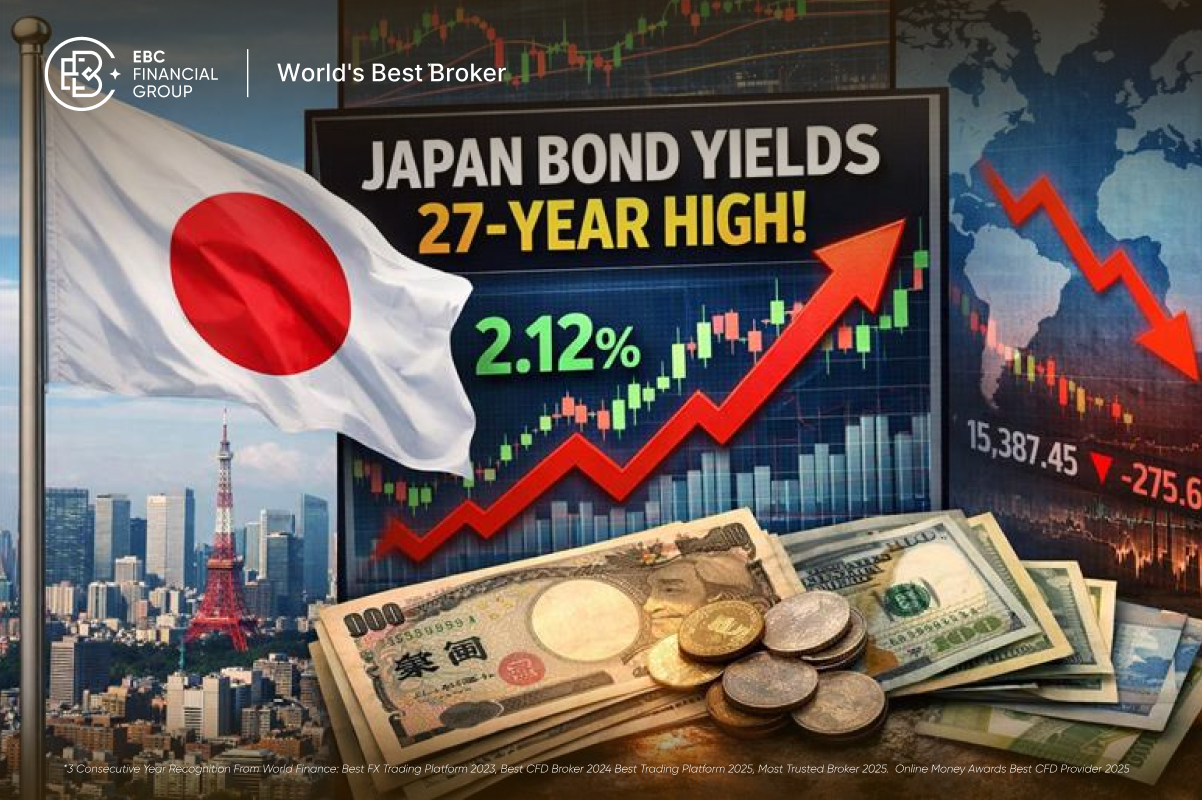
Japan’s government bond market has entered a new regime. In early January 2026, the benchmark 10-year Japanese government bond (JGB) yield briefly touched about 2.125%, its highest level since February 1999, before easing slightly.
This development has global implications. For decades, Japan anchored ultra-low interest rates worldwide. As rates rise, global borrowing costs may increase, leveraged trades using cheap yen could face pressure, and cross-border capital flows that finance deficits and risk-taking may shift.
The rise in yields reflects monetary policy normalization, persistent inflation, and a gradual reduction in central bank support, requiring the market to operate more independently.
By early January 2026, the 10-year JGB yield had risen to levels last seen in 1999, peaking around 2.125%.
At the same time, super-long yields moved even more sharply. The 30-year JGB traded around the mid-3% range and reached fresh highs in early January, around 3.5%.
These figures indicate that the market expects Japan to move away from near-zero rates toward a more typical interest-rate environment.
The Bank of Japan (BOJ) has been steadily shifting policy from emergency-era accommodation to gradual tightening:
Short-term policy rate raised to around 0.75% (December 19, 2025), up from around 0.5%.
A clear message that further hikes remain possible if the inflation outlook holds.
A multi-year plan to reduce monthly JGB purchases to roughly 3 trillion yen by January to March 2026, down from much higher levels in 2024.
An additional framework that points to continued balance-sheet normalization beyond March 2026, but with a pace designed to avoid disorderly market moves.
The BOJ is now allowing market forces greater influence over yields. As the central bank reduces its presence, yields may rise unless private demand increases accordingly.
Japan’s inflation environment has changed significantly compared to previous years:
The BOJ has explicitly noted that Japan’s CPI has consistently exceeded 2% since spring 2022.
Official indicators show consumer inflation remains elevated, with the Statistics Bureau highlighting CPI changes in the high-2% range in late 2025.
Wage dynamics remain mixed: regular pay has been rising, but real wages have been pressured by inflation and volatile bonus payments.
This is important for bonds because investors are most concerned about inflation. If they expect inflation to remain at 2% or higher, they will require higher yields to preserve purchasing power.
Japan is also preparing to fund another very large budget. For fiscal 2026, plans include roughly 29.6 trillion yen of new bond issuance tied to a record-size budget.
Even with careful management, bond supply remains substantial. As yields rise, investors are increasingly focused on the outlook for long-term debt.
| Metric | Recent level | Notable reference point | Why it matters |
|---|---|---|---|
| BOJ short-term policy rate | ~0.75% | Raised Dec 19, 2025 | Sets the floor for money-market rates and signals tightening |
| 10-year JGB yield | ~2.1% | Peaked near 2.125% in early Jan 2026, highest since 1999 | Benchmarks pricing for Japan’s economy and global spillovers |
| 30-year JGB yield | ~3.5% | Reached record highs in early Jan 2026 | Directly impacts long-term borrowing costs and duration risk |
| BOJ monthly JGB purchase target | ~¥3T (Jan–Mar 2026) | Taper plan set in 2024 | Reduced BOJ demand forces the market to absorb more supply |
Japan is one of the world’s largest sources of savings. Japanese institutions have traditionally invested abroad when domestic yields were low. As domestic yields rise, the attractiveness of foreign bonds decreases, potentially causing global ripple effects.
As JGB yields increase, Japanese investors can earn higher returns domestically without incurring currency risk.
If domestic yields rise and hedging costs remain high, some investors may reduce foreign bond holdings and shift funds to JGBs. This can increase yields in other major markets where Japanese institutions are significant investors.
Japan’s policy shift is not theoretical. The BOJ is actively shrinking the monetary base and reducing asset purchases relative to peak stimulus levels.
For years, investors borrowed in yen at low rates to invest in higher-yielding assets elsewhere. As Japanese rates rise, this strategy becomes less appealing.
A disorderly unwind can spill into:
Emerging-market bonds
High-yield credit
Leveraged equity strategies
Volatility-sensitive trades
Even small increases in Japanese rates are significant because many leveraged strategies depend on stable funding and low volatility, rather than just low interest rates.
Long-term yields are not just a forecast of future policy rates. They also include a term premium, the extra return investors demand for holding long-duration bonds through uncertainty.
Japan’s bond market is now pricing:
Less central-bank backstopping
More inflation uncertainty
Greater sensitivity to fiscal supply decisions
When a major market increases its term premium, it can affect risk pricing globally, as investors compare long-duration risks across markets.
A weaker yen increases import costs and can sustain higher inflation, which supports higher yields. In early January 2026, USD/JPY traded in the mid-150s, indicating continued currency pressure despite rising Japanese yields.
This feedback loop is globally important because currency fluctuations impact trade competitiveness, corporate earnings, and overall risk sentiment.

Japan’s interest burden increases gradually, as much of its debt carries older, lower coupons. As bonds mature and are refinanced, average interest costs rise.
Over time, higher yields can:
Increase the share of the budget devoted to interest payments.
Reduce flexibility for stimulus.
Intensify scrutiny of issuance strategy, especially in super-long maturities.
Concerns about bond supply have already affected market discussions, with super-long yields responding sharply to issuance expectations.
Higher yields have two opposing effects on financial institutions:
Positive
New purchases earn higher yields.
Investment income improves over time.
Negative
Existing bond holdings lose market value when yields rise.
Capital ratios and reported earnings can become more volatile if portfolios are marked to market.
The super-long segment is particularly sensitive, as long-duration bond prices decline significantly when yields increase.
Japan’s transition remains gradual, but the trend is clear. Higher risk-free yields typically lead to increases in:
Mortgage rates
Corporate loan pricing
Discount rates used in equity valuation
If rates increase while real wages remain under pressure, consumer spending may decline. Late-2025 wage data already indicates real-income strain in some sectors.
BOJ meeting outcomes and guidance, especially the January 22–23 meeting window referenced by policymakers.
10-year yield stability above 2%, which reinforces the idea that Japan has left the ultra-low era behind.
Super-long auctions and bid quality, because weak demand at the long end can accelerate yield rises.
JPY exchange rate direction, since a weaker yen can keep inflation sticky and strengthen the case for further tightening.
BOJ taper implementation, particularly purchase reductions scheduled through early 2026.
BOJ continues gradual tightening and tapering.
Yields remain elevated but move in an orderly range.
Global spillovers are present but manageable.
Inflation proves stickier than expected.
The BOJ is pressured to tighten faster.
Super-long yields rise more sharply, increasing volatility and spillovers.
Consumption softens under real wage pressure.
Fiscal needs remain large.
The market demands a higher term premium even if growth weakens.
Because the BOJ is tightening policy and reducing bond purchases, while inflation has remained above 2% for an extended period, pushing investors to demand higher yields.
It refers to the 10-year JGB yield reaching levels last seen in 1999, peaking around 2.125% in early January 2026.
Japan is a major source of global capital. Higher domestic yields can pull money back into Japan, shift currency funding costs, and reprice duration risk across global bond markets.
It is moving in that direction, but policy remains cautious. The BOJ has raised the policy rate to around 0.75% and signaled gradual adjustment rather than aggressive tightening.
A rapid shift in capital flows and leveraged positioning. If investors unwind yen-funded trades or Japanese institutions abruptly reduce foreign bond holdings, it can push global yields higher and tighten financial conditions.
Yes. If inflation cools faster than expected or growth weakens materially, yields can stabilize or decline. However, reduced BOJ buying may mean the market remains more sensitive than in the past.
Japan’s bond yields reaching multi-decade highs reflect a structural shift: persistent inflation, rising policy rates, and a central bank reducing its bond purchases. The 10-year yield’s return to 1999 levels marks the end of Japan’s prolonged period of near-zero long-term rates, a transition with global implications.
For global markets, the main risk is not a sudden shift to high rates in Japan, but a return to a normal market where yields are determined by private demand, inflation expectations, and fiscal factors. In a world accustomed to cheap funding and abundant liquidity, even gradual normalization in Japan can alter capital flows, currency dynamics, and the global pricing of long-term risk.
Disclaimer: This material is for general information purposes only and is not intended as (and should not be considered to be) financial, investment, or other advice on which reliance should be placed. No opinion given in the material constitutes a recommendation by EBC or the author that any particular investment, security, transaction, or investment strategy is suitable for any specific person.