Published on: 2026-05-25
Updated on: 2026-05-25
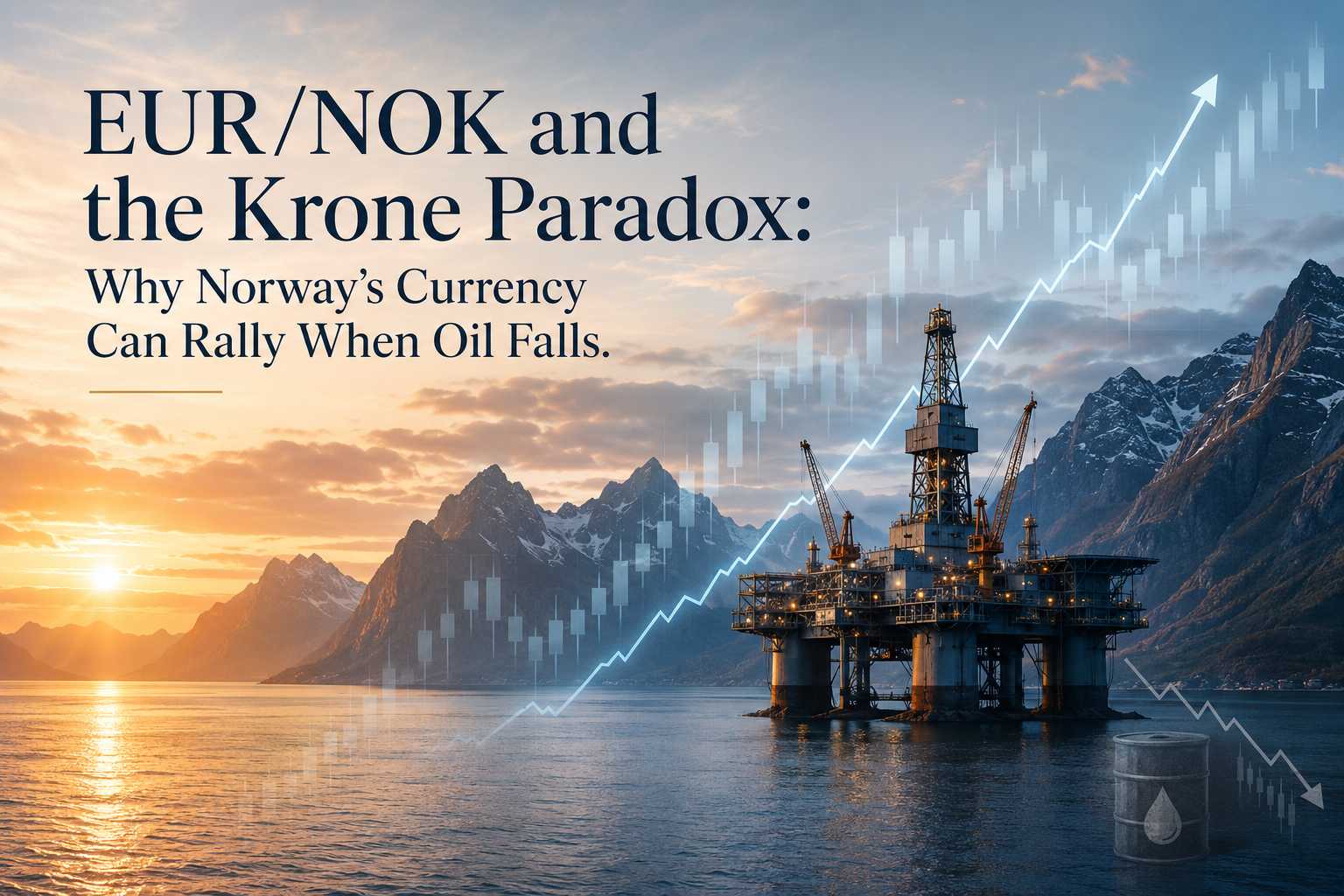
EUR/NOK is the kind of forex pair that punishes lazy textbook logic.
Norway exports oil and gas. Oil falls. The Norwegian krone should weaken. That is the simple version. But the market is not trading the simple version.

The euro was worth 10.7295 Norwegian kroner on May 22, according to the European Central Bank’s latest reference rate. That put EUR/NOK near its strongest krone levels of 2026, after the pair had traded as high as 11.8259 at the start of January. A falling EUR/NOK means the krone is strengthening against the euro, not weakening. That is the krone paradox: Norway’s currency can rally even when oil stops helping it.
Norway is one of Europe’s most important energy suppliers, and crude oil and natural gas accounted for 57% of the total value of Norway’s goods exports in 2025, according to Norsk Petroleum. Nearly all oil and gas produced on the Norwegian shelf is exported. That gives traders a structural reason to treat NOK as a commodity currency, one whose value moves with energy markets.
Higher oil prices can improve Norway’s trade income, fiscal position, and external balance. Lower oil prices typically remove part of that support. The logic holds. The problem is that it only holds partially, and not always when it is supposed to.
EUR/NOK is also a rate trade, an inflation trade, and an energy security trade for Europe. Traders who reduce the pair to a Brent chart frequently get the direction right for the wrong reason, and eventually get the direction wrong entirely.
On May 7, 2026, Norges Bank raised its policy rate from 4.00% to 4.25%, a move that the market had not priced in. Consensus had expected no change.
The Monetary Policy and Financial Stability Committee stated that inflation remained too high, that it had run above target for several years, and that elevated wage growth and energy prices had altered the inflation outlook. The central bank’s published rate path from its March Monetary Policy Report had already flagged that a move toward 4.25%-4.50% by end-2026 was likely, but the timing surprised markets.
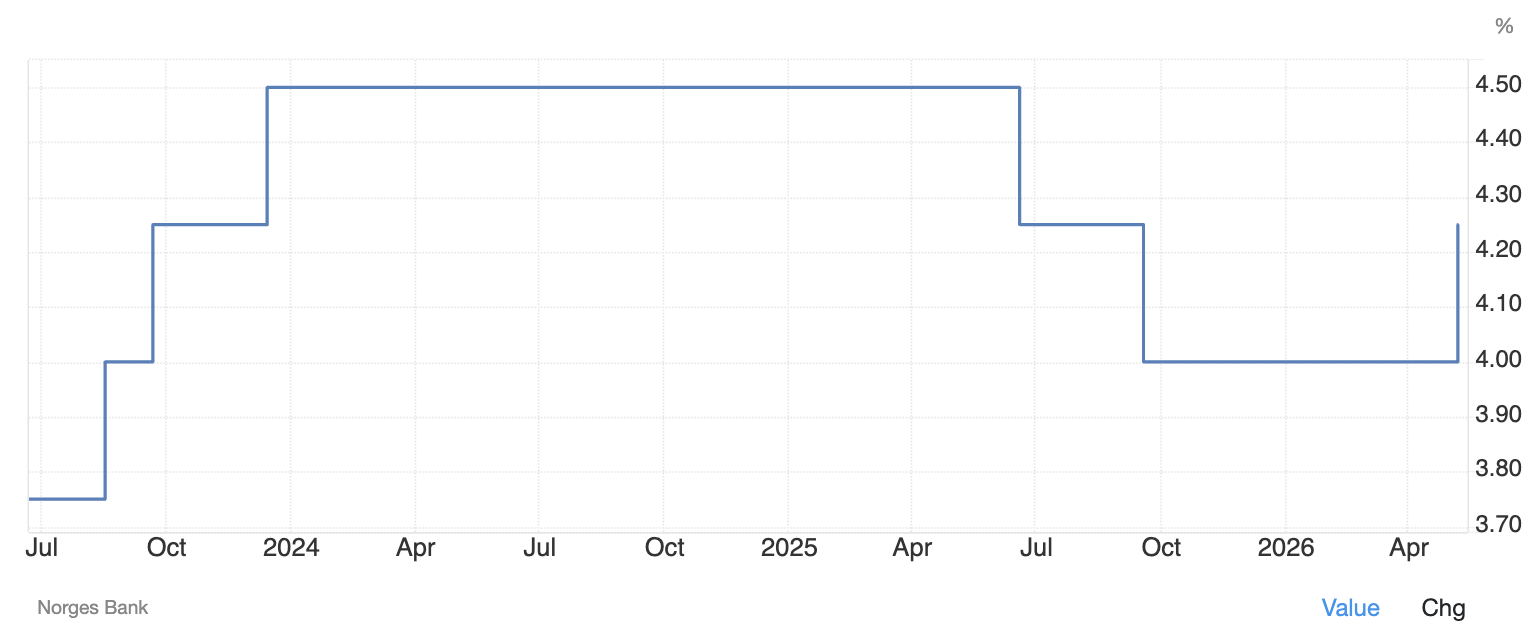
A rate decision that is anticipated is largely priced in before the announcement. A decision that is not anticipated moves the currency. When Norges Bank tightened on May 7 against market expectations, NOK received a repricing, not just a confirmation of what traders already owned.
The practical result is that the krone entered the second half of May with a rate advantage that the market had underweighted only weeks earlier.
If Norway offers a higher and rising yield while the euro area faces softer growth and a different rate trajectory, NOK can attract buyers without any help from oil at all. At that point, the krone is no longer trading as an energy proxy. It is trading as a currency backed by a central bank that raised rates when markets expected it to stand still.
Oil prices pulled back as markets priced in signs of progress toward a U.S.-Iran deal and a potential reopening of the Strait of Hormuz. Brent crude, which had been trading above $100, gave back part of its geopolitical premium as the risk of a supply disruption appeared to recede.
Under the standard commodity currency model, that should have pressured NOK and pushed EUR/NOK higher, meaning the krone would have weakened.
Instead, traders had to price three countervailing forces simultaneously.
1) First, Norway’s rate advantage had just been re-established. A surprise or hawkish rate decision can support a currency even when its primary export commodity falls. The magnitude of the NOK repricing from the Norges Bank hike was sufficient to offset a moderate pullback in crude.
Rate differentials and commodity prices do not move in the same direction at the same speed, and when they diverge, the more recent signal often dominates in the short term.
2) Second, lower oil does not have a single meaning for Norway’s inflation picture. For most importing economies, a fall in energy prices reduces inflationary pressure and may allow central banks to ease. For Norway, the effect is more ambiguous.
Weaker oil export income can deteriorate the fiscal and trade position, which is generally negative for the krone. But lower domestic energy costs can reduce cost pressures and potentially delay the need for further tightening, which may, paradoxically, support economic stability without removing the rate advantage Norway already holds.
The net effect is not clean. It depends on how much oil falls, how fast, and what the rest of the inflation data is doing at the same time.
3) Third, Europe still depends heavily on Norwegian gas. Norway exported a gas volume equivalent to more than 30% of total gas consumption in the EU and the United Kingdom in 2024, and approximately 95% of Norwegian gas production is transported via pipeline directly to European markets.
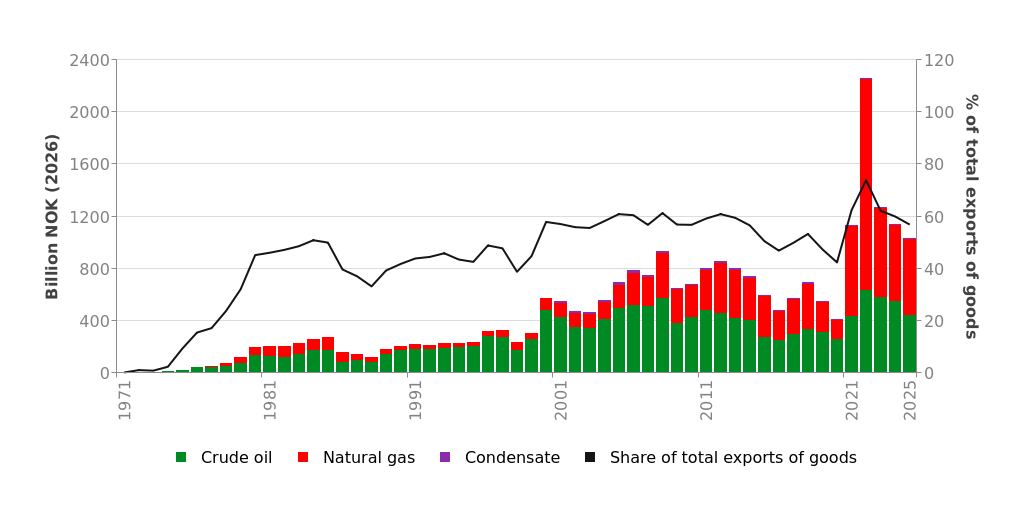
That makes Norway structurally embedded in Europe’s energy security calculus in a way that spot crude prices do not fully capture. The krone is not just tied to oil spot moves. It is tied to Europe’s longer-term reliance on Norwegian gas supply, a relationship that does not reprice on a daily oil chart.
EUR/NOK traders tend to track three variables rather than one.
The oil and gas trade. Norway's fiscal position, the Government Pension Fund Global, and Norges Bank's foreign currency purchases are all influenced by energy export revenues. A prolonged crude selloff driven by collapsing global demand would eventually feed through into NOK weakness. The transmission is real; it is just slower and more conditional than a simple correlation chart implies.
The rate differential. Norway's 4.25% policy rate sits well above the ECB's current path, with Norges Bank's forward guidance signalling a potential move to 4.50% by year-end. As long as that differential is wide and widening, NOK has a yield-based bid that does not require rising oil to sustain it. It became the dominant short-term driver precisely because the May hike surprised the market.
Europe's structural energy exposure. Because Norway supplies such a large share of European gas demand through fixed pipeline infrastructure, the krone carries a floor of strategic importance that spot-commodity logic underestimates. Ordinary crude price volatility does not carry the same weight here; that dynamic only activates when Norwegian gas supply to Europe is itself at risk.
The key distinction in the current EUR/NOK move is what drove the oil pullback. Oil fell because the probability of a Middle East supply disruption declined. That is a geopolitical risk reduction event, not a demand destruction event.
When oil falls on demand destruction, recessions, slowing industrial output, global growth downgrades, Norway’s export income weakens, and the currency usually follows.
When oil falls because a specific geopolitical premium unwinds, the situation is more nuanced. The geopolitical premium was never priced into Norwegian fundamentals in the same way as a sustained demand boom would be.
Its removal does not damage Norway’s fiscal position or export income in any structural sense. It simply removes a temporary markup from crude that had more to do with Strait of Hormuz risk pricing than with Norwegian production economics.
EUR/NOK teaches one useful lesson: commodity currencies do not always follow the commodity. They follow the commodity relative to everything else.
If oil falls because global demand is collapsing, NOK usually suffers. If oil falls because geopolitical risk is easing while Norway’s central bank is still tightening, the reaction can be entirely different. The same oil move can carry opposite implications depending on why it happened.
That is what makes EUR/NOK analytically useful. It forces a more precise question at every decision point: is NOK moving because of oil, rates, inflation expectations, risk appetite, or Europe’s long-term energy exposure?
At present, the rate story is strong enough to challenge the oil story. That does not make NOK immune to a deeper crude selloff; a sustained move below $85 on collapsing global demand would likely test the krone’s resilience. It means NOK has more than one engine, and not all of those engines are pointing in the same direction at the same time.
The krone paradox is not that oil no longer matters.
It is that oil is no longer the only variable powerful enough to set the direction of EUR/NOK. Norges Bank’s surprise May hike, Norway’s structural role in European gas supply, and the specific character of the current oil price decline have created a configuration where the krone can strengthen even as crude falls.
Understanding which of those forces is dominant in any given period, and why, is the analytical work that separates a trader who uses EUR/NOK well from one who simply follows a Brent price chart and wonders why the krone keeps moving the wrong way.
European Central Bank — Euro Foreign Exchange Reference Rates, May 22, 2026: http://ecb.europa.eu/stats/policy_and_exchange_rates/euro_reference_exchange_rates
Norges Bank — Rate Decision May 2026 (published May 7, 2026): norges-http://norges-bank.no/en/topics/monetary-policy/Monetary-policy-meetings/2026/may-2026
Norges Bank — Policy Rate, current rate 4.25%: http://norges-bank.no/en/topics/monetary-policy/policy-rate
Norsk Petroleum — Exports of Norwegian oil and gas (2025 data): http://norskpetroleum.no/en/production-and-exports/exports-of-oil-and-gas
Axios — Oil prices fall on signs of U.S.-Iran deal, May 24, 2026: https://www.axios.com/2026/05/24/oil-prices-iran-war-hormuz-strait-trump-tehran-peace-talks