Published on: 2026-02-10
Updated on: 2026-02-10
Japan's yen is beginning 2026 with a different tone compared to previous years, as the Bank of Japan is no longer maintaining emergency measures. At the same time, U.S. rates are still high enough to reward holding the $ against the yen, which keeps the tug of war intact.

As of February 10, $1 exchanges for approximately ¥155.33, down from an early January peak of about $1 = ¥159.46. This indicates that the yen has strengthened significantly in a short period.
Thus, is now a good time to buy yen? The answer ultimately relies on timing the turning points in interest-rate differentials and global risk appetite.
| Indicator | Latest reference point | Why it matters for a "buy yen" decision |
|---|---|---|
| USD/JPY spot | 156.22 (Feb 10, 2026) | This level defines the entry risk in a range-bound but volatile market. |
| BOJ policy rate guide | ~0.75 percent | A higher Japan policy rate reduces the structural appeal of short-JPY carry over time. |
| Fed policy range | 3.50 percent to 3.75 percent | This spread still favors the US Dollar unless US policy eases or Japan tightens further. |
| Japan 10-year yield | ~2.28 percent (Feb 9, 2026) | Rising Japan yields can support yen via repatriation and higher hedging costs for foreign assets. |
| US 10-year yield | ~4.20 percent | The US–Japan long-end gap still supports USD/JPY when risk appetite is stable. |
| Japan core inflation | 2.4 percent YoY (Dec 2025) | Inflation above target supports continued BOJ normalization bias. |
| Japan wage growth | 2.4 percent YoY (Dec 2025) | Wage growth supports the “wage–price interaction” the BOJ wants to see. |
| Japan current account | ¥3,674.10 billion surplus (Nov 2025) | A surplus is a structural yen support during risk-off conditions. |
| FX intervention operations | ¥0 (Dec 29, 2025–Jan 28, 2026) | “No action” confirms that authorities are focused on volatility rather than defending a single number. |
*Data points reflect BOJ, Fed, official Japan statistics, and widely used market datasets.
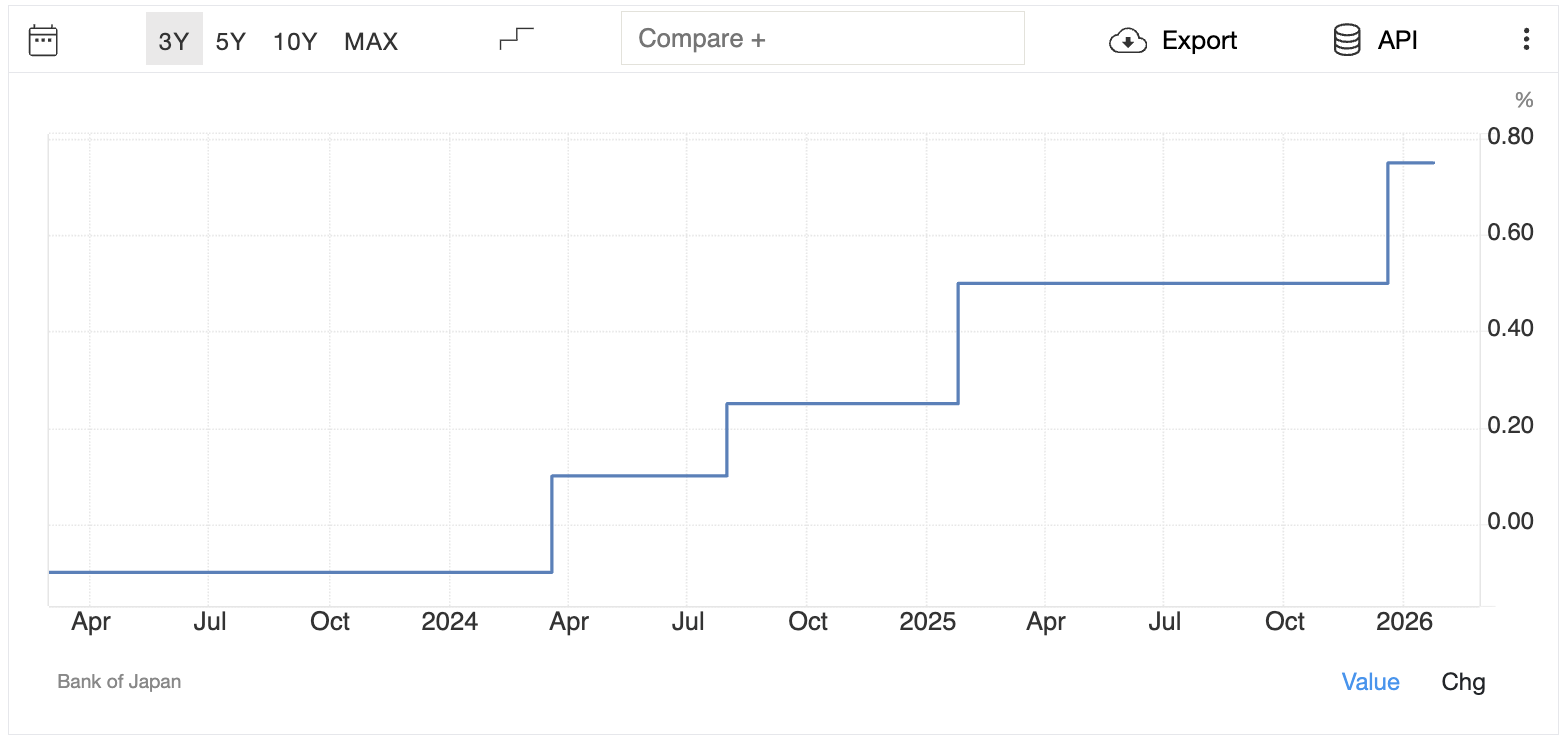
One simple arithmetic built the yen's long period of structural weakness: Japan's rate floor was near zero while the rest of the developed world lifted policy rates. That logic has weakened.
On January 23, 2026, the BOJ's policy statement kept the uncollateralized overnight call rate at around 0.75 percent, and the vote details showed an internal debate that still leans toward gradual normalization rather than a return to emergency-era settings.
More importantly, the BOJ's January 2026 Outlook material frames the next steps. It explicitly states that, if its outlook is realized, the BOJ will continue to raise the policy rate and adjust accommodation as economic activity and prices improve.
That is not a promise of aggressive tightening, but it is enough to change how currency markets price "future Japan."
Japan's political backdrop in February 2026 is important because fiscal decisions can affect Japanese yields more quickly than the BOJ can manage.
Following the election outcome, market reporting highlighted rising JGB yields and a stronger equity market, while the yen fluctuated and later strengthened amid debate over intervention risk and fiscal credibility.
A simple way to frame it is this: fiscal expansion can lift growth expectations and equities, but it can also lift yields and risk premia, which can either support or weaken the yen depending on whether higher yields attract capital or trigger risk aversion around debt sustainability.
A yen purchase tends to work when at least three conditions align: the yield spread narrows in Japan's favor, global risk sentiment deteriorates (or at least becomes more selective), and Japan's domestic inflation-wage cycle stays credible.
Buy-yen conditions tend to look like this:
The Bank of Japan stays on a tightening path or signals comfort with higher yields.
The U.S. rate path shifts lower, or long-end yields soften meaningfully. The U.S. 10-year yield is about 4.22% in early February, so there is room for duration moves to matter.
Japan's long-end yields stay elevated without triggering financial stress. Japan's 10-year yield is around 2.25% as of February 10, which is high by Japan's recent standards.
What You Should Watch:
If U.S. yields fall while Japan's yields stay firm, the market starts to pay you for holding yen again, because the "carry" advantage shrinks.
Sustained yen strength typically requires a convincing reason for the Bank of Japan to maintain a less accommodative stance.
Japan's CPI in 2025 rose 3.2% YoY, while CPI excluding fresh food rose 3.1%, reinforcing that inflation is not purely a temporary energy story.
In the Bank of Japan's January outlook, it noted that CPI inflation has been around 2.5% recently for CPI less fresh food, and it expects a deceleration below 2% in the first half of the year before inflation gradually firms again later in the projection period.
Checklist Interpretation:
If Japan's inflation data cools more quickly than anticipated, the yen could still strengthen during risk-off periods. Still, the long-term bullish case becomes more challenging as the Bank of Japan has less incentive to tighten monetary policy.
Japan's current account remains a vital indicator, as it reflects ongoing net gains from trade, services, and investment income.
Japan recorded a current account surplus of ¥7,288B in December 2025, according to Trading Economics.
Checklist Interpretation:
A healthy current account does not guarantee yen strength, but it makes it easier for the yen to stabilize when speculative selling exhausts.
Yen rallies often accelerate when the market is crowded short yen, and something forces a rapid unwind.
Data shows that leveraged funds remain net short on yen futures, although their short positions have been reduced recently. This matters because extreme positioning can amplify market moves when the narrative changes.
Checklist Interpretation:
If spec shorts are still heavy and the yen starts strengthening for fundamental reasons, the rally can extend further than most traders expect.
Japan's officials tend to care less about the exact level and more about the speed of moves.
For instance, Japan increased warnings about currency intervention as authorities aimed to counter undesirable declines in the yen, while the central bank indicated a potential near-term rate hike.
Checklist Interpretation:
If the market is leaning into fast yen weakness again, the odds rise that official pushback becomes part of the trade calculus, which can cap upside in USD/JPY and support the yen on sharp spikes.
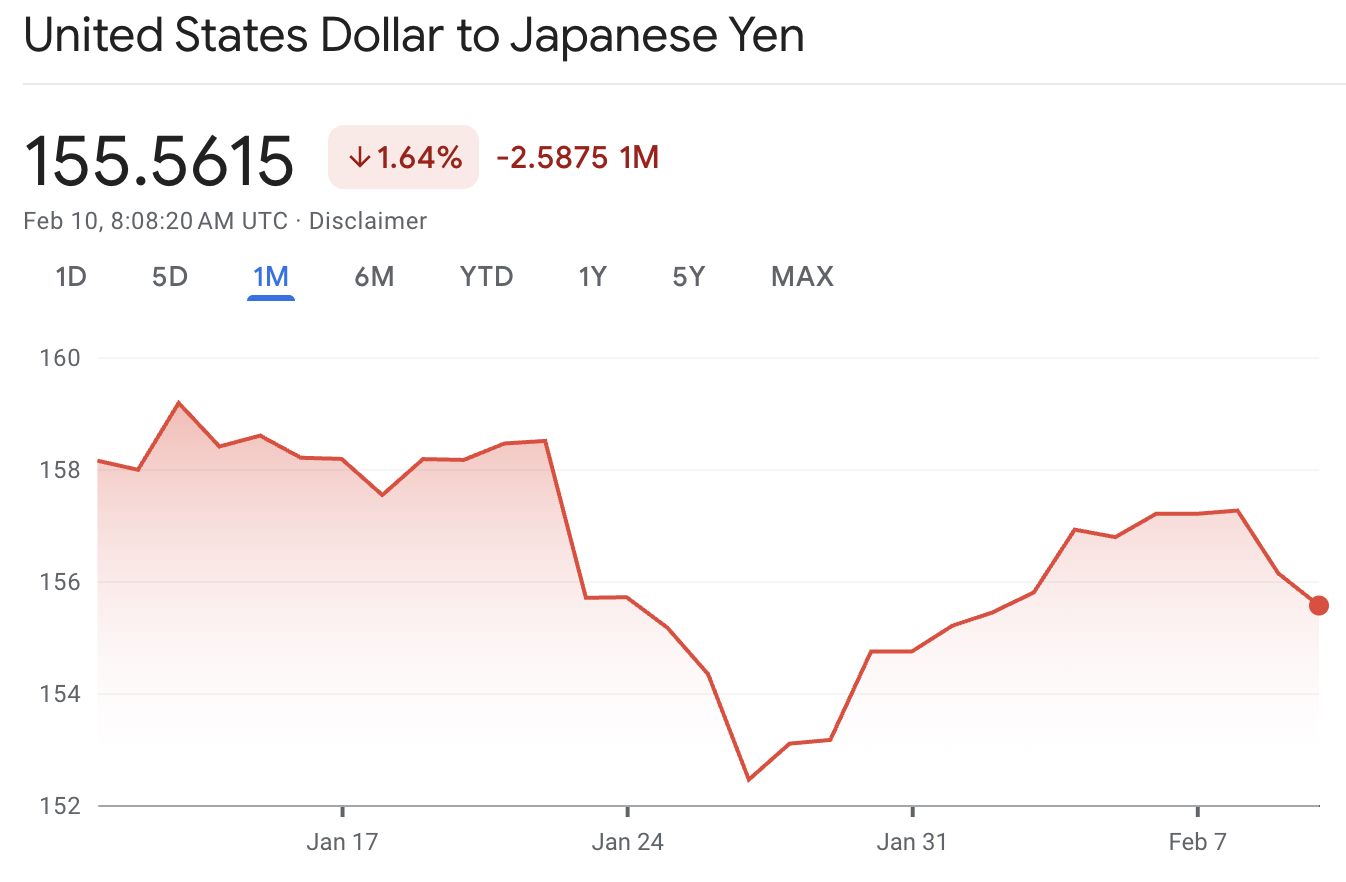
Buying yen is often expressed as selling USD/JPY, so price discipline matters. Early 2026 has already provided a clean reference range.
| Level | Source in early 2026 data | Why it matters |
|---|---|---|
| 159.17 (area) | January 13 high | A break above this zone typically signals yield-spread dominance and renewed carry appetite. |
| 156.22 (area) | February 10 spot | This is the market's "mid-range," where checklist signals matter more than momentum. |
| 152.46 (area) | January 27 low | A break below this zone increases the probability of a trend shift toward yen strength. |
| 2026 scenario | What changes first | Typical USD/JPY reaction | Yen buyer takeaway |
|---|---|---|---|
| "Fed eases faster" | US data softens and cuts are priced | USD/JPY drifts lower over weeks | This is the cleanest macro tailwind for a yen allocation. |
| "BOJ surprises hawkish" | BOJ signals faster normalization | USD/JPY falls sharply on the day | Event risk favors those already positioned with defined risk. |
| "Risk-off shock" | Equities sell off and volatility jumps | Yen strengthens quickly | This is when safe-haven behavior can overpower yield spreads. |
| "Japan fiscal premium" | JGB yields rise on funding concerns | Yen can weaken despite higher yields | Higher Japan yields are not always yen-positive if confidence deteriorates. |
The bond and political context that drove yield sensitivity has been visible in February 2026 market coverage and Japan yield prints.
A simple statement about inflation persistence or wage momentum can rapidly influence expectations regarding interest rates.
USD/JPY still behaves like a rate product during calm markets.
Equity drawdowns can trigger rapid carry unwinds that strengthen the yen, regardless of domestic economic data.
Faster depreciation tends to increase intervention chatter, which can flip intraday momentum.
If the market remains net short on yen, any catalyst could trigger a swift covering of positions.
Interest rate expectations remain the primary driver. The Bank of Japan's 0.75% interest rate, compared to the federal funds upper limit of around 3.75%, creates carry-trade incentives, making any changes in this gap often drive short-term price movements.
The yen can look undervalued when you focus on Japan's current account surplus and improving inflation dynamics, but valuation alone rarely turns the trend. The market usually needs a catalyst, such as a narrowing rate gap or a risk-off shock, to sustain yen strength.
Yes, a current-account surplus typically supports the currency during risk-off periods by facilitating repatriation and decreasing reliance on external funding.
The yen can weaken if yields rise for "bad reasons," such as fiscal uncertainty or market dysfunction, because investors demand a higher risk premium and may reduce exposure.
The BOJ expects CPI inflation to decelerate below 2 percent in the first half of 2026 and then rise later, while reiterating that it will continue raising rates if its outlook is realized.
In conclusion, now can be a good time to buy yen in 2026 when the decision is anchored to a checklist rather than a single forecast. However, timing matters more than it did when Japan was locked at zero.
The Bank of Japan's shift to a 0.75% policy setting gives the yen a policy backbone, while U.S. rates still provide enough carry to keep USD/JPY rebounds alive.
Thus, focus on whether the rate gap is narrowing, whether Japan's inflation and wage story stays credible, and whether global risk appetite is stable or cracking.
Disclaimer: This material is for general information purposes only and is not intended as (and should not be considered to be) financial, investment or other advice on which reliance should be placed. No opinion given in the material constitutes a recommendation by EBC or the author that any particular investment, security, transaction or investment strategy is suitable for any specific person.