Published on: 2026-04-23
Updated on: 2026-04-23
Japan remains one of the world’s largest external creditors, with ¥1,659 trillion in total external assets at end-2024 and a record net international investment position of ¥533.05 trillion.
Germany overtook Japan in the net-creditor ranking for the first time since 1991, but the shift says less about bond markets than about faster German external-asset growth, valuation support, and yen translation effects.
March 2026 flow data point to rotation, not retreat. Japan’s designated major investors sold ¥3.76 trillion of foreign long-term debt while buying ¥2.22 trillion of foreign equities and fund shares in the same month.
Hedging costs now sit at the center of the foreign-bond decision. On a simple carry basis, a yen-based investor may retain only around 0.55 to 0.80 percentage points of pickup from a fully hedged 10-year US Treasury before basis costs.
JGB yields are no longer dead weight. The 10-year JGB touched 2.49% on April 13, 2026, the highest level since 1997, making Japan’s domestic market a credible competitor for local savings for the first time in a generation.
The most exposed markets remain US Treasuries in size, French OATs in spread risk, and Australian government bonds in investor-base concentration.
Japan may have lost its 34-year run as the world’s top creditor nation to Germany, but the change in ranking is not the real issue for markets. Japan’s overseas balance sheet remains enormous.
What matters now is whether one of the world’s deepest pools of external savings is becoming a less automatic buyer of foreign duration.
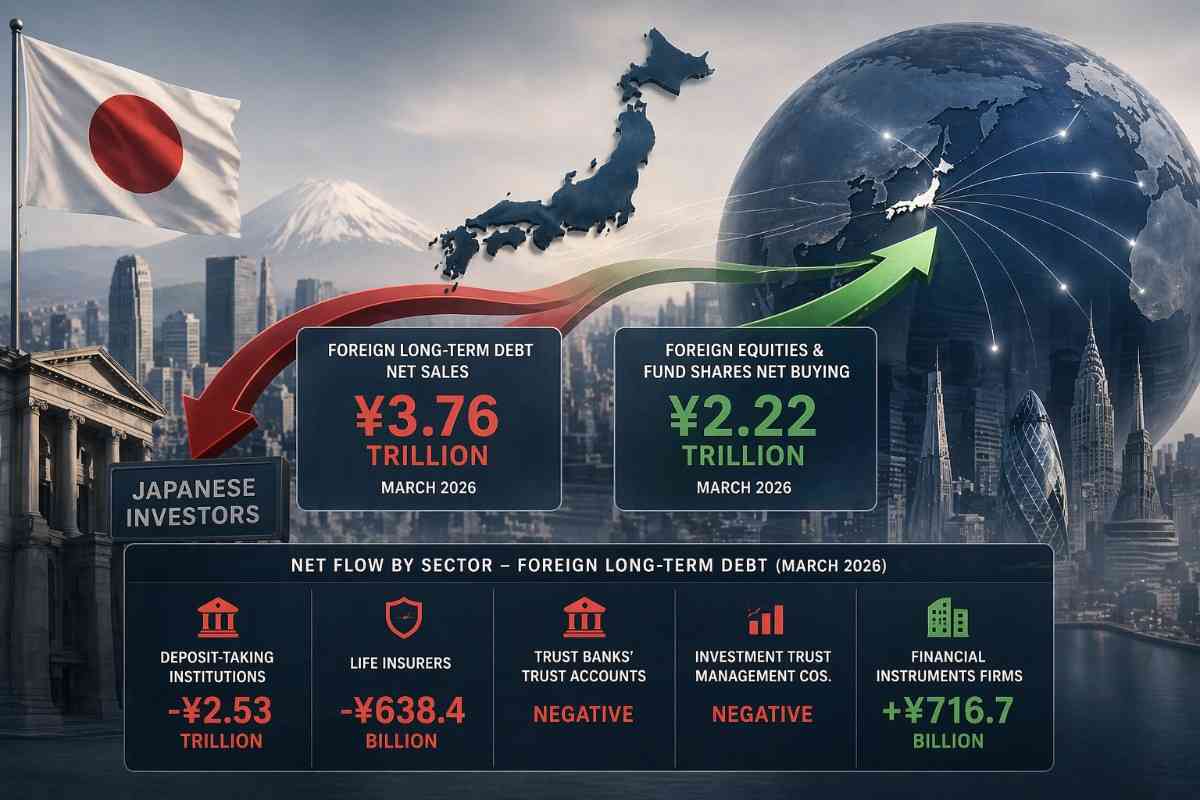 The flow data show that Japan’s overseas bond demand has softened even as outward capital flows continue.
In March 2026, Japan’s designated major investors were net sellers of ¥3.76 trillion in foreign long-term debt. In the same month, they bought ¥2.22 trillion of foreign equities and fund shares. Capital is still moving abroad. It is simply no longer flowing into foreign bonds with the same consistency.
The sector breakdown matters more than the headline. Deposit-taking institutions sold ¥2.53 trillion of foreign long-term debt in March. Life insurers sold ¥638.4 billion. Trust banks’ trust accounts and investment trust management companies were also net sellers. Only financial instruments firms were net buyers, adding ¥716.7 billion.
This is not a wholesale withdrawal from global fixed income. It is a repricing of Japan’s appetite for foreign bonds. Banks are responding fastest to balance-sheet economics. Insurers are reworking portfolios more selectively across hedge ratios, spread products, and domestic alternatives. The broad, dependable Japanese bid that once supported foreign sovereign markets no longer looks as unified as before.
That does not mean Japan is retreating from foreign assets altogether. GPIF remains strategically allocated to overseas bonds, and major insurers are rotating rather than disappearing. The change is in the reliability of the sovereign-bond bid, not in Japan’s relevance as a source of capital.
Hedging is now the decisive constraint on Japanese demand for foreign sovereign bonds.
Foreign yields still look attractive in nominal terms. They look far less attractive in yen. Japanese institutional investors typically hedge foreign bond positions using short-dated FX swaps that are rolled every 3 or 6 months. They own long-duration bonds but pay hedging costs tied to short-term rates. When US short-term rates remain far above Japan’s, that structure compresses the effective return on hedged foreign bonds.
That is exactly what has happened. With the Fed at 4.25 to 4.50% and the BOJ at 0.75%, a simple carry framework suggests that a fully hedged 10-year Treasury may leave a yen-based investor with only around 0.55 to 0.80 percentage points of annual pickup before cross-currency basis costs are applied.
The cross-currency basis worsens the arithmetic. USD/JPY has long exhibited some of the widest and most persistent deviations from covered interest parity. In practice, that means Japanese investors pay not only the short-rate differential but also a market-driven surcharge for hedging against the dollar.
This is why the foreign-bond calculus has changed so sharply. Japanese investors are not comparing Treasury yields with JGB yields in isolation. They are comparing the hedged return on a foreign bond with the return available at home. Once the hedged pickup disappears, foreign sovereign carry ceases to be the default trade.
That shift is also visible in insurer behavior. When hedging costs surged in 2022, life insurers unwound FX hedges on existing foreign securities rather than absorb sharply higher costs. The same logic still applies. If a hedged Treasury no longer offers a meaningful premium over domestic alternatives, the investment case has to rest on spread, currency, duration, or some combination of the three. Carry alone is no longer enough.
A different mix of conditions could restore demand. Lower hedge costs, a narrower US-Japan short-rate gap, or a wider spread advantage in overseas credit would make foreign bonds look more compelling again.
BOJ normalization is raising the hurdle rate for foreign bonds by making Japan’s domestic market investable again.
The 10-year JGB yield started fiscal 2024 around 0.7% and rose to roughly 1.49% by the end of March 2025. By April 2026, it briefly touched 2.49%, the highest level since 1997. Japan’s domestic bond market is no longer a dead asset class.
The BOJ’s bond-purchase reduction plan reinforces that shift. Monthly outright JGB purchases were roughly ¥2.9 trillion in early 2026 and are scheduled to fall to around ¥2.1 trillion by early 2027. The BOJ has also explicitly stated that, in principle, long-term interest rates should be determined in financial markets. That marks a clear break from the old regime of maximum curve suppression.
This is not a clean repatriation story. Rising domestic yields do not automatically pull capital home, because the transition also creates mark-to-market losses on existing JGB portfolios. Banks, in particular, have responded by shortening duration and reducing yen-bond holdings rather than extending them aggressively.
The better interpretation is recalibration. Domestic bonds no longer need to be ignored. Once that changes, foreign sovereign paper loses its advantage as the default outlet for Japanese savings.
Nippon Life’s portfolio stance captures the shift well. The insurer accelerated domestic bond replacement as rates rose, but still expects domestic bond holdings to decline in FY2025 as it disposes of legacy low-yield assets.
At the same time, it plans to add foreign sovereign bonds on an unhedged basis alongside corporate bonds and alternative assets. Japanese capital is still moving abroad, but it is no longer underwriting foreign sovereign duration by default.
If Japan becomes a less dependable exporter of bond demand, the impact will not be evenly distributed.
| Market | Japan’s Exposure | Primary Risk Channel |
|---|---|---|
| US Treasuries | $1.239 trillion | Rising term premium; fewer price-insensitive buyers at the margin |
| French OATs | ~€26 billion sold in 6 months to Nov. 2024 | Spread widening versus Bunds |
| Australian government bonds | ~A$80 billion cumulative net position | Investor-base concentration |
The US Treasury market remains the first-order channel. Japan’s $1.239 trillion Treasury position makes it the largest foreign holder in the market and a crucial part of the external demand base. A weaker Japanese bid would not leave a vacuum, but it would remove one of the most reliable external buyers of long-duration government paper at the margin. That matters most when supply is heavy or risk aversion rises.
France is exposed in a different way. Japanese investors sold roughly €26 billion of French debt in the six months to November 2024, and non-euro-area investors still hold relatively large shares of French government debt. That makes France more vulnerable to wider spreads than Germany, where Bunds continue to benefit from safe-asset status.
Australia’s exposure is more structural. Japan remains the single largest foreign investor in Australian fixed income by country, and Japanese holdings in Australian government bonds are large enough that any shift in allocation behavior has an outsized effect on the investor base.
Japan has not abandoned global bond markets. It still holds ¥337.4 trillion in foreign long-term debt securities and remains one of the world’s largest external creditors, even though Germany has overtaken it in the net-creditor ranking. Its investors are still active across every major fixed-income market.
What has changed is the character of that demand. For two decades, Japanese institutions operated in a world where domestic yields were suppressed and overseas bonds, even after hedging costs, still offered usable carry. That regime produced an automatic and predictable Japanese bid for foreign duration.
That regime has ended. With the BOJ at 0.75%, JGB yields back at levels not seen since the late 1990s, and hedged Treasury returns compressed toward negligible pickup, the economics of the old trade no longer hold. Foreign bonds now need a deliberate investment case built on spread, currency, duration, or some combination of the three.
Japan is not leaving global bond markets. It is leaving behind the role of an automatic, price-insensitive buyer of foreign sovereign duration.



World's Best Broker