Published on: 2026-01-21
Updated on: 2026-01-21
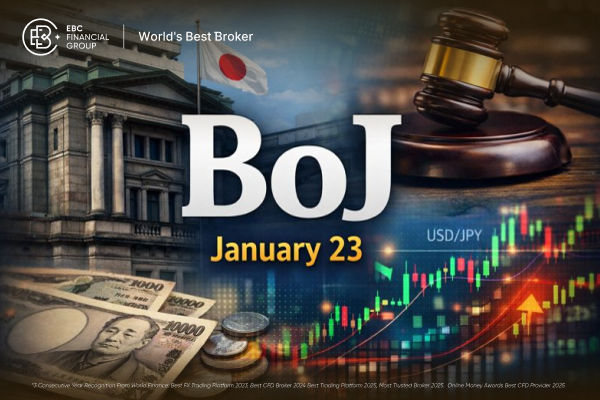
Friday's BoJ decision lands at a tense moment for the yen. The BoJ's next Monetary Policy Meeting is January 22–23, 2026, and the policy announcement is expected at the end of that meeting.

The BoJ raised rates only last month and has guided the overnight policy rate to around 0.75%, already a massive shift for Japan. Yet the yen has still struggled. Last week, USD/JPY reached 159.45 before bouncing back to approximately 158.18 on Tuesday.
At the same time, Japanese government bond yields have surged, with long-dated bonds hitting record territory in recent days. Additionally, politics is adding pressure after Prime Minister Sanae Takaichi called a snap election for February 8, 2026, and markets are debating what her fiscal plans could mean for Japan's debt path and risk premium.
That mix raises the probability of a sharp, asymmetric reaction if the BoJ delivers a genuinely hawkish hold, forcing markets to reprice the timing and terminal level of the hiking cycle.
The BoJ decision on January 23 is heavily priced for a hold, so the yen needs guidance that accelerates the expected path of hikes to strengthen sustainably.
Inflation and wage dynamics remain consistent with a slow normalization cycle, with the BoJ's own wage intelligence pointing to broadly similar wage gains in fiscal 2026 as in fiscal 2025.
A renewed build in speculative yen shorts increases the risk of a squeeze if the BoJ signals less tolerance for yen weakness or a higher policy path.

A "hawkish hold" refers to the central bank maintaining interest rates, signaling a higher likelihood of a near-term rate hike.
In Japan, that signal usually shows up in three places:
The wording on inflation and wages (whether price gains look "durable" rather than "cost-push").
The tone of the outlook report (whether inflation and growth forecasts are revised higher).
The reaction function (what conditions would trigger the next hike, and how soon the BoJ thinks those conditions can be met)
Despite the BoJ raising rates to 0.75%, the yen weakened, indicating that the market's primary concern is not "Did the BoJ hike?" but "Will it continue to hike?"
The yen also trades on a global "rate gap" story. If U.S. yields rise simultaneously, the incentive to borrow yen and invest in higher-yielding assets can remain strong. For instance, the global bond sell-off has elevated U.S. yields, which, along with Japan's actions, may limit support for the yen.
| Variable | Latest reference | Why traders care |
|---|---|---|
| BoJ policy guideline | ~0.75% | Sets the floor for Japan rate expectations. |
| Overnight call rate (avg) | ~0.728% (Jan 20) | Confirms money-market conditions are aligned with guidance. |
| 10-year JGB yield | ~2.34% (Jan 20) | Higher yields can help the yen, unless fiscal fear dominates. |
| 40-year JGB yield | ~4.215% | Signals term-premium stress and market discomfort. |
| Wage settlements (Shunto 2025) | +5.25% (avg) | Supports the case for further BoJ tightening over time. |
| USD/JPY range (early Jan 2026) | ~156.63 to ~159.17 | Defines the near-term battleground and intervention anxiety. |
As mentioned above, USD/JPY briefly hit 159.45 last week, the weakest level since Japan's previous intervention episode in July 2024.
Independent spot-history trackers also show USD/JPY reached roughly 159.17 on January 13, 2026, after starting the year closer to the mid-156s.
Long-dated yields jumped to record highs. For context, the 40-year JGB yield rose to about 4.215%, a striking level for Japan.
TradingEconomics data indicates that the 10-year JGB yield has been fluctuating within the low-to-mid 2% range, reaching approximately 2.34% on January 20, 2026.
Investors are concerned that an election could spur fiscal expansion, further eroding debt sustainability and pushing yields higher.
If the BoJ acknowledges higher yields as a "healthy" price signal, markets may interpret that as tolerance for tighter financial conditions. That stance is often yen-positive, because it reduces the odds of policy backtracking.
If the BoJ emphasises stability and hints at concern over market functioning, traders may price a slower hiking path, and the yen may soften.
Policymakers are considering whether the weakness of the yen is contributing to the risk of inflation.
A central bank rarely targets the exchange rate, but it can signal that currency weakness is becoming part of the inflation outlook. That is a hawkish tell.
Some policymakers believe there is potential for an earlier rate increase than what markets anticipate.
Elsewhere, a market survey indicated that numerous analysts are anticipating the next adjustment in July, with a significant portion forecasting a rate of 1% or more by September.
Any hint that "April is live" can move USD/JPY quickly, because it changes the front-end rate path.
When USD/JPY sits near the high-150s, traders start talking about the Ministry of Finance again. Market participants often regard the 158–160 zone as a potential area for intervention.
That risk can create sharp intraday reversals even without policy changes.
| Scenario | What it looks like in the statement | Market pricing and probability signal | Likely yen reaction |
|---|---|---|---|
| Hawkish Hold | Clear bias toward further hikes, stronger confidence on wage pass-through. | A hold is priced, but timing can reprice quickly. | Yen strengthens, especially if shorts cover and yields shift higher at the front end. |
|
Dowish Hold |
Data-dependent language, limited emphasis on the next hike. | Consistent with current pricing. | Yen response fades, and USD/JPY reverts to yield-differential support. |
| Surprise hike | Rate increase despite low market-implied odds. | Market-implied probability is very low. | Yen spikes stronger, but follow-through depends on the projected hiking pace and fiscal backdrop. |
A hawkish hold can lift the yen, but the lift requires a specific pattern. The BoJ must sound more confident on the wage-price mechanism, indicate that further hikes remain active rather than optional, and avoid language that treats yen weakness as a tolerable side effect of easing financial conditions.
| Level zone | Why it matters |
|---|---|
| ¥160 | A psychologically important level that has been discussed as a stress point for the market. |
| ¥159 to ¥159.2 | Recent highs in early January that define near-term resistance. |
| ¥156.6 to ¥157 | Recent lows and pivot area that can flip to resistance if the yen strengthens. |
| ¥155 | A round-number magnet that can become the first downside target on a hawkish repricing shock. |
Price action suggests that the market remains attracted to the ¥160 area, while the early January range provides nearby reference points that can accelerate moves once broken.
A hawkish hold that forces repricing can pull USD/JPY toward the mid-¥150s, while a neutral hold can keep the pair grinding back toward the top of the range.
Japan's Statistics Bureau release schedule indicates that the Tokyo CPI (preliminary) for December 2025 is scheduled for January 23, 2026, while the nationwide CPI for the same month will be released on January 30, 2026.
That means the BoJ decision and fresh inflation signals can collide on the same day.
The Federal Reserve's calendar indicates that the next FOMC meeting is scheduled for January 27–28.
If the Fed leans hawkish, USD/JPY can rebound even after a hawkish BoJ hold, because yield differentials can widen again.
With an election scheduled for February 8, markets may stay sensitive to fiscal headlines, especially if new spending plans or tax proposals gain traction.
The BoJ policy decision is scheduled for Friday, January 23, 2026, after a two-day meeting that runs from Thursday, January 22, to Friday, January 23. The policy statement was released on January 23.
0.75%. The Bank of Japan set that level on December 19, 2025, and it took effect on December 22, 2025.
Volatility remains relatively subdued, with an implied volatility index near recent lows, even as event risk rises.
Watch whether the BoJ frames yen weakness as an inflation risk.
In conclusion, the most likely outcome is a rate hold at Friday's meeting, because the BoJ just hiked to 0.75% and now faces bond-market turbulence and election noise.
A hawkish hold can lift the yen on Friday, but the yen needs more than a predictable pause. It requires the BoJ to pull forward the market's expected hiking path, and it needs that repricing to be large enough to overwhelm carry incentives that are still supported by the US-Japan yield gap.
For positioning, the cleanest approach is to treat Friday as a volatility event, with defined levels and a clear plan for both directions.
Disclaimer: This material is for general information purposes only and is not intended as (and should not be considered to be) financial, investment or other advice on which reliance should be placed. No opinion given in the material constitutes a recommendation by EBC or the author that any particular investment, security, transaction or investment strategy is suitable for any specific person.