Published on: 2026-05-25
Updated on: 2026-05-25
Apple has not announced a new stock split.
AAPL near $350 would strengthen the 3-for-1 case, as the post-split price would sit near $117.
AAPL near $400 would revive 2020-style 4-for-1 comparisons, but Apple’s current share authorization does not support that ratio at the latest share count.
The strongest confirmation would be an SEC filing that names a split ratio, sets a record date or increases authorized shares.

The next Apple stock split is not a date prediction. It is a test of whether AAPL’s price rises far enough to justify a reset, and whether Apple’s share authorization creates room for the ratio traders remember from 2020.
The 2026 watchlist is narrow: $350, $400 and an SEC filing change. Price raises the question, but Apple’s filings decide which split ratio is realistic.
| Signal | What It Means for AAPL |
|---|---|
| AAPL near $350 | Strengthens the 3-for-1 case because the post-split price would sit near $117 |
| AAPL near $400 | Revives 2020-style 4-for-1 comparisons, but the current share authorization becomes the test |
| SEC filing change | Gives the clearest confirmation if Apple raises authorized shares or names a split ratio |
As of May, AAPL trades at around $308.82, below the first major watch zone. Around $350, the 3-for-1 case becomes easier to defend. Around $400, the question shifts from price to whether Apple has enough authorised-share room for a larger split.
AAPL near $350 would make a 3-for-1 split the most practical reset. That ratio would put the stock near $116.67, low enough to change the quoted price while staying within Apple’s current share authorization.
Apple’s latest 10-Q shows 14.687 billion shares outstanding and 50.4 billion authorized shares. A 3-for-1 split would create about 44.06 billion shares, leaving roughly 6.34 billion shares of room.
At $300, the split debate is mostly speculation. At $350, the price and filing math begin to align.
AAPL near $400 would revive the 2020-style 4-for-1 argument, but Apple’s current share authorization does not cleanly support that ratio. A 4-for-1 split at $400 would reset the stock near $100, which is why the comparison would attract attention.
The filing math is the constraint. At the latest share count, a 4-for-1 split would create about 58.75 billion shares. Apple’s current authorization is 50.4 billion shares, leaving a gap of roughly 8.35 billion shares.
That does not rule out a 4-for-1 split. It means Apple would likely need either a lower share count after more buybacks or a filing that increases authorized-share capacity.
If AAPL reaches $400 and filings stay unchanged, the market may be expecting a 2020 repeat that Apple’s current share structure does not yet support. If Apple files to raise authorized shares, the larger-split case changes immediately.
The filing section is where the split debate becomes measurable. Apple currently has room for a 2-for-1 or 3-for-1 split under its existing authorization. A 4-for-1 split would require more room at the latest share count.
| Possible Apple Stock Split | Implied AAPL Price at $308.82 | Implied Share Count | Fit Under 50.4 Billion Authorized Shares |
|---|---|---|---|
| 2-for-1 | $154.41 | 29.37 billion | Yes |
| 3-for-1 | $102.94 | 44.06 billion | Yes |
| 4-for-1 | $77.21 | 58.75 billion | No, based on the latest share count |
The filing signal to watch is either a formal split announcement or an authorized-share increase. A formal split filing would likely name the ratio, record date and split-adjusted trading date. An authorized-share increase would give Apple more room to support a larger split ratio.
A 2-for-1 split would leave AAPL above $150, which weakens the access case. A 3-for-1 split would reset the stock near $103 and stay within current authorization. A 4-for-1 split would create the sharper headline, but it likely needs buybacks to reduce the share count or a filing that expands Apple’s authorized shares.
Apple’s buybacks can make a larger split easier by reducing the number of shares Apple has to divide. A lower share count creates more room under the same 50.4 billion authorized-share limit.
Apple ended the March quarter with $63.8 billion remaining under its repurchase authorization. On April 30, 2026, the board authorized another $100 billion in buybacks and raised the quarterly dividend to $0.27 per share.
The gap remains large. For a 4-for-1 split to fit under 50.4 billion authorized shares, Apple would need pre-split shares of 12.6 billion or less. The latest count is 14.687 billion.
Buybacks can narrow that gap over time, but they do not create an immediate 4-for-1 setup. Without an authorized-share increase, the 3-for-1 route remains the cleaner structure.
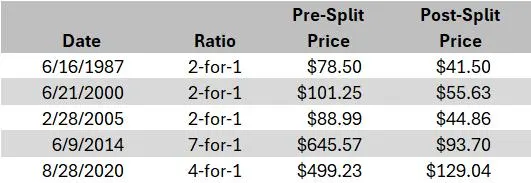
Image Credit: Forbes
Apple’s split history does not point to a calendar date. It points to a pattern: strong value creation, a high quoted share price and a structure the board can execute cleanly.
The pattern is more useful than the timeline. Apple’s 7-for-1 split in 2014 followed a move above $600 and reset AAPL to the low-$90s. The 4-for-1 split in 2020 took effect after the stock traded around $500, resetting it near $125. Both large splits moved AAPL back below $150, which is why today’s $350-to-$400 zones matter more than the calendar.
The current setup has part of that pattern. Apple’s fiscal second-quarter revenue reached $111.2 billion, up 17% year over year, while diluted EPS rose 22% to $2.01. The missing piece is not business performance. It is whether Apple wants a split ratio that fits today’s share authorization or a larger one that needs more room.
A stock split would not make Apple cheaper on earnings, sales or cash flow. It would lower the quoted share price and increase the share count by the same ratio.
A holder with one AAPL share near $300 would hold three shares near $100 after a 3-for-1 split, before market movement. The ownership stake would stay the same.
The market effect comes from behavior. A lower quoted price can broaden participation among accounts that prefer smaller ticket sizes, make options exposure easier to size, increase headline momentum, and place AAPL back on price-based watchlists.
That is why a split can affect demand without changing Apple’s business value. The announcement may shift trading psychology; earnings, cash flow, and the buyback path still determine whether the move lasts.
The first clue would likely appear in a proxy statement, an 8-K, an earnings release, or a board-approved filing. A proxy change would matter most if Apple asks for more authorized shares, because that would make a larger split ratio easier to execute.
Yes, but it is less clean than a 3-for-1 split at the latest share count. A 4-for-1 split would likely need Apple to reduce shares further through buybacks or increase its authorized-share capacity first.
AAPL would likely need to move closer to $400, while Apple would need either a much lower share count or more authorized-share capacity. Under the current authorization, a 4-for-1 split would fit only if shares outstanding fell to 12.6 billion or less; otherwise, Apple would likely need to file for more authorized shares.
Apple’s next stock split signal may come from the proxy before it comes from the chart. If AAPL pushes toward $400 while buybacks keep reducing the share count, the question is no longer whether split speculation returns.
It is whether Apple chooses the 3-for-1 route that already fits, or quietly creates room for a bigger reset. An authorized-share increase in a proxy filing, not a split announcement, would be the earlier tell.