Published on: 2025-12-22
Updated on: 2025-12-22
The dollar is not "finished" in 2026, but it is more vulnerable than it was in the hiking cycle. For context, the US dollar approaches 2026 with two opposing forces tugging vigorously in different directions.
On one side, the Fed has started cutting rates, and markets are actively debating how many more cuts could follow. Additionally, the weaker dollar is showing up in gold prices.
On the other hand, the dollar remains the world's primary trading currency and reserve anchor, and that structural demand rarely fades quickly. IMF reserve data puts the dollar at about 56.92% of global FX reserves in 2025Q3, while BIS data shows the dollar on one side of roughly 89.2% of global FX trades in April 2025.
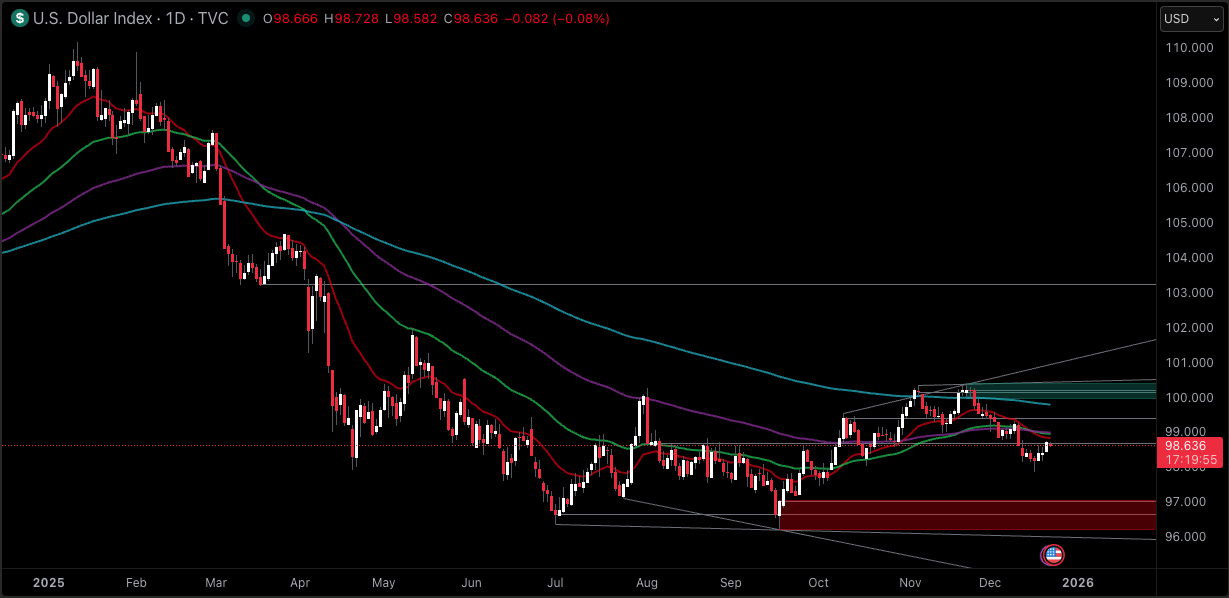
A simple benchmark is the US Dollar Index (DXY), which tracks the dollar against six major currencies and is heavily influenced by EUR/USD because the euro accounts for 57.6% of the basket.
As of December 22, 2025, DXY stands at roughly 98.6, well below its 52-week high of 110.2 and only marginally above its 52-week low of about 96.2.
That tells you two things straight away:
The dollar has already experienced much of the decline that concerns many.
Currently, the market is not treating the dollar as a one-way bet. It is range-like and reactive to data.
A weaker dollar is not the same as a dollar in trouble. For 2026, "trouble" would manifest as ongoing weakness that reinforces itself, rather than a typical cyclical downturn.
| Signal | What it would look like | Why it matters |
|---|---|---|
| Fed cuts accelerate | Markets price a faster drop from today’s 3.50%–3.75% range | Faster cuts usually compress yield support for the dollar |
| US yields fall while inflation holds | Real yields fade, not just nominal yields | The dollar often follows real rate advantage |
| Fiscal risk premium rises | Long-end yields stay sticky even as growth slows | A "bad" mix for the dollar: weak growth, high borrowing needs |
| Reserve demand slips materially | Dollar share in reserves falls faster than trend | A structural hit, not a trading move |
| DXY breaks support and fails rallies | Clear lower lows and failed rebounds | That is when trend funds start leaning short |
If most of these show up together, the dollar is not just soft. It is losing its usual supporters.
The dollar's strongest fuel is yield. When US yields decline slightly compared to Europe, the UK, or even Japan, the USD forfeits a portion of its carry benefit.
Markets are already pricing additional US cuts into 2026, and have linked dollar softness and gold strength to rate-cut expectations.
If that expectation firms, the dollar's "easy support" becomes harder to defend.
New York Fed President John Williams said inflation is expected to moderate in 2026 and outlined an outlook that includes 2.25% growth in 2026 with inflation easing further.
A "soft landing" can still mean a weaker dollar if it comes with steady easing and less need for safe-haven USD demand.
The US fiscal picture is a recurring 2026 headline risk because it affects term premium, Treasury issuance, and the political debate around debt sustainability.
The fiscal data from the US Treasury indicate that the deficit results from a disparity between expenditures and income.
The CBO's long-run outlook highlights large projected deficits in the coming years.
Fiscal stress doesn't necessarily trigger a dollar collapse, but it can increase volatility and slightly diminish the USD's appeal, especially if yields are falling simultaneously.
Reserve managers are diversifying at the edges, and the topic drives sentiment, even when the data is not dramatic.
That said, the IMF's COFER release shows the dollar share is 56.92% in 2025Q3, down only slightly from 2025Q2. That is not a collapse.
The structural story is gradual, but headlines can still pressure the dollar when the market is already leaning bearish.
If the dollar is coming off a multi-year strength cycle, a normal valuation mean reversion can extend weakness even without a crisis.
As mentioned above, the BIS triennial survey for April 2025 shows the US dollar was on one side of 89.2% of all FX trades. That level of dominance is a powerful form of demand.
When international investors require quick liquidity, the dollar remains the simplest bridge currency.
IMF COFER statistics show that the dollar remains the leading reserve currency in Q3 2025, comprising 56.92%, whereas the euro stands at around 20.33%.
This isn't the dollar "losing its reserve status"; it's the dollar staying on top as global reserves diversify gradually.
When equities drop hard or geopolitics flare, USD demand often returns, even if rates are falling. A weaker dollar narrative can reverse sharply in a true risk-off event.
The Fed cut rates in December 2025 to a target range of 3.50%–3.75%. That puts 2026 in a different regime from the last two years. The question is whether the Fed will continue cutting or pause.
The Fed's December 2025 Summary of Economic Projections implies a higher-for-longer bias compared with earlier easing cycles. Based on the distribution of dots for end-2026, the median sits at 3.375%
Watch the gap between:
What are the market prices for 2026 cuts
What Fed speakers signal
Even with Fed cuts, US yields remain high in absolute terms. The US 10-year Treasury yield is around 4.17% heading into year-end.
If 10-year yields drift lower in 2026 while inflation stays controlled, the dollar can soften in an orderly way.
If yields rise because the market demands a bigger premium to hold US debt, that can create two very different outcomes:
Short-term dollar support (higher yields pull in flows)
Longer-term dollar risk (if the rise reflects fiscal stress and confidence erosion)
That second path is what people mean when they say "the dollar is in trouble.
The US fiscal outlook is a slow-burning issue, but it becomes more significant when the Fed lowers rates and external demand is sensitive to prices. The CBO's 2025–2035 outlook projects large deficits and a rising debt path through the next decade.
You do not need a crisis for this to move FX. You only need:
persistent heavy issuance, and markets demanding slightly more yield to absorb it.
If that pushes US yields higher for the wrong reasons, the dollar can become a more volatile currency in 2026, not just a strong one.
The dollar still behaves like the world's shock absorber. When risk breaks, global investors reach for the USD's liquidity first. That is why the dollar can rally even when US fundamentals look messy.
So a key 2026 watchpoint is not just US data. It is global stress:
geopolitical flare-ups
emerging market funding strain
banking or credit accidents.
If those rise, the dollar can stay firm even in a US slowdown.
Many headlines suggest that the dollar will be replaced imminently. The data does not support that.
The IMF's COFER release for Q3 2025 shows the dollar share of disclosed global reserves at 56.92%, slightly below the 57.08% in Q2.
The IMF's own commentary also notes the share is "little changed" after adjusting for exchange rates.
That is not a collapse. It is a gradual drift. In short, it means:
The dollar can weaken over the years as portfolios diversify.
It is unlikely to "break" in a single year without a policy shock.
| Category | Indicator | Value | Signal |
|---|---|---|---|
| Oscillator | Relative Strength Index (14) | 43.915 | Neutral |
| Oscillator | Stochastic %K (14, 3, 3) | 45.254 | Neutral |
| Oscillator | Commodity Channel Index (20) | −44.325 | Neutral |
| Oscillator | Average Directional Index (14) | 24.672 | Neutral |
| Oscillator | Awesome Oscillator | −0.846 | Neutral |
| Oscillator | Momentum (10) | −0.457 | Sell |
| Oscillator | MACD Level (12, 26) | −0.245 | Sell |
| Oscillator | Stochastic RSI Fast (3, 3, 14, 14) | 65.244 | Neutral |
| Oscillator | Williams Percent Range (14) | −46.570 | Neutral |
| Oscillator | Bull Bear Power | −0.062 | Sell |
| Oscillator | Ultimate Oscillator (7, 14, 28) | 54.528 | Neutral |
| Moving Average | Exponential Moving Average (10) | 98.615 | Buy |
| Moving Average | Simple Moving Average (10) | 98.524 | Buy |
| Moving Average | Exponential Moving Average (20) | 98.831 | Sell |
| Moving Average | Simple Moving Average (20) | 98.917 | Sell |
| Moving Average | Exponential Moving Average (30) | 98.936 | Sell |
| Moving Average | Simple Moving Average (30) | 99.187 | Sell |
| Moving Average | Exponential Moving Average (50) | 98.950 | Sell |
| Moving Average | Simple Moving Average (50) | 99.190 | Sell |
| Moving Average | Exponential Moving Average (100) | 98.991 | Sell |
| Moving Average | Simple Moving Average (100) | 98.600 | Buy |
| Moving Average | Exponential Moving Average (200) | 99.791 | Sell |
| Moving Average | Simple Moving Average (200) | 99.187 | Sell |
| Moving Average | Ichimoku Base Line (9, 26, 52, 26) | 99.132 | Neutral |
These levels are simple, but traders use them because they align with recent ranges and round-number behaviour.
Support zone: 96.2–97.0 (52-week low area)
Pivot area: 98.5–100.0 (current price region and psychological handle)
Resistance zone: 102–103, then 105 (range recovery levels)
Major ceiling: 110 (52-week high)
If DXY breaks below 96 and cannot reclaim it, that is when "trouble" becomes a serious conversation.
Additionally, because DXY is euro-heavy, you can often explain 80% of the move by watching these two pairs:
If European growth stabilises while the Fed trims rates, EUR/USD tends to grind higher, pulling DXY lower. Since the EUR comprises 57.6% of the DXY, it remains the biggest influence.
USD/JPY is where rate differences appear live. Japan is now hiking again, but has also shown how a "cautious" BoJ message can still leave the yen weak. If US yields stay high, USD/JPY can remain elevated, which limits broad dollar downside even if EUR/USD rises.
It is possible, particularly if the Fed continues to make cuts and worldwide growth stabilises.
Not in any fast, dramatic way. Currently, it is a gradual diversification, not a collapse.
Gold often rises when real yields fall, and the dollar weakens.
A sustained break below the 96–97 zone, because that is the 52-week low area. If rallies fail after that, it signals a shift from range to trend.
In conclusion, the US dollar is not "in trouble" by default in 2026. The data still shows deep structural support: the Fed is not racing to zero, US yields remain high, and the dollar still dominates reserve holdings even as diversification continues slowly.
The risk for 2026 is a more specific one: a weaker dollar that becomes a trend if the Fed cuts faster than expected, while fiscal pressure and policy uncertainty push investors to demand a higher risk premium.
Disclaimer: This material is for general information purposes only and is not intended as (and should not be considered to be) financial, investment or other advice on which reliance should be placed. No opinion given in the material constitutes a recommendation by EBC or the author that any particular investment, security, transaction or investment strategy is suitable for any specific person.