Published on: 2025-12-04
Updated on: 2026-05-21
The Fed meets again on 16–17 June 2026. The bigger risk is a hold that weakens late-2026 rate-cut expectations.
A hawkish hold would reprice markets through yields first. Higher 2026 rate projections would support the US Dollar and pressure gold, equities and rate-sensitive assets.
April inflation raised the bar for a June cut. CPI rose 3.8% YoY, with firm services prices limiting the Fed’s room to sound dovish.
Jobs data gives the Fed room to wait. April payrolls rose 115,000, and unemployment held at 4.3%, soft but not recessionary.
The dot plot is the June catalyst. Stable rate projections preserve the delayed-cut trade; higher dots would tighten financial conditions without a hike.
A Fed hold in June could still trade like tightening if policymakers signal that rate cuts are no longer the default path for 2026. The market risk is not an unchanged rate decision. It is a higher projected rate path that lifts front-end yields, strengthens the US Dollar, pressures gold and removes part of the valuation support behind risk assets.
The most market-moving outcome may be a hold that sounds less willing to cut. That would let the Fed tighten financial conditions through guidance rather than a rate hike.
Stocks: Growth stocks, homebuilders and REITs get relief as discount-rate pressure eases.
US Dollar: Loses policy support if rate spreads stop widening.
Gold: Benefits if real-rate pressure falls.
Signal to watch: Two-year Treasury yields soften after the statement.
Stocks: Technology, small caps and rate-sensitive shares lag as valuation pressure rises.
US Dollar: Strengthens as US rates stay higher for longer.
Gold: Faces pressure from higher yields and a firmer Dollar.
Signal to watch: Two-year Treasury yields rise before equities fully react.
Stocks: Defensive sectors outperform high-beta shares as investors reduce rate-sensitive exposure.
US Dollar: Gains from a less dovish Fed signal.
Gold: Turns choppy as inflation-hedge demand competes with yield pressure.
Signal to watch: Financial conditions tighten without an actual rate hike.
A surprise cut after cooler inflation would support risk assets and gold while weakening the Dollar.
A surprise cut after weak jobs would carry a different message: lower rates would start to look like damage control, not relief.
The weakest setup is a hawkish hold paired with softer jobs. That combination removes rate-cut support while raising questions about earnings, credit quality and consumer demand.
A Fed hold can move markets when it changes what traders expect the Fed to do next.
The April FOMC statement kept the target range at 3.50%–3.75% and retained language on the “extent and timing of additional adjustments.” That wording preserved room for later cuts. If June weakens that signal, the Fed can tighten financial conditions through guidance before changing the policy rate.
The risk is that traders read “hold” as policy stability while the Fed uses the dot plot to reduce cut expectations. A higher 2026 rate path would make the headline look calm and the market reaction more restrictive.
The transmission is direct: two-year yields reprice the expected Fed path, the US Dollar follows rate differentials, gold reacts to real yields, and equities adjust through discount rates and sector rotation.
The headline may say the Fed held rates. The trade may say fewer cuts.
Inflation is the main obstacle to a softer June message.
April CPI rose 0.6% MoM and 3.8% YoY. Energy drove part of the acceleration, with the energy index up 17.9% over 12 months, but core CPI also rose 2.8% YoY after 2.6% in March.
The Fed can look through volatile fuel prices more easily than persistent services inflation. If May CPI cools in core services, the delayed-cut path survives. If services stay firm, the June statement has less room to sound patient.
The labour market is soft enough to keep cuts alive, but not weak enough to force June action.
April payrolls rose 115,000, while unemployment held at 4.3%. Hiring came from health care, transportation and warehousing, and retail, while federal government employment continued to decline.
A mild slowdown supports later cut expectations without signalling recession pressure. A sharper payroll drop before June would change the trade: yields could fall, but equities would have to decide whether lower rates reflect policy relief or economic damage.
Growth is firm enough for the Fed to delay easing unless inflation cools quickly.
Real GDP rose at a 2.0% annualised rate in Q1 2026, up from 0.5% in Q4 2025. Q1 PCE inflation rose 4.5% annualised, while core PCE inflation rose 4.3% annualised.
That mix supports a longer pause. Growth is still positive, inflation is uncomfortable, and the Fed does not need to rescue demand unless the next jobs report weakens sharply.
The dot plot can make a Fed hold trade like a policy shift.
The March projections put the median 2026 federal funds rate at 3.4%, below the current 3.50%–3.75% target range. That gave markets room to price late-year cuts even while the Fed held rates steady.
If the 2026 dot stays near 3.4%, markets can treat cuts as delayed rather than cancelled. That would limit upside in short-term yields, cap some US Dollar strength and support gold if real-rate pressure eases.
If the median dot moves higher, the message changes. The Fed would be signalling that inflation has reduced the room for policy relief. Two-year yields would likely reprice first, followed by the US Dollar, gold, equities and credit-sensitive sectors.
The latest minutes already leaned in that direction. The options-implied path shifted higher, consistent with no rate change this year rather than the previous one-cut expectation, while the distribution of early-2027 outcomes moved toward higher rates.
| FOMC Meeting | Decision Date | SEP and Dot Plot |
|---|---|---|
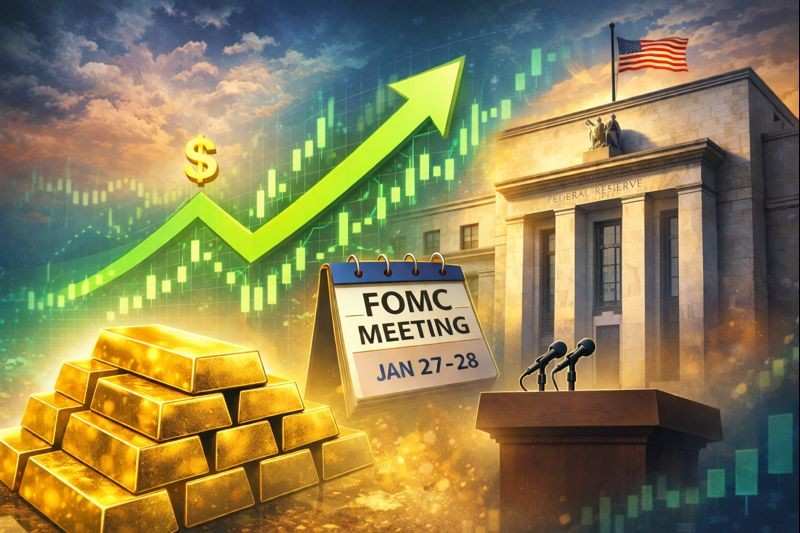
| January | 27–28 January 2026 | No |
| March | 17–18 March 2026 | Yes |
| April | 28–29 April 2026 | No |
| June | 16–17 June 2026 | Yes |
| July | 28–29 July 2026 | No |
| September | 15–16 September 2026 | Yes |
| October | 27–28 October 2026 | No |
| December | 8–9 December 2026 | Yes |
The June statement is scheduled for 2:00 p.m. ET on 17 June, followed by the press conference at 2:30 p.m. ET. June, September and December include updated projections.
The Fed meets on 16–17 June 2026. The policy statement is due at 2:00 p.m. ET on 17 June, followed by the press conference at 2:30 p.m. ET. June also includes updated economic projections and a new dot plot.
A hold supports markets only if the Fed keeps late-2026 cuts alive. A hold turns restrictive if the dot plot shifts higher or the statement removes the cut signal, because yields, the US Dollar, gold and equities would reprice the next move rather than the current rate.
Watch the two-year Treasury yield and the US Dollar. If both rise after the statement, markets are reading the Fed as less willing to cut. If yields fall and the Dollar weakens, traders are still pricing policy relief later in 2026.
If the Fed holds rates but signals that late-2026 cuts are no longer the base case, will traders read higher rates as proof the economy can absorb tighter policy, or as the point where yields, the Dollar, gold and equities stop confirming the same macro story?