Published on: 2026-07-02
IJR vs IWM has become a more relevant comparison as U.S. small-cap stocks regain momentum in 2026. Both ETFs offer exposure to smaller U.S. companies, but they are not interchangeable. IJR tracks the S&P SmallCap 600 Index, while IWM tracks the Russell 2000 Index. That difference affects portfolio size, index construction, trading profile, valuation metrics and investor use case.
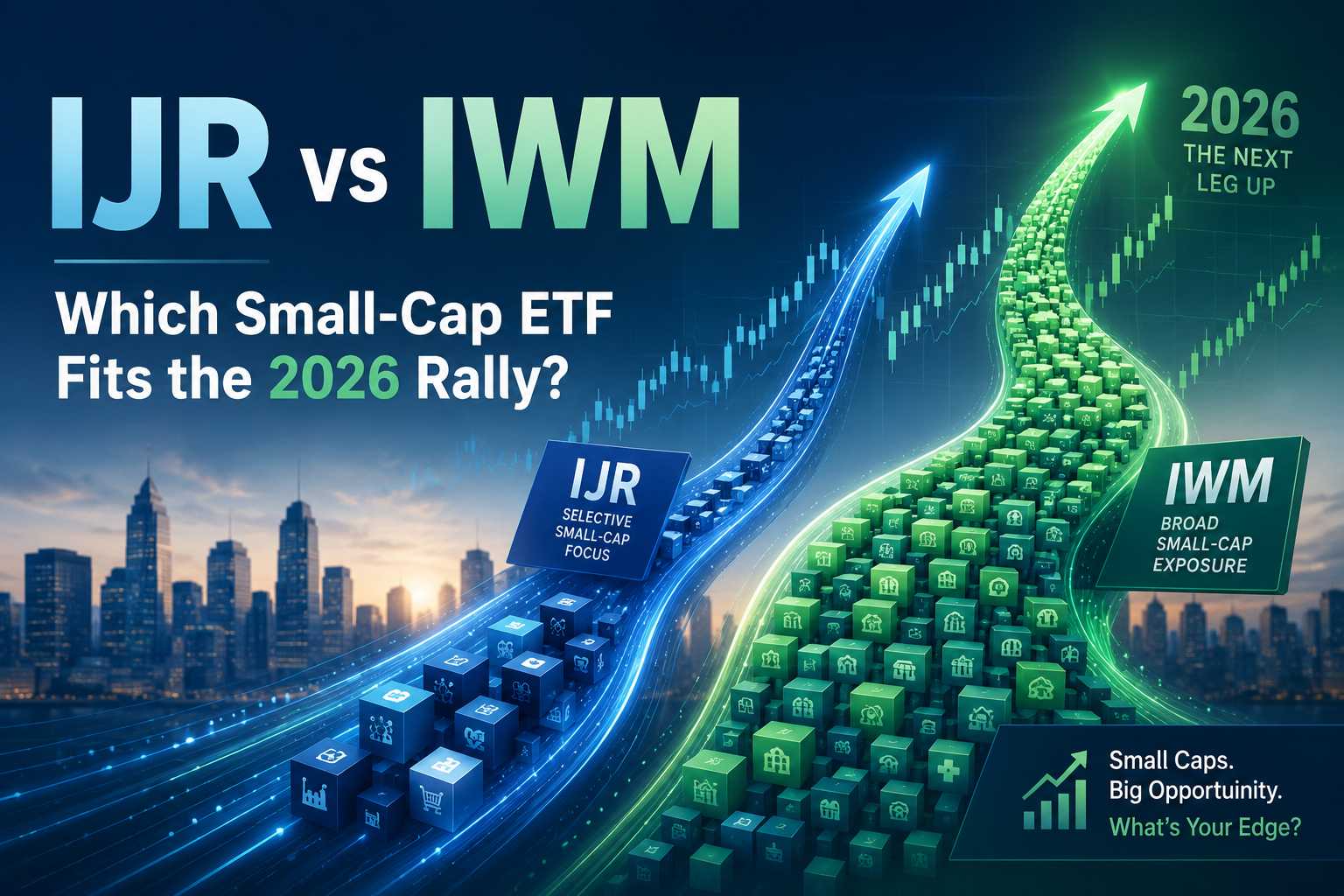
The 2026 rally has improved the case for small-cap ETFs, but investors still need to decide whether they want broader market exposure or a more selective small-cap benchmark.
IWM offers wider Russell 2000 exposure and stronger trading liquidity. IJR offers a lower expense ratio, fewer holdings and exposure to the S&P SmallCap 600, an index with liquidity and financial viability criteria.
| Metric | IJR | IWM | Investor relevance |
|---|---|---|---|
| Fund name | iShares Core S&P Small-Cap ETF | iShares Russell 2000 ETF | Both provide U.S. small-cap exposure. |
| Benchmark | S&P SmallCap 600 Index | Russell 2000 Index | The biggest structural difference between the funds. |
| NAV | $147.48 | $299.19 | Shows each fund’s latest net asset value. |
| Net assets | $110.7 billion | $83.1 billion | Both are large, established small-cap ETFs. |
| Number of holdings | 654 | 2,004 | IJR is narrower; IWM is broader. |
| Expense ratio | 0.06% | 0.19% | IJR has the lower ongoing cost. |
| YTD NAV total return | 23.90% | 22.48% | Both reflect strong small-cap momentum in 2026. |
| 30-day SEC yield | 1.50% | 0.95% | IJR currently has the higher yield. |
| P/E ratio | 19.69 | 19.13 | Valuations are broadly similar. |
| P/B ratio | 2.10 | 2.22 | IJR trades at a slightly lower price-to-book ratio. |
| 3-year beta | 1.14 | 1.30 | IWM has shown higher market sensitivity. |
| 3-year standard deviation | 19.53% | 20.29% | IWM has shown slightly higher volatility. |
| 30-day average volume | 4.7 million shares | 30.0 million shares | IWM has the stronger trading profile. |
The main difference between IJR and IWM is not the issuer. Both are iShares ETFs. The key difference is the index.
IJR tracks the S&P SmallCap 600 Index, which is designed to measure the U.S. small-cap segment while applying liquidity and financial viability criteria. This makes IJR a more selective small-cap ETF. It does not make the fund low-risk, but it does mean the portfolio is built differently from a broader small-cap benchmark.
IWM tracks the Russell 2000 Index, which represents approximately 2,000 small-cap U.S. equities and forms part of the broader Russell 3000 universe. The Russell 2000 is widely followed because it gives investors broad exposure to the U.S. small-cap market.
In practical terms, IJR is the more concentrated S&P SmallCap 600 ETF, while IWM is the broader Russell 2000 ETF.
IJR may appeal to investors who want long-term small-cap exposure with a lower expense ratio. Its 0.06% fee is below IWM’s 0.19%, which can matter for investors holding small-cap exposure over several years.
The fund also has fewer holdings, with 654 positions compared with IWM’s 2,004. That gives IJR a narrower portfolio, but it also reflects the S&P SmallCap 600 methodology, which applies additional eligibility rules. Investors who prefer a more selective benchmark may see this as a cleaner way to access small-cap stocks.
Molina Healthcare Inc.
FormFactor Inc.
Argan Inc.
BrightSpring Health Services Inc.
Element Solutions Inc.
IJR also currently has a higher 30-day SEC yield, a slightly lower price-to-book ratio and lower three-year beta than IWM. These differences do not guarantee better returns, but they support the view that IJR may be better aligned with investors seeking lower-cost, long-term small-cap exposure.
IWM may be more suitable for investors who want broad Russell 2000 exposure or a more liquid trading vehicle. Its portfolio includes 2,004 holdings, giving investors wider exposure across the small-cap universe.
Liquidity is also a major distinction. IWM’s 30-day average volume was about 30.0 million shares, compared with roughly 4.7 million for IJR. Both ETFs are large and liquid, but IWM’s trading profile is stronger. That may matter for tactical investors, institutional traders or investors who use options.
Hut 8 Corp.
Moog Inc. Class A
BlackRock Cash Funds Treasury SL Agency
Cytokinetics Inc.
BrightSpring Health Services Inc.
The trade-off is cost. IWM is more expensive than IJR, with a 0.19% expense ratio. For frequent traders, liquidity may outweigh that difference. For long-term investors, the fee gap may be more important.
ETF demand has remained strong in 2026, but the flow picture should be interpreted carefully. Broad ETF inflows do not automatically mean investors are concentrating new money in small-cap ETFs. Sector demand, large-cap technology exposure and thematic funds can all attract flows even when small caps are performing well.

This is why flows are useful context, but they should not be the whole story. A small-cap rally can be driven by changing expectations around interest rates, earnings recovery, domestic growth and risk appetite. ETF flows may confirm investor participation, but they do not fully explain which small-cap ETF is the better fit.
That makes the IJR vs IWM comparison more useful than simply asking whether investors are buying small-cap ETFs. The better question is whether investors want broader Russell 2000 exposure or a more selective S&P SmallCap 600 portfolio.
For investors choosing between IJR and IWM, the decision comes down to investment objective.
IJR may be the better fit for investors who want lower-cost exposure to a more selective small-cap index. Its lower expense ratio, higher current yield and S&P SmallCap 600 methodology make it a compelling option for long-term investors who are less focused on trading volume.
IWM may be the better fit for investors who want broad Russell 2000 exposure, deeper liquidity and stronger trading flexibility. It remains one of the most widely followed small-cap ETF vehicles, especially for investors who want tactical exposure to the small-cap rally.
Neither ETF is automatically superior. IJR is stronger on cost and index selectivity. IWM is stronger on breadth and liquidity.
Small-cap stocks remain sensitive to changes in interest rates, credit conditions and earnings expectations. Smaller companies can have less diversified revenue bases, higher borrowing costs and more volatile margins than larger companies. A strong rally can also bring valuation risk if prices move faster than earnings.
Index construction does not remove those risks. IJR’s S&P SmallCap 600 exposure may be more selective, but it is still small-cap equity exposure. IWM’s Russell 2000 exposure is broader, but that breadth can include companies with more uneven profitability profiles.
Investors should also consider portfolio role. A small-cap ETF may complement large-cap exposure, but it can increase volatility if used too aggressively.
IJR may be better for long-term investors who prioritize lower fees and S&P SmallCap 600 exposure. IWM may be better for investors who want broader Russell 2000 exposure and stronger trading liquidity.
IJR tracks the S&P SmallCap 600 Index, while IWM tracks the Russell 2000 Index. IJR holds fewer stocks and has a lower expense ratio. IWM holds more stocks and has higher trading volume.
IJR may suit investors seeking lower-cost, more selective small-cap exposure. IWM may suit investors seeking broader and more liquid exposure to the small-cap rally.
The 2026 small-cap rally has made both IJR and IWM more relevant, but the better ETF depends on investor preference. IJR offers lower fees, fewer holdings and exposure to the S&P SmallCap 600. IWM offers broader Russell 2000 exposure, deeper trading volume and stronger tactical flexibility.
For long-term investors focused on cost and index discipline, IJR may be the more attractive small-cap ETF. For investors focused on liquidity, trading access and broad market representation, IWM may be the better fit.
Traders following the small-cap ETF rotation can also compare the Russell 2000 Index alongside IJR and IWM on EBC’s platform to monitor whether the rally is broadening or becoming more ETF-specific.