Published on: 2026-05-26
The Russell 2000 index, Wall Street’s most closely watched barometer of U.S. small-cap health, has become the unexpected star of 2026, outpacing its large-cap rivals and sending a clear signal that a fundamental shift in market leadership is underway.
The index hit a fresh record on May 6, closing at 2,888.62, as small-cap stocks extended their 2026 leadership and reinforced the broadening of Wall Street’s rally.
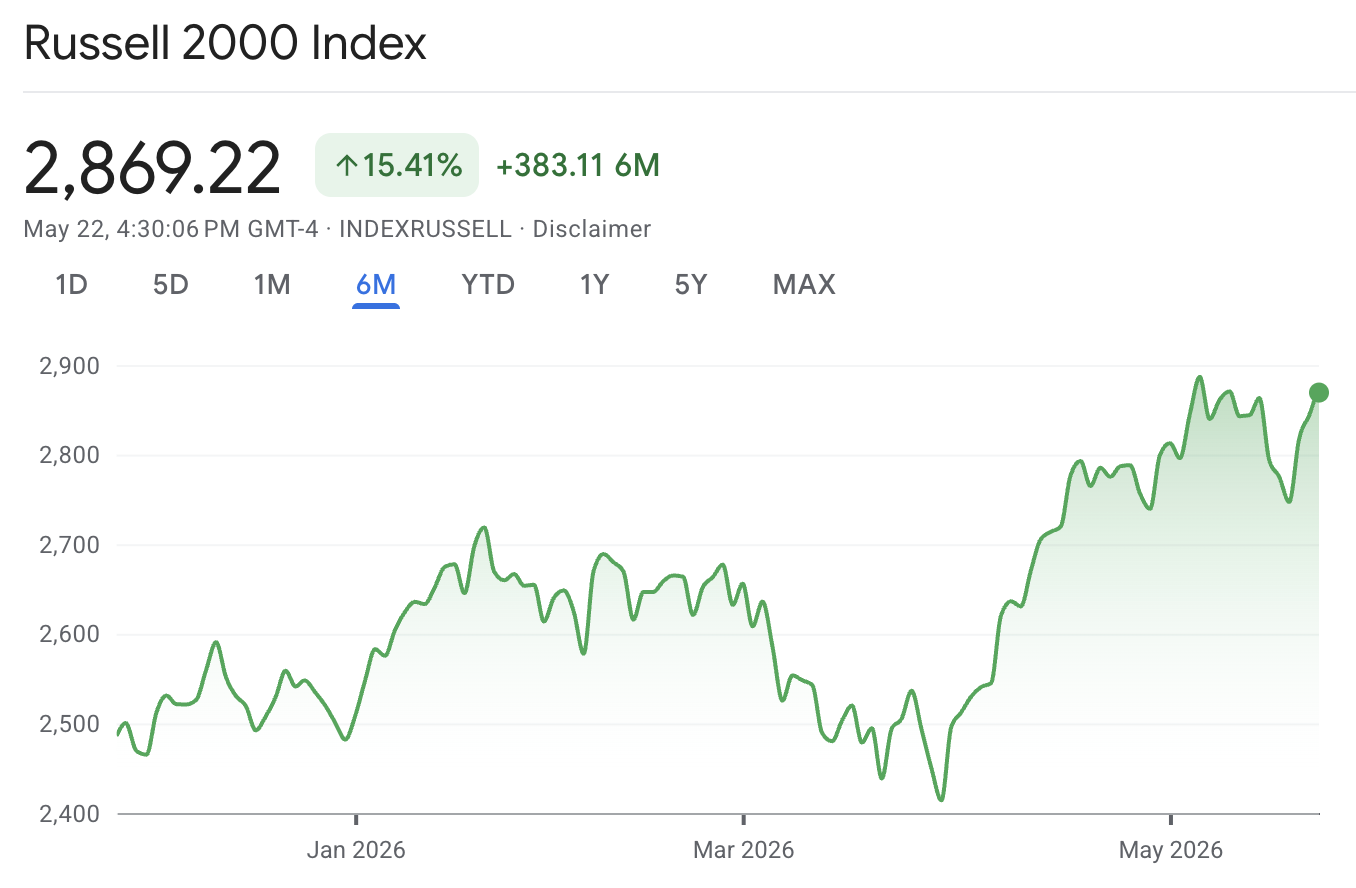
As of the latest available U.S. cash-market close on May 22, the Russell 2000 stood at 2,869.23, up 0.91% for the session, while the S&P 500 ended at 7,473.47, the Nasdaq Composite at 26,343.97, and the Dow Jones Industrial Average at 50,579.70.
The index’s 52-week range has spanned from a low of 2,011.20 to a high of 2,888.62, reflecting a remarkable turnaround of nearly 43% from the trough recorded just over a year ago.
| Indicator | Latest Reading |
|---|---|
| Russell 2000 close | 2,869.23 |
| Daily move | +0.91% |
| Year-to-date performance | +15.6% |
| One-year performance | +40.7% |
| 52-week low | 2,011.20 |
| 52-week high | 2,888.62 |
| Distance from record high | -0.67% |
| S&P 500 close | 7,473.47 |
| Nasdaq Composite close | 26,343.97 |
| Dow Jones Industrial Average close | 50,579.70 |
The headline story of 2026 has been the so-called “Great Rotation.” Small caps have stood out this year, with the Russell 2000 up 15.6% in 2026, ahead of the S&P 500’s 9.2% gain, the Nasdaq’s 13.3% advance, and the Dow’s 5.2% rise. The rally reflects a meaningful shift in market leadership.
Unlike previous false starts in small-cap rallies, the current move is backed by concrete earnings growth, with small-cap industrials and biotechs projected to see 18–35% earnings increases throughout the 2026 fiscal year. More broadly, small-cap earnings are expected to grow 17.1% in 2026 and 18% in 2027.
This recovery marks a sharp reversal after years during which mega-cap technology dominated. By the end of 2025, the valuation gap between small and large caps had reached a 25-year extreme. The Russell 2000 was trading at a forward price-to-earnings ratio of roughly 18x, while the S&P 500 hovered near 26x and the tech-heavy Nasdaq even higher.
This valuation disconnect made small caps a “coiled spring” for value seekers.
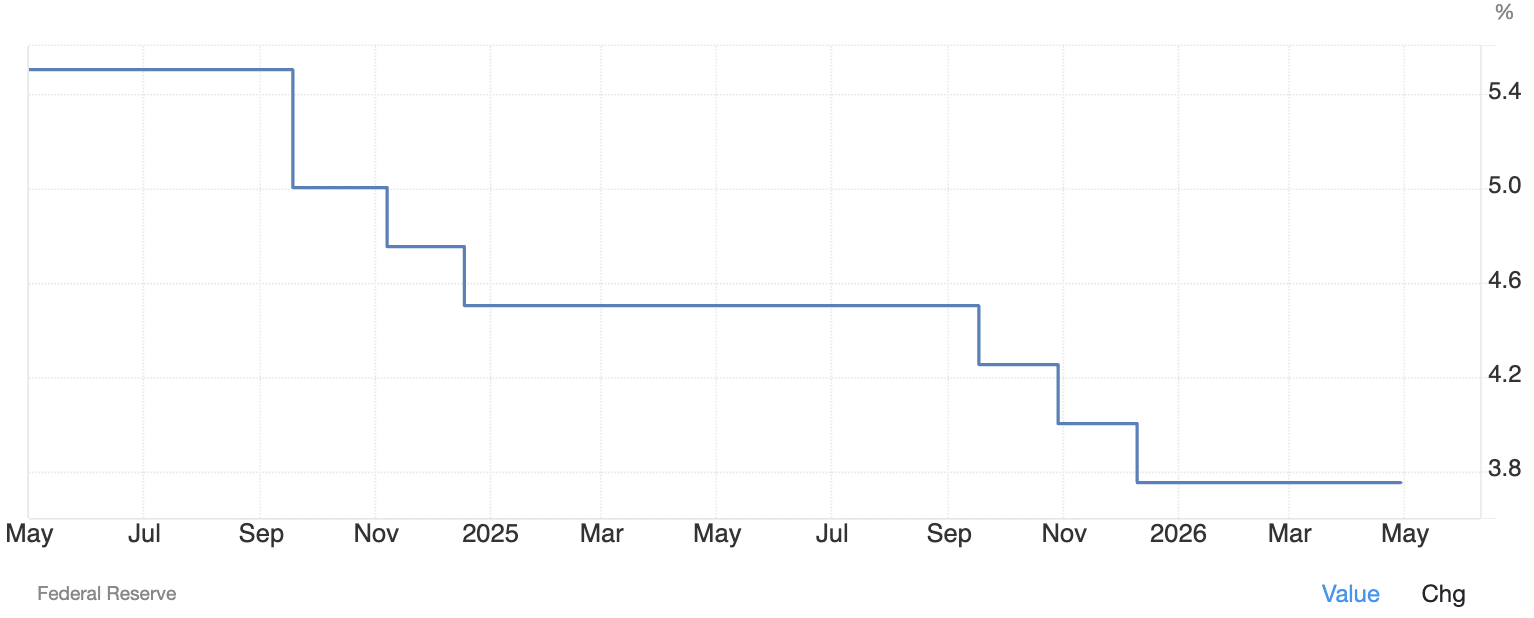
Central to this rally has been the Federal Reserve’s monetary policy pivot. The Fed delivered three consecutive 0.25% rate cuts in late 2025, which lowered the federal funds rate to 3.50-3.75%, reducing borrowing costs for smaller companies that rely heavily on floating-rate debt. This shift eased financial pressure, improved cash flow, and supported investment, refinancing, and shareholder returns.
The impact was particularly acute for the Russell 2000 constituents. Nearly 40% of the index’s constituent companies carry floating-rate debt, meaning the reduction in borrowing costs acted as an immediate injection of liquidity into these balance sheets, directly boosting earnings power that had been suppressed for years.
However, attention now turns to monetary policy going forward. Kevin Warsh has taken over as Federal Reserve chair after Jerome Powell’s term expired in May 2026, making the policy path more important for small-cap momentum. A dovish stance could accelerate the rotation, while a more hawkish response to inflation might introduce temporary volatility.
One defining characteristic of Russell 2000 stocks has worked in their favour this year: their predominantly domestic revenue base. The Russell 2000 was tacking on 0.82% in late April as the index signalled that investors weren’t backing down from the risk-on trade.
Trump’s announcement of an extension to the U.S. cease-fire with Iran was a direct catalyst, as the earlier Iran conflict had sent oil prices surging and compressed margins for domestically focused businesses that cannot easily pass energy costs on to customers.
Trade tensions and supply chain concerns are also driving a domestic manufacturing revival, benefiting small companies with U.S.-focused operations, a structural tailwind that could sustain the Russell 2000’s advantage well beyond 2026.
Not every corner of the index has benefited equally. The Russell 2000’s rally is not lifting every company equally. The strongest gains have been concentrated in firms with healthier balance sheets, improving earnings visibility, and direct links to domestic spending. Industrials have been among the clearest beneficiaries.
Meanwhile, corporate deal-making has added another layer of upside potential. Accelerating M&A activity, with U.S. transactions over $100 million up 25% by volume and 43% by value in early 2026, creates additional upside through potential acquisition premiums for small-cap targets.
Bank of America, which has been among the most constructive voices on the segment, highlighted specific strategies for investors seeking to enhance returns. The bank called out the iShares US Small-Cap Equity Factor ETF, noting that more than 8 out of 10 companies in the fund are profitable, compared to only about two-thirds of the broader Russell 2000.
The fund is up more than 11% this year. Stocks in the fund include nVent Electric, an AI infrastructure play up more than 65% in 2026, and Apple supplier Jabil, up 48% this year.
On the structural side, a notable change is coming to the index itself. Following market consultation, FTSE Russell has announced that the reconstitution of the Russell US Indexes will change from an annual to a semi-annual schedule in 2026, a move designed to better reflect the dynamic nature of the small-cap universe and reduce the distortions that can accompany a once-a-year rebalancing.
Despite the euphoria, seasoned analysts urge caution. The Russell 2000’s RSI is near 58, suggesting that while the hype has cooled, the structural uptrend remains intact. The index has pulled back roughly 0.7% from its all-time high set earlier this month, and small-cap stocks within the Russell 2000 face greater challenges than their large-cap counterparts due to less stability and fewer resources, making stock selection crucial.
Inflation remains a wildcard. Bank of America expects core PCE to end 2026 at around 3.0% year over year, slightly higher than earlier estimates, and cautions that core PCE may run hotter than core CPI in the months ahead.
Any re-acceleration in inflation could prompt the Fed to pause or reverse its easing path, a scenario that would disproportionately hurt the interest-rate-sensitive small-cap segment.
The Russell 2000 is benefiting from lower borrowing costs, stronger small-cap earnings expectations, improving domestic growth, and a rotation away from expensive mega-cap technology stocks into more undervalued cyclical companies.
The rotation is driven by Fed rate cuts, wider valuation discounts versus large caps, improving earnings visibility, and renewed investor demand for domestically focused companies with stronger leverage to the U.S. economy.
Small-cap companies rely more heavily on floating-rate debt and external financing. Lower interest rates reduce debt-servicing costs, improve cash flow, and support reinvestment, making the Russell 2000 more sensitive to Fed easing than large-cap indexes.
A rebound in inflation, higher Treasury yields, weaker U.S. growth, tighter credit conditions, or a hawkish Fed policy shift could pressure small caps, especially companies with weaker balance sheets or limited pricing power.
The Russell 2000’s 2026 story is one of a long-awaited reckoning: a market rediscovering the value of domestic, cyclically exposed businesses after years of crowding into mega-cap technology names.
With earnings growth accelerating, borrowing costs still easing, M&A activity rising, and the domestic economy holding firm, the fundamental backdrop remains supportive. Whether the index can reclaim its record highs and close out 2026 with further gains will depend on the twin variables of Federal Reserve policy and the resilience of U.S. economic growth, both of which, for now, remain tilted in small caps’ favour.