Published on: 2026-05-07
Updated on: 2026-05-07
The Russell 2000 climbed to a fresh record on 6 May as small-cap stocks extended their 2026 leadership and reinforced the broadening of Wall Street’s rally. The index closed at 2,886.77, up 1.5% for the session, as the Nasdaq, S&P 500 and small-cap benchmark all reached record territory.

The move came as easing oil prices, lower yields and stronger risk appetite lifted global equities. Small caps have stood out this year, with the Russell 2000 up 16.3% in 2026, ahead of the S&P 500’s 7.6% gain and the Nasdaq’s 11.2%advance.
The rally reflects a shift in market leadership. After years of dominance by mega-cap technology stocks, capital is rotating toward smaller U.S. companies tied more closely to domestic growth, industrial activity, regional lending and infrastructure spending.
The Russell 2000 closed at 2,886.77 on 6 May, up 1.5% for the session.
The index is up 16.3% year to date, leading the major U.S. benchmarks.
Small caps are benefiting from lower yields, easing oil prices and stronger risk appetite.
Lower policy rates have reduced borrowing pressure for rate-sensitive companies.
The rally is broadening beyond mega-cap technology, but earnings quality remains important.
The Russell 2000’s record marks a clear break from years of uneven small-cap performance.” The index has broken out from a multi-year range and is now leading a market advance that had previously depended heavily on large-cap technology.
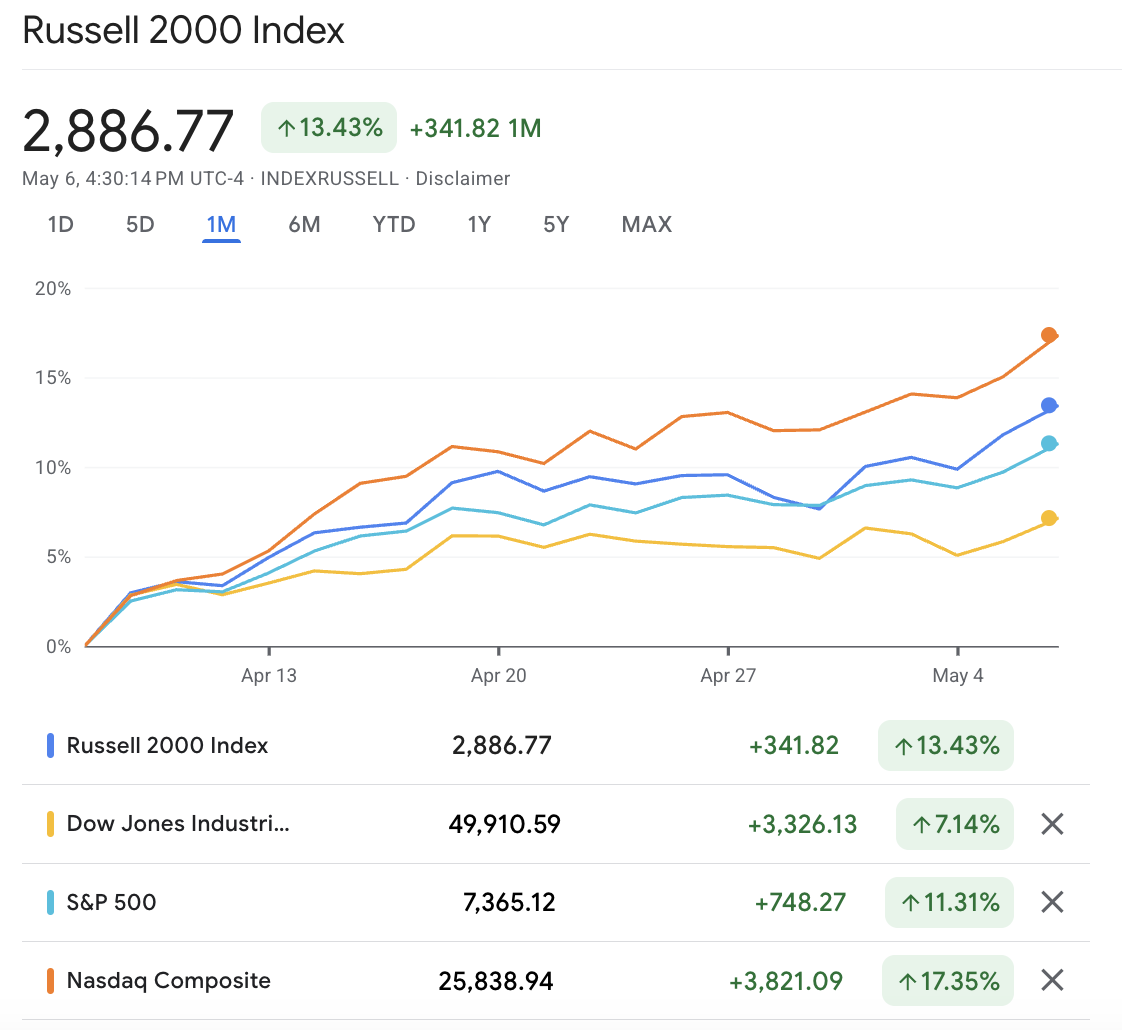
At Wednesday’s close, the major U.S. benchmarks showed broad strength:
| Index | Close | Daily move | Market signal |
|---|---|---|---|
| Russell 2000 | 2,886.77 | +1.5% | Small-cap leadership |
| S&P 500 | 7,365.12 | +1.46% | Broad-market record |
| Nasdaq Composite | 25,838.94 | +2.02% | Growth stocks remain firm |
| Dow Jones Industrial Average | 49,910.59 | +1.24% | Blue-chip participation |
The S&P 500 record is encouraging for broad-market bulls, but the leadership shift is the main story. Small caps are no longer simply participating in the rally. They are helping define it.
The Federal Reserve’s move away from peak policy rates has helped reset the small-cap trade, even as policymakers remain data-dependent.
Small-cap companies are generally more sensitive to borrowing costs than large-cap technology firms. Many have less cash on hand, thinner margins and greater exposure to floating-rate or refinancing pressure. As rates declined, the pressure on those balance sheets eased, allowing the market to reassess earnings potential.
That shift has helped bring capital back into small-cap indexes, especially among companies with stronger balance sheets and clearer links to domestic demand.
Business tax changes have also supported the case for smaller and mid-sized companies. Provisions such as full bonus depreciation, immediate research and development expensing and a more favorable interest-deduction framework can improve cash flow for firms with heavy capital spending needs.
The benefit is more meaningful for companies tied to manufacturing, construction, infrastructure and domestic investment. Cash-rich mega-cap companies may still gain, but smaller firms with real capital requirements are better positioned to see a direct financial impact.
That has strengthened the rotation into industrials, regional banks, infrastructure-linked companies and other real-economy sectors.
Small caps entered 2026 at a deep valuation discount to large-cap stocks. The Russell 2000 traded at a lower forward earnings multiple than the S&P 500, while mega-cap technology valuations remained elevated after years of outperformance.
Once rates moved lower and domestic growth held firm, that valuation gap became harder to ignore. Large allocators began shifting some exposure away from crowded mega-cap positions and into smaller companies with stronger cyclical upside.
The result has been a more balanced market advance, with small caps taking a larger share of performance leadership.
The Russell 2000 rally is not lifting every company equally. The strongest gains have been concentrated in firms with healthier balance sheets, improving earnings visibility and direct links to domestic spending.
Industrials have been among the clearest beneficiaries. Companies tied to construction, infrastructure, data-center support, manufacturing equipment and reshoring demand have drawn fresh interest as capital spending flows into the U.S. economy.
Regional banks are also participating. A steeper yield curve, improving loan demand and easing credit concerns have supported lenders that were pressured by the 2023 banking stress and the high-rate environment that followed.
Biotechnology remains more selective. Companies with strong clinical milestones and manageable funding needs have held up better, while names dependent on external financing continue to lag.
The breadth of the rally is important. A small-cap advance led by multiple sectors suggests stronger market participation than a rally powered only by a few mega-cap names.
The rally still carries risks. Small-cap companies often have weaker balance sheets, thinner margins and less pricing power than larger peers. A renewed rise in yields would quickly test the move, especially for firms facing refinancing needs.
Earnings quality is another issue. The Russell 2000 includes companies with uneven profitability, so index-level gains can hide wide differences between stronger operators and weaker balance sheets. Sustained gains will require revenue growth, margin recovery and credit stability.
Oil also remains a swing factor. The latest equity rally benefited from falling crude prices and easing inflation concerns. A renewed rise in energy prices would pressure margins and revive fears of sticky inflation.
The small-cap rotation is real, but its durability depends on several conditions holding.
Fed policy: Markets need confidence that rates will remain supportive.
Credit spreads: Tight high-yield spreads would signal that refinancing risk remains manageable.
Earnings delivery: Industrial, regional bank and consumer-linked small caps need to show real profit growth.
Oil stability: Lower energy prices help margins and reduce inflation pressure.
Market breadth: The rally needs continued participation beyond a narrow group of high-momentum names.
Quality will become more important as the rally matures. Small-cap benchmarks with profitability screens may hold an advantage if credit conditions tighten or earnings disappoint.
The Russell 2000 at record levels shows that Wall Street’s 2026 rally has moved beyond a narrow mega-cap technology trade. Lower rates, stronger domestic demand and improved risk appetite have turned small caps into one of the clearest expressions of the market’s rotation.
The next phase will depend on whether earnings growth can confirm the move. If rates stay contained and domestic demand remains firm, small caps can continue to lead. If yields rise or credit stress returns, the rally will face a tougher test.
For now, the Russell 2000 breakout shows that Wall Street’s 2026 rally has broadened. Small caps are no longer a lagging corner of the market. They have become one of the clearest expressions of the rotation trade.