Published on: 2026-03-24
The recent significant rebound in the Russell 2000 has raised questions about whether this movement marks the onset of a sustained small-cap breakout or represents only a temporary relief rally.
After flirting with correction territory last week, the small-cap benchmark jumped 2.3% on March 23 to 2,494.23, easily beating the S&P 500’s 1.1% gain.
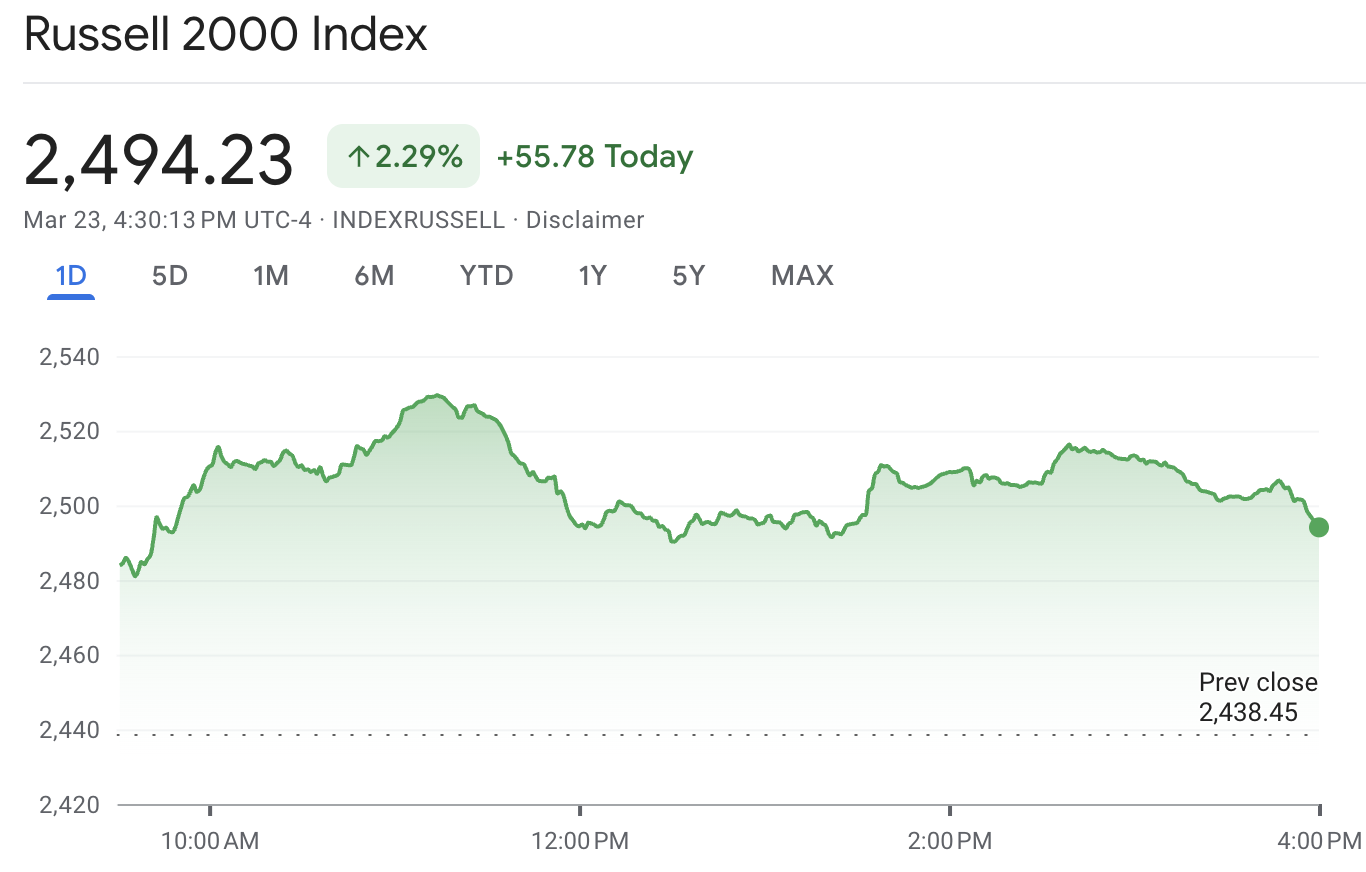
This rebound is significant because the Russell 2000 serves as a primary indicator for small-cap stocks, which often respond rapidly to changes in interest rates, oil prices, and domestic economic growth expectations.
The primary catalyst was geopolitical in nature.
The rally was driven by a rapid de-escalation of geopolitical tensions in the Middle East and a sharp decline in crude oil prices. These developments alleviated pressure on interest-rate-sensitive companies that had previously faced persistent inflation concerns.
U.S. stocks rose after President Donald Trump announced discussions with Iran aimed at resolving the conflict.
This announcement contributed to Brent crude prices falling below $100 and the 10-year Treasury yield declining to 4.35% from 4.39%. These factors provided relief to small-cap stocks following a period of underperformance.
The rebound followed a period of significant volatility. By March 20, 2026, the Russell 2000 had surrendered its strong early-year gains, declining to a year-to-date return of only +0.75% after previously reaching an increase of 8.9%.
The Russell 2000 became the first of the major U.S. benchmarks to fall into correction territory in 2026, closing down 10.9% from its all-time high. For context, a correction is defined as a decline of more than 10% from a recent peak.
Three primary factors contributed to the recent decline in small-cap stocks:
Sticky inflation: Stronger-than-expected labor data and a stubborn CPI reading in February forced market participants to price out further Fed rate cuts for the first half of 2026.
A hawkish Fed: The FOMC meeting on March 18, 2026, served as a final catalyst, with the Fed voting 11-1 to maintain the federal funds rate at 3.50%–3.75% while revising its 2026 PCE inflation outlook upward to 2.7%.
A debt maturity wall: Analysts estimate that 41% to 46% of Russell 2000 companies are classified as “zombie” firms, unable to cover interest expenses with operating profits. These firms face a $368 billion maturity wall in 2026 and must refinance debt at rates approaching 6.5%.
This structural characteristic defines investing in small-cap stocks. Approximately 32% of the Russell 2000’s debt is tied to floating rates, compared to only 6% for the S&P 500, making the index significantly more sensitive to changes in borrowing costs.
The Federal Reserve's decision to pause and signal no imminent rate cuts disproportionately affected small-cap stocks.
Large-cap companies, with substantial cash reserves, were better positioned to withstand the challenging environment, whereas smaller firms faced greater difficulties.
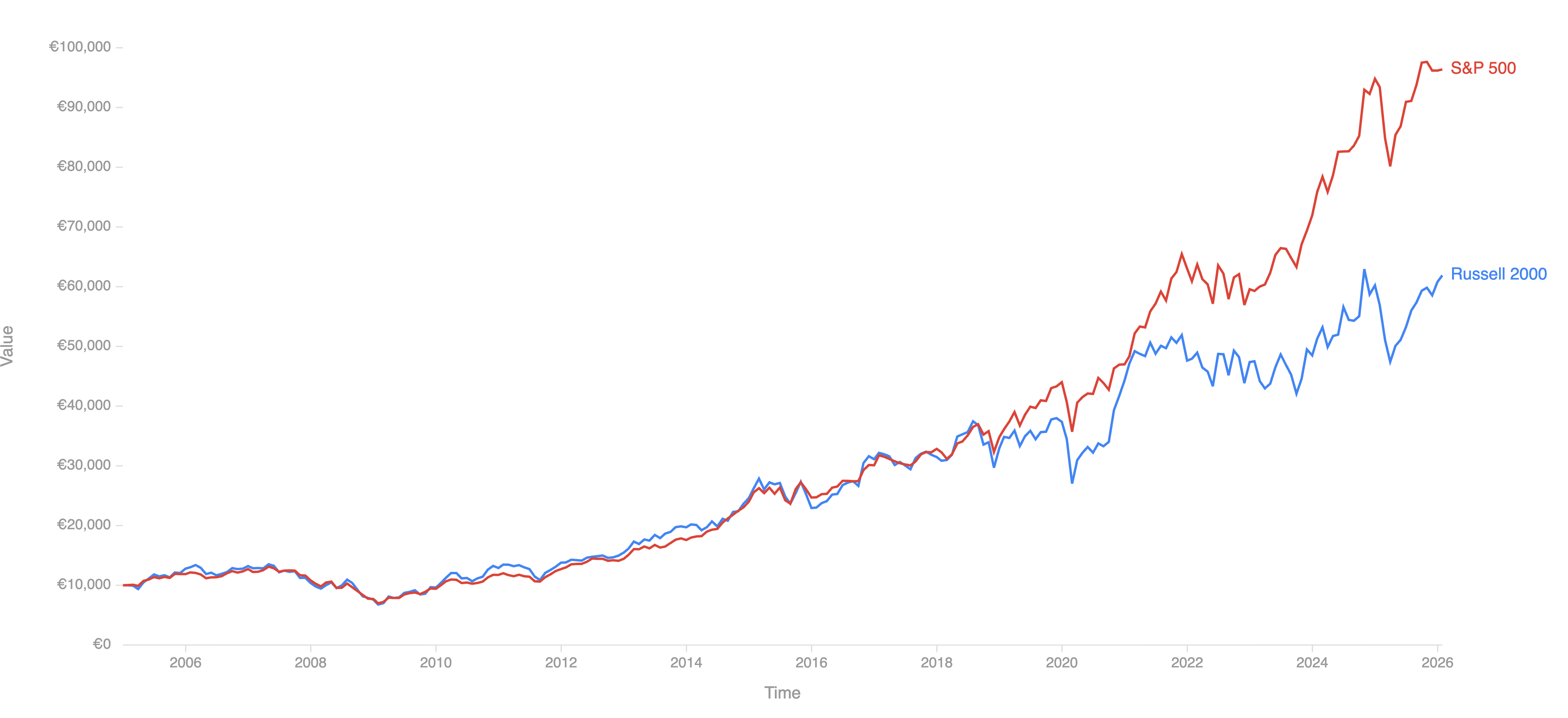
Despite recent volatility, small-cap valuations remain attractive. Small-cap stocks continue to trade at a significant discount relative to large-cap equities.
| Metric | Russell 2000 | S&P 500 |
|---|---|---|
| Trailing P/E Ratio | ~19.5x | ~30x |
| Floating-Rate Debt Exposure | 32-40% | ~6% |
| YTD Return (as of Mar 20) | +0.75% | ~flat |
| Peak-to-Trough Correction | -10.9% | -7.1% |
Several factors support a constructive outlook. Data indicate that over the last seven rate-cut cycles, the Russell 2000 outperformed the S&P 500 by at least 4% annualized over subsequent one-, two-, and three-year periods.

Earnings projections for small-cap companies are favorable in the medium term. Analysts forecast median earnings growth of 18.4% for small-cap firms in 2026, significantly exceeding the S&P 500’s 9.8%.
This divergence is evident across industries including industrials, consumer discretionary, and manufacturing.
The passage of the One Big Beautiful Bill Act restored 100% bonus depreciation and domestic research and development (R&D) expensing, policies that disproportionately benefit capital-intensive small- and mid-sized enterprises.
These measures represent a structural fiscal tailwind that is likely to persist.
But this does not yet look like the clean start of a sustained small-cap bull run. For that, investors likely need three things to hold at once:
Oil prices need to stabilize lower
Treasury yields need to stop lurching higher
The Fed needs a clearer path to easing without a fresh inflation shock
Russell Investments noted that its baseline outlook still calls for solid U.S. economic growth and that, historically, strong economic growth has provided a tailwind for small-cap equities, with maintaining exposure to small caps remaining an important component of a diversified equity allocation.
If oil prices remain stable and the debt maturity wall is addressed through innovative private credit solutions, the current sell-off may represent a significant entry opportunity for value investors, especially those targeting high-quality small-cap companies with low debt and strong margins.
Until these conditions are met, the Russell 2000 rebound appears to reflect a temporary improvement in market sentiment rather than conclusive evidence that small-cap stocks have regained market leadership.
The Russell 2000 tracks approximately 2,000 of the smallest U.S. publicly listed companies. It is widely used as the benchmark for the small-cap segment of the market and is considered a leading indicator of domestic economic health.
A combination of rising Treasury yields, a hawkish Fed pause in March 2026, sticky inflation, and a looming corporate debt maturity wall pushed the index down over 10% from its January peak before bouncing on March 23.
Yes. The Russell 2000’s trailing P/E ratio compressed to around 19.5x, while the S&P 500 maintained a valuation near 30x, making small caps relatively cheap by historical standards.
The iShares Russell 2000 ETF (IWM) is the most widely used instrument to gain exposure.
In 2025, Materials was the strongest-performing sector within the Russell 2000 on a year-to-date basis, followed by Health Care and Industrials, reflecting strength across both cyclical and defensively oriented growth areas.
The Russell 2000’s 3% increase on March 23 is a notable event; however, it does not resolve the underlying structural challenges that contributed to the recent correction.
The index hit an all-time high of 2,718 in January, fell 10.9% into official correction territory by March 20, and then snapped back sharply on geopolitical relief and falling oil prices.
The long-term investment case for small-cap stocks remains robust. Valuations are near 25-year lows relative to large caps, 2026 earnings growth projections significantly exceed those of the S&P 500, and fiscal policy incentives for domestic manufacturing provide tangible support.
The near-term risk, however, is just as real. Sticky inflation, a Fed that is in no hurry to cut, and a wave of floating-rate debt coming due in 2026 could keep pressure on the most leveraged names.
The key consideration for investors is that while opportunities in small-cap stocks are genuine, selectivity is crucial. Companies with strong balance sheets, consistent free cash flow, and significant domestic revenue exposure are more likely to outperform, whereas weaker firms may face continued challenges.
Disclaimer: This material is for general information purposes only and is not intended as (and should not be considered to be) financial, investment or other advice on which reliance should be placed. No opinion given in the material constitutes a recommendation by EBC or the author that any particular investment, security, transaction or investment strategy is suitable for any specific person.