Published on: 2026-06-23
Updated on: 2026-06-23
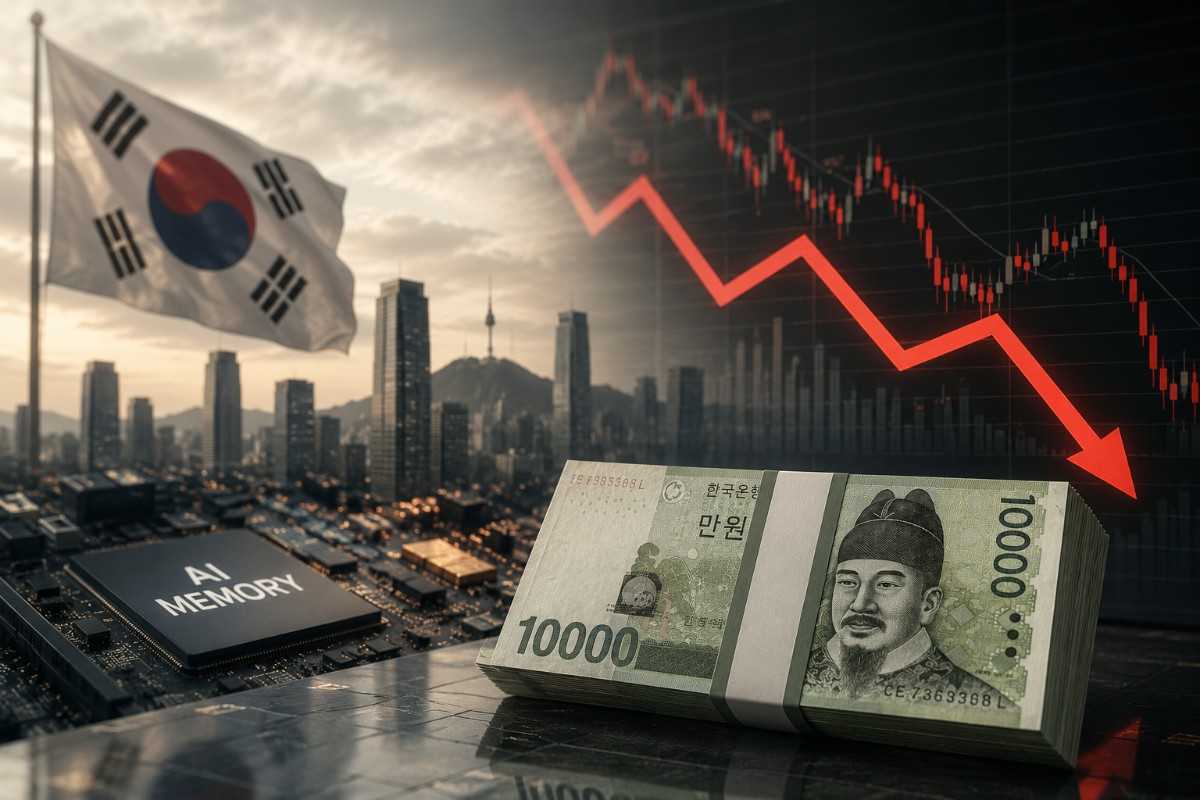
South Korea’s AI memory boom has crossed an unusual line: a chip-sector bonus cycle is now large enough for the Bank of Korea to study its inflation effect. In the first quarter, nominal wages rose 3.4% from a year earlier, and IT-sector bonuses reportedly accounted for 1.3 percentage points of that increase.
The flashier number is the 60.6% jump in IT-sector special pay, but the wage contribution is what makes economists sit up and take notice. So why is a central bank modelling semiconductor bonuses at all?
IT-sector special pay in South Korea reportedly jumped 60.6% year over year in the first quarter, while wages outside IT rose only 2.1%. (Pulse)
IT-sector bonuses contributed 1.3 percentage points to Korea’s 3.4% nominal wage growth in Q1, making the bonus surge difficult for policymakers to ignore. (Pulse)
The Bank of Korea reportedly estimated that a rise in top-tier bonus payments can lift consumer prices by about 0.05 percentage points after five months. (Bank of Korea)
SK Hynix overtaking Samsung is the market headline, but the wage data is the stronger macro signal.
Department-store sales in Korea’s semiconductor belt rose 20-25% early this year, while some luxury categories jumped 45-200%, giving the BOK’s wage concern a visible real-economy signal.

The Bank of Korea is not reacting to one large bonus figure. It is reacting to a wage channel that is now visible in national data.
| Korea AI Wage Signal | Latest Read |
|---|---|
| IT-sector special pay | +60.6% YoY |
| Non-IT wage growth | +2.1% YoY |
| Total nominal wage growth | +3.4% YoY |
| IT bonus contribution to wage growth | +1.3 percentage points |
| Estimated CPI effect | +0.05 percentage points after five months |
| 2026 BOK GDP forecast | 2.6% |
| 2026 BOK CPI forecast | 2.7% |
Source: IT wage, bonus contribution, percentile and CPI-effect figures are from BOK analysis reported by Pulse/Maeil Business News. GDP and CPI forecasts are from the Bank of Korea’s May 2026 Economic Outlook.
The key number is not the 60.6% bonus spike. It is the 1.3-point contribution to national wage growth. That is what turns Korea’s AI memory boom from a company-pay story into a macro signal.
A large bonus number can remain part of a company's story. A large bonus contribution to national wage growth cannot.
That is why the 1.3 percentage-point figure carries more weight than the 60.6% headline. It shows that semiconductor compensation was not a side note in Korea’s first-quarter labour data. It explained more than one-third of the country’s nominal wage growth.
The Bank of Korea reportedly placed that contribution near the 97th percentile of its 2012-2025 historical range. It also warned that the contribution could climb above the 99th percentile early next year if the bonus cycle continues. Korea may be looking at a temporary payout shock, or the first wage spillover from the AI memory boom.
Central banks track wages because wages can make inflation harder to cool. What makes Korea unusual is the source of wage pressure: a concentrated compensation surge from firms located near one of AI’s most profitable bottlenecks.
Samsung Electronics and SK Hynix are exposed to high-bandwidth memory, the advanced memory used in AI infrastructure. Strong demand has lifted profits, and profit-linked bonuses have channelled part of that boom into workers' pay. The BOK’s concern is whether that income stays contained or becomes a reference point for wider wage bargaining.
If chip-sector bonuses remain isolated, the effect fades. If other workers, unions, and employers begin using them as a pay benchmark, the story changes.
The reported consumer-price impact is about 0.05 percentage points after five months when more firms pay top-10% level bonuses. That will not decide Korea’s rate path by itself, nor will it turn chip workers into the main inflation driver.
But the number is still useful. It keeps the argument grounded while showing that the BOK is identifying a measurable channel between concentrated bonus payments and delayed price pressure. AI memory profits have moved far enough through Korea’s economy to become something policymakers can model, even if the first measured impact is modest.
The BOK’s concern is not limited to a spreadsheet. Some of the income effect is already visible in Korea’s semiconductor belt.
In southern Gyeonggi, where Samsung Electronics and SK Hynix facilities are concentrated, department stores have reported unusually strong spending. Lotte Department Store’s Dongtan branch rose 25% year over year from January to May. Shinsegae’s South City branch rose 23%, and Hyundai Department Store’s Pangyo branch rose 20%. The gains were sharper in high-end categories: luxury watches and jewellery at Lotte Dongtan rose 45%, Shinsegae South City’s luxury jewellery sales nearly tripled, and Hyundai Pangyo’s high jewellery sales rose 59%.
This does not prove that chip bonuses are driving national inflation. It shows the mechanism that the BOK is worried about appearing in the real economy. Bonus expectations are showing up in retail demand, new customer growth, and VIP spending around Korea’s chip clusters.
The bonus scale explains why. SK Hynix employees are projected to receive an average performance bonus of about 670 million won per person early next year, more than four times last year’s average of 140 million won. When payouts reach that size, the question becomes how much of that income stays local, how much becomes spending, and how much becomes a benchmark for everyone else.
The Bank of Korea raised its 2026 GDP growth forecast to 2.6% from 2.0%, citing a robust semiconductor cycle. It also raised its CPI forecast to 2.7% from 2.2%, citing oil shocks and a buildup of demand-side pressure.
That mix creates a policy problem. The semiconductor boom supports growth, exports, earnings, and market valuations. At the same time, it can strengthen wages in a way that keeps household demand firmer than expected.
Energy remains the larger near-term inflation pressure. The wage channel is smaller but stickier. Oil shocks can reverse. Pay expectations are harder to reset once workers start comparing bonuses across sectors.
SK Hynix overtaking Samsung as South Korea’s most valuable listed company shows how much the market now values AI memory leadership. Samsung had been Korea’s default corporate No. 1 for decades. SK Hynix taking that spot is a clear sign that HBM exposure has rewritten the country’s equity hierarchy.
But the market-cap flip is still the visible part of the story. The stronger signal is happening in wage data. Investors see AI memory through valuations. The Bank of Korea sees it through compensation, spending power, and inflation risk.
Korea may be showing what an AI supply chain boom looks like as it becomes large enough to affect national data. Earlier macro cycles moved through oil, housing, credit, and commodities. This one is moving through advanced memory.
The pattern is familiar. A scarce input becomes essential to a global investment boom. Profits concentrate around the companies closest to that bottleneck. Those profits lift compensation. Policymakers then have to decide whether the boom is temporary or changing inflation dynamics.
Korea is exposed because semiconductors sit near the centre of its economy, and HBM sits near the centre of the AI buildout. That does not mean every AI-exposed economy will face the same wage channel. It means investors should stop treating AI as only a stock-market theme when the profits are large enough to appear in national labour and inflation data.
Traders who want to monitor this theme beyond Samsung and SK Hynix can compare EWY.P for South Korea exposure with SMH.OQ and SOXX.OQ for semiconductor-sector exposure on EBC’s ETF instruments. ETF CFDs are leveraged products, so position size and event timing matter when wage, inflation, or central-bank data are part of the setup.
Because the bonuses are large enough to affect national wage data. IT-sector bonuses reportedly added 1.3 percentage points to Korea’s 3.4% nominal wage growth in Q1, which turns a company compensation issue into a possible inflation signal.
No. The reported inflation effect is small, at about 0.05 percentage points after five months. The bigger drivers remain energy, currency moves, and broader demand. The important point is that semiconductor bonuses are now measurable inside the inflation discussion.
The 60.6% figure shows how fast IT special pay grew. The 1.3-point contribution shows the effect on national wage growth. That is the number economists care about because it connects the AI memory boom to the broader labour market.
The next signal is Korea’s early-2027 bonus cycle. If another round of AI-memory payouts pushes the wage contribution above the BOK’s 99th-percentile warning zone, the story moves from an unusual data point to a clearer macro pressure.
The Bank of Korea’s bonus warning is not dramatic because the estimated inflation effect is large. It is dramatic because the channel exists.
The 60.6% jump in IT-sector special pay is the headline. The 1.3 percentage-point contribution to 3.4% nominal wage growth is the stronger evidence. The 0.05 percentage-point inflation effect is small, but it shows that concentrated AI-linked compensation has entered Korea’s inflation framework.
SK Hynix beating Samsung is the market version of the story. The BOK’s wage and inflation analysis is the macro version. The retail data from Korea’s semiconductor belt gives the story its real-economy evidence.
The next test is Korea’s early-2027 bonus cycle: if another round of AI-memory payouts pushes the wage contribution above the BOK’s 99th-percentile warning zone, the AI trade will no longer be just lifting chip stocks; it will be testing Korea’s inflation model.