Published on: 2026-06-24
Updated on: 2026-06-24
The Doncasters IPO is not a simple aerospace debut. Doncasters is coming to the NYSE with specialized engine and turbine exposure, a planned $700 million raise and a $75 million QIA placement, yet its financial profile still carries losses and leverage. That tension will determine whether DPC trades as a premium aerospace supplier or as a debt-heavy industrial name wearing an aerospace multiple.
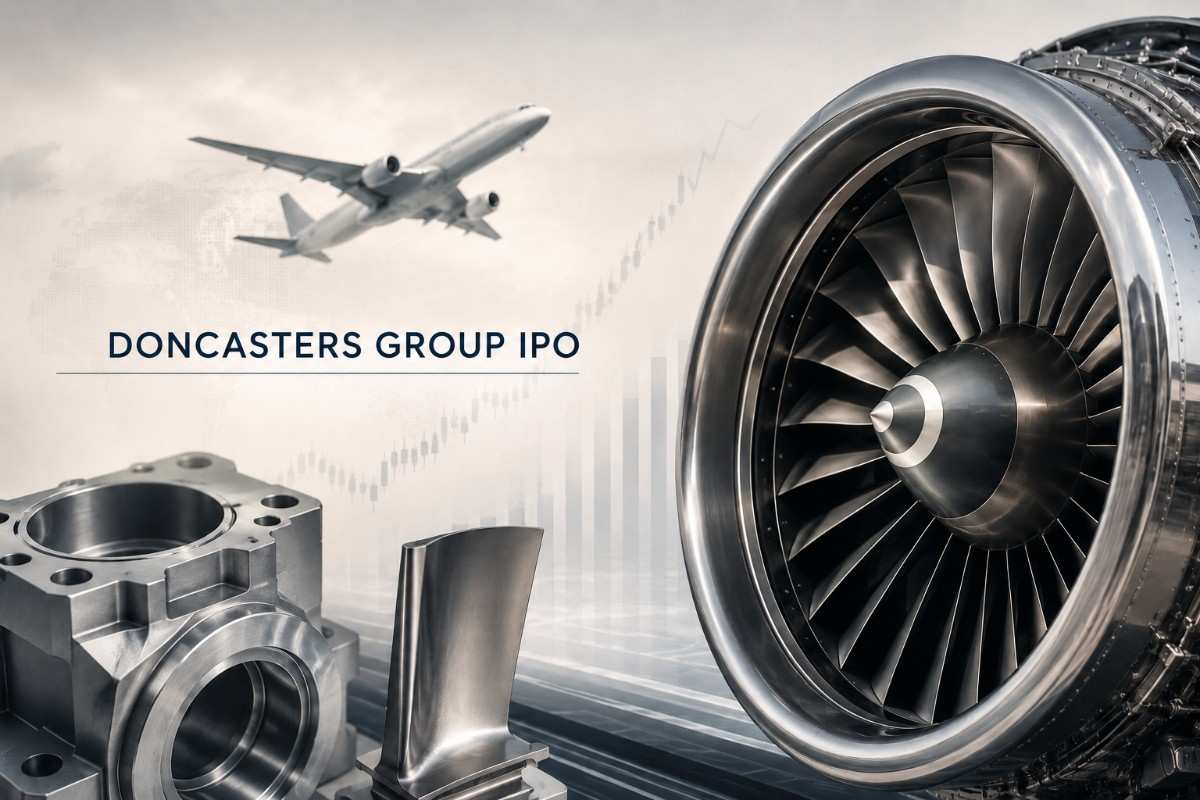
DPC is expected to list on the NYSE on June 25, 2026, with Doncasters offering 23.33 million shares at $28 to $32 each.
The IPO would raise about $700 million at the midpoint, turning Doncasters’ aerospace supply-chain exposure into a public valuation test.
QIA’s $75 million placement gives DPC an anchor-buyer signal, but the real demand test begins after public trading starts.
Doncasters generated $837 million of 2025 revenue and $138 million of adjusted EBITDA, while still posting a $173 million net loss.
The decisive signal is whether DPC earns an aerospace-scarcity multiple or trades like a leveraged industrial name using IPO proceeds for balance-sheet repair.
The terms are straightforward; the read-through is not. Doncasters is raising capital, visibility and scrutiny at the same time.
| DPC IPO Detail | Latest Figure |
|---|---|
| Company | Doncasters |
| Ticker | DPC |
| Exchange | NYSE |
| Expected listing date | June 25, 2026 |
| IPO price range | $28 to $32 |
| Shares offered | 23.33 million |
| Midpoint proceeds | About $700 million |
| Estimated market cap | About $4.2 billion |
| QIA placement | About $75 million |
| 2025 revenue | $837 million |
| 2025 adjusted EBITDA | $138 million |
| 2025 net loss | $173 million |
The headline number is the $700 million raise, but the pressure point is the $173 million net loss. That gap is why the DPC IPO cannot be judged only as an aerospace demand story.
Doncasters is a UK-based precision manufacturing group that makes complex cast components and nickel- and cobalt-based superalloys for aerospace engines and industrial gas turbines.
The company sits deep inside the supply chain rather than in front of consumers. Its products are used in systems where heat, pressure and reliability standards leave little room for supplier error.
The DPC IPO gives the market a way to price a business built around engineering difficulty rather than brand visibility.
The DPC IPO is selling more than a new ticker. It is asking public investors to value a private aerospace supplier at a time when qualified manufacturing capacity is difficult to replace.
That is the core of the deal. If investors see Doncasters as a scarce supplier inside aircraft engine and turbine platforms, DPC may earn a premium. If they see only leverage, losses and debt repayment, the stock will trade more like an industrial balance-sheet story.
The $28 to $32 price range puts Doncasters in front of investors before the market has tested its public valuation. At the $30 midpoint, the IPO would raise about $700 million and imply an estimated market value near $4.2 billion.
A price near the top of the range would signal demand, but it would also raise the standard for the first sessions of trading. The higher DPC prices, the less room investors have to ignore losses, leverage and dilution.
Doncasters makes parts that most passengers will never see, but aircraft and turbine customers cannot quickly replace critical suppliers. The company serves major aerospace and turbine OEMs, including GE Aerospace, Pratt & Whitney, Rolls-Royce, Safran, GE Vernova and Siemens Energy, which makes supplier qualification more than a procurement formality.
Components used in engines and turbines must pass strict engineering, certification and reliability requirements before they become part of production systems.
That qualification process is the moat. Once a part is embedded in an engine or turbine program, replacing a supplier can become a multi-year engineering, testing and approval process. That gives Doncasters more customer-stickiness potential than a conventional metal parts manufacturer, even if the company lacks broad public visibility.
The $700 million midpoint raise changes Doncasters’ story from private supplier demand to public-market accountability. Investors are not just funding growth; they are assigning a price to certified aerospace capacity.
Proceeds will go toward debt repayment and balance-sheet obligations. The growth story is real, but the IPO also carries a financial clean-up element that investors will price into the debut.
Qatar Investment Authority’s planned $75 million purchase gives DPC a visible institutional backer before the stock trades. At the $30 midpoint, QIA would receive about 2.5 million shares.
That improves the optics of the deal, but anchor capital is not the same as open-market demand. QIA can support confidence before pricing; it cannot force public buyers to defend DPC after the first print.
The financial tension is that Doncasters generated $837 million in revenue in 2025 and $138 million in adjusted EBITDA, yet reported a $173 million net loss.
That is the hardest number in the IPO. Investors are not deciding whether Doncasters makes important products. They are deciding how much they will pay for that importance before net income turns positive and leverage becomes less central to the story.
Doncasters is expected to begin trading on the NYSE on June 25, 2026, under ticker symbol DPC. Doncasters is offering 23.33 million shares at $28 to $32 each, making the first session a direct test of demand for the aerospace supplier.
Doncasters makes precision cast components, superalloys and engineered engine products for aerospace and industrial gas turbine markets. These are not high-visibility consumer products; they are critical parts used in systems where heat, pressure, certification and reliability leave little room for supplier failure.
Doncasters is targeting about $700 million at the $30 midpoint of its IPO range. The underwriters also have a 30-day option to buy an additional 3.5 million shares, which could increase the final deal size if demand is strong.
Doncasters was not profitable on a net income basis in 2025. The company reported $837 million in revenue and $138 million in adjusted EBITDA, yet still recorded a $173 million net loss, so the IPO cannot be judged solely on aerospace demand.
QIA is Qatar Investment Authority, Qatar’s sovereign wealth fund and one of the world’s largest state-backed investors. Its planned $75 million DPC placement gives Doncasters a visible long-horizon backer before pricing, but anchor capital is only a confidence signal. It cannot guarantee post-listing demand.
Doncasters has a credible scarcity story, but the IPO still has to prove that story can carry a public-market multiple. A strong DPC debut would show investors are willing to pay for certified aerospace capacity despite losses and leverage; a weak one would make the listing look less like a growth opportunity and more like a balance-sheet reset. Scarcity gets DPC noticed. Proof decides the premium.