Published on: 2026-08-07
Atlassian expects FY2027 revenue growth of roughly 13% while guiding cloud revenue up about 25.5%, a divergence driven largely by Data Center revenue falling around 17%.
Subscription ARR growth is guided to 18% from 23%, a cleaner read on underlying deceleration than the 13% headline, because ARR is less affected by the upfront term-license recognition driving unusually large swings in reported Data Center revenue.
Non-GAAP operating margin is guided to about 25% against 30% in FY2026, so profitability compresses at the same time growth slows.
Customers above $3 million in annual recurring revenue rose more than 50% to 164, and those above $5 million rose more than 70% to 69, both company records.
The after-hours price cleared the roughly $139.70 average analyst target that stood before the release, moving Atlassian to about 5.1 times FY2027 guided revenue from 3.8 times at Wednesday’s close.
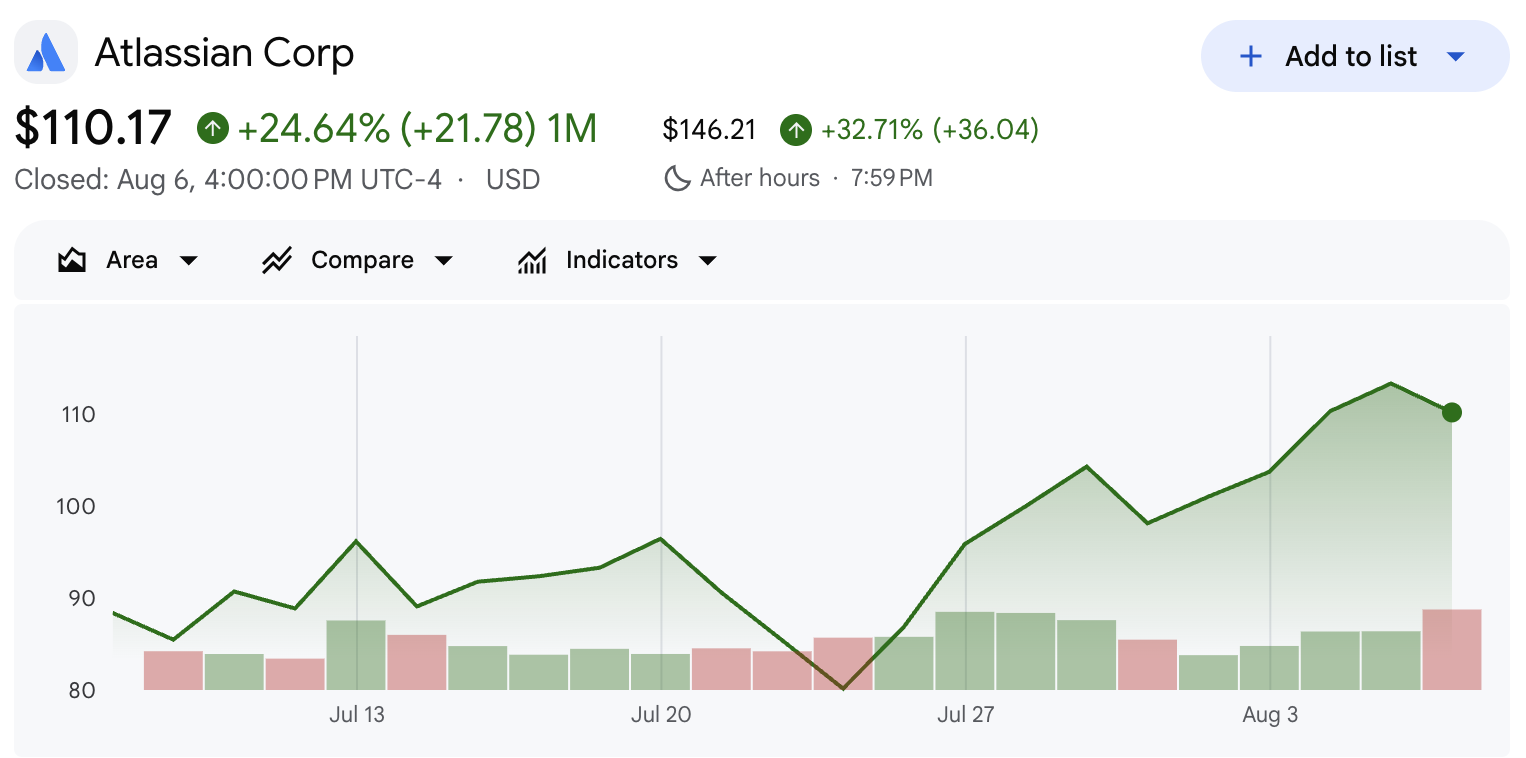
Atlassian stock (NASDAQ: TEAM) jumped more than 35% in after-hours trading, to around $149.51 against a regular-session close of $110.17, after fourth-quarter revenue of $1.77 billion and adjusted earnings of $1.87 a share cleared consensus of roughly $1.66 billion and $1.50.

The company guided FY2027 revenue growth down to about 13% in the same release, from approximately 26% in FY2026, and the stock rose anyway. The explanation sits in one line item: Data Center revenue is expected to fall roughly 17% next year while cloud keeps growing at 25.5%.
Fourth-quarter revenue climbed 28% year over year to $1.77 billion, with cloud revenue up 31% to $1.21 billion. Subscription annual recurring revenue reached $6.61 billion, up 23%, while remaining performance obligations, the contracted revenue Atlassian has not yet recognised, rose 44% to $4.8 billion. Remaining performance obligations grew almost twice as fast as subscription ARR, leaving Atlassian with a much larger pool of contracted revenue still to be recognised.
Profitability moved with the top line. GAAP operating income swung to $211 million from a $28 million loss a year earlier, lifting the quarterly GAAP operating margin to 12% from -2%, while non-GAAP operating margin expanded to 36% and free cash flow reached $475 million on a 27% margin.
Full-year GAAP operating income was $10 million, which puts the quarterly figure in context: Atlassian has only just crossed into GAAP profitability on an annual basis. Q1 revenue guidance of $1.705 billion to $1.715 billion also exceeded consensus near $1.67 billion, with cloud growth of roughly 28.5%, even as management guided full-year revenue growth down to roughly 13%.
Fiscal 2026 revenue reached about $6.57 billion, growth of roughly 26%. Management expects approximately $7.42 billion in FY2027, growth of about 13%. Most of the step down comes from Data Center, which is forecast to shrink around 17% and drag the consolidated figure lower even as cloud compounds.
The FY2027 slowdown reflects two effects from the Data Center transition. Customers pulled purchasing and expansion forward into FY2026 ahead of Data Center end-of-life milestones, inflating the prior-year base and creating harder comparisons.
Customers midway through a cloud migration also tend to hold seat counts flat or defer commitments until the move completes, which suppresses expansion revenue during the transition without eliminating it.
Subscription ARR gives a cleaner reading, because it measures the annualised value of active cloud and Data Center subscriptions and excludes one-time fees. Management guided ARR growth to about 18% from 23%, citing a tougher comparison from the DX acquisition and a conservative view of enterprise budgets. An 18% underlying growth rate is a materially better outcome than 13% suggests, and a materially worse one than 25.5% cloud growth implies on its own.
| FY2027 Guidance | Rate |
|---|---|
| Total revenue growth | ~13% |
| Cloud revenue growth | ~25.5% |
| Data Center revenue growth | ~-17% |
| Subscription ARR growth | ~18%, from 23% |
| Non-GAAP operating margin | ~25%, from 30% |
Two lines in Atlassian’s guidance move in the same direction. Growth slows from 26% to 13% while non-GAAP operating margin falls from 30% to 25%, so FY2027 brings slower expansion and lower profitability at once. Pull-forward effects soften revenue comparisons for roughly a year and cannot carry a growth narrative beyond that, and they do nothing for the margin line.
Cloud growth of 25.5% against consolidated growth of 13% is the arithmetic case for the rally. The commercial case came from the largest customers, and large enterprise contracts provide a more direct revenue signal than product-usage statistics.
Atlassian signed the biggest enterprise agreement in its history during the quarter. Customers above $3 million in ARR increased more than 50% to 164, while the $5 million-plus cohort rose more than 70% to 69.
Both cohorts set company records, and both are expanding faster than the $1 million tier management has highlighted in previous quarters, which indicates the growth is concentrated at the top of the customer base.
Management has previously said Fortune 500 customers account for only around 10% of Atlassian’s business despite broad penetration across the group, leaving substantial room to expand spending inside existing enterprise accounts.
When Atlassian stock rallied 8% in July, the open question was whether AI adoption inside Jira and Confluence would reach the income statement. Rovo users expand their ARR at roughly twice the rate of non-users, and management cites AI and the Teamwork Graph among the leading reasons customers upgrade tiers.
Rovo now reaches more than 80% of the Fortune 500, Rovo-assisted actions rose more than 50% from the prior quarter, and the Teamwork Graph holds more than 150 billion objects and relationships, which management says delivers more accurate answers on fewer tokens.
The relationship does not establish causation. Customers already expanding fastest may also have been more likely to adopt Rovo early, and Atlassian has not broken out Rovo revenue independently. As evidence linking AI usage to paid growth, it still exceeds what most enterprise software peers have produced.
On roughly 254 million shares outstanding, the after-hours move lifts Atlassian’s market value from about $28 billion to roughly $38 billion, or about 5.1 times the $7.42 billion of revenue management has guided for FY2027, against 3.8 times at Wednesday’s close.
The stock is also 64% above the $91.23 it closed at in February, when the market priced it as a structurally impaired business.
Two reference points frame how much of the recovery has already happened. The after-hours price sits above the roughly $139.70 average analyst target that stood before the release, so the sell side has to raise numbers for the move to be justified on published targets.
It also remains about 21% below the 52-week high of $189.69, which leaves room if cloud growth holds. Both statements can be true, and the gap between them is where the FY2027 evidence will land.
The post-earnings surge shows the market is currently willing to treat much of the FY2027 slowdown as a Data Center transition effect rather than evidence that cloud demand has fallen to 13% growth. That tolerance depends on Data Center comparisons staying distorted by the FY2026 pull-forward, and cloud growth falling below the mid-20% range would remove the defence.
Three numbers decide the year. Cloud growth needs to hold near 25%. The $3 million and $5 million cohorts need to keep compounding at current rates. And Rovo needs a disclosed revenue contribution instead of a correlation. A quarter that misses on the first two would make the 13% outlook look less like a transition and more like the run rate.