Published on: 2025-12-29
Updated on: 2025-12-29
Global markets spent the past year relearning an old lesson. When inflation risk falls, and policy rates stop rising, price moves stop being random and start lining up across assets. That shift was visible in stocks, bonds, and metals, and it set clear lines for the next year.
By December 2025, U.S. policymakers had lowered the target range for the federal funds rate to 3.50% to 3.75%, while consumer inflation had cooled to 2.7% year over year in the latest published reading. [1]
Those two numbers explain most of the year’s “why,” and they also explain why 2026 will be defined by the tug of war between easier short-term rates and still-tight long-term financial conditions.
The opportunity for 2026 is not guessing headlines. It is building positions around a small set of measurable drivers: the path of inflation, the path of policy rates, the pace of government borrowing, and how fast the global economy absorbs AI-related investment.
The clearest snapshot is the gap between short- and long-term rates at year's end. On December 26, 2025, the U.S. Treasury curve showed roughly 3.46% on the 2-year and 4.14% on the 10-year. [2]
That is a steep curve by post-pandemic standards, and it matters because it shows that long-term borrowing costs stayed high even as the central bank eased.
Inflation data supported that easing. The latest consumer price report showed 2.7% year-over-year inflation for November 2025. That reading does not mean inflation risk disappeared, but it does mean rate policy was no longer stuck in emergency mode.
The U.S. large-cap benchmark closed at 6,929.94 on December 26, 2025. That level captures two ideas at once: the economy avoided a deep contraction, and investors were still willing to pay for long-duration earnings streams when the policy rate began to fall.
Precious metals reflected the same regime shift. Late-December pricing in the most actively traded U.S. gold futures contract was around $4,519/oz, and the comparable silver contract was around $78.84/oz. When long-term yields remain high, but the policy rate falls, metals tend to trade on currency and insurance demand as much as on inflation.
| Market Measure | Late-2025 Level | Why It Mattered For Positioning |
|---|---|---|
| U.S. Policy Rate Target Range | 3.50% to 3.75% | Easing cycle underway, but not “easy money.” |
| U.S. CPI Inflation (Latest) | 2.7% y/y | Disinflation created room for cuts. |
| U.S. 10-Year Treasury | 4.14% | Long borrowing costs stayed restrictive. |
| S&P 500 Close | 6,929.94 | Equity risk premium stayed compressed. |
| Gold (Active U.S. Futures) | ~$4,519/oz | Demand for hard-asset insurance stayed strong. |
| Silver (Active U.S. Futures) | ~$78.84/oz | Industrial and monetary demand moved together. |
The most important market story of 2025 was the return of predictable inflation. Inflation did not vanish; it just stopped accelerating. That shift gave central banks room to lower short-term rates without signaling panic.
In the U.S., the policy rate was lowered to a 3.50% to 3.75% target range in December. The latest inflation reading available at year's end showed 2.7% year over year. Those two facts helped explain why risk assets kept finding buyers even when headlines were noisy.
Many investors focused on the direction of the policy rate and missed the more important detail: long-term yields did not collapse. With the 10-year yield near 4.14% on December 26, long-dated financing costs stayed meaningful. That kept pressure on interest-sensitive sectors, and it raised the bar for speculative cash-flow stories.
This is the key bridge into 2026. Cuts in the policy rate help valuations, but if long yields stay firm, the benefit is selective, and earnings quality matters more.
Bond markets spent much of the year repricing the endgame. The shift was not simply “rates down.” It was a debate about where rates settle when inflation is near 2% to 3% and governments still borrow heavily.
The late-December curve showed a clear message. The 2-year near 3.46% and the 10-year near 4.14% implied a world in which near-term policy easing is real, but long-term investors still demand compensation for inflation uncertainty and supply risks.
Practical takeaway: 2025 rewarded investors who separated short-rate direction from long-rate stability. That same separation is likely to matter even more in 2026.
Equity performance was strong, but it was not evenly distributed. Leadership clustered around companies with visible earnings power and direct exposure to the AI build-out. The index level near 6,930 at the end of the year reflects a market that priced in continued growth and contained recession risk.
Nvidia’s reported fundamentals explain why AI chips dominated the tape. In its third quarter of fiscal 2026 (quarter ended October 26, 2025), the company reported $57.0B in revenue and $51.2B in data center revenue, with gross margin reported at 73.4% on a GAAP basis.[3] Those numbers are not “sentiment.” They are on a cash-flow scale.
For the full fiscal year 2025, Nvidia reported $130.5B in revenue and GAAP earnings per diluted share of $2.94. That combination of growth and profitability anchored the broader AI trade through 2025.
When a single spending theme drives index gains, drawdowns become sharper when expectations slip. This does not require a crash. It only requires a few quarters in which capacity additions arrive faster than end demand, or when customers slow orders to digest inventory.
The lesson from 2025 is simple: AI investment is real, but the market price can move ahead of the installation schedule.
Gold and silver did more than track inflation in 2025. Investors treated gold as a safe asset when rates, geopolitics, and government borrowing risks moved markets. Silver followed the same safe-haven bid, but its price also reflected tight physical supply and strong industrial demand in sectors such as electronics and data centres.
By late December, spot gold was trading near $4,495.73/oz, while spot silver was near $76.47/oz in Asian hours. Those levels followed sharp year-end swings, including a spike that sent silver through $80/oz and to a fresh record.
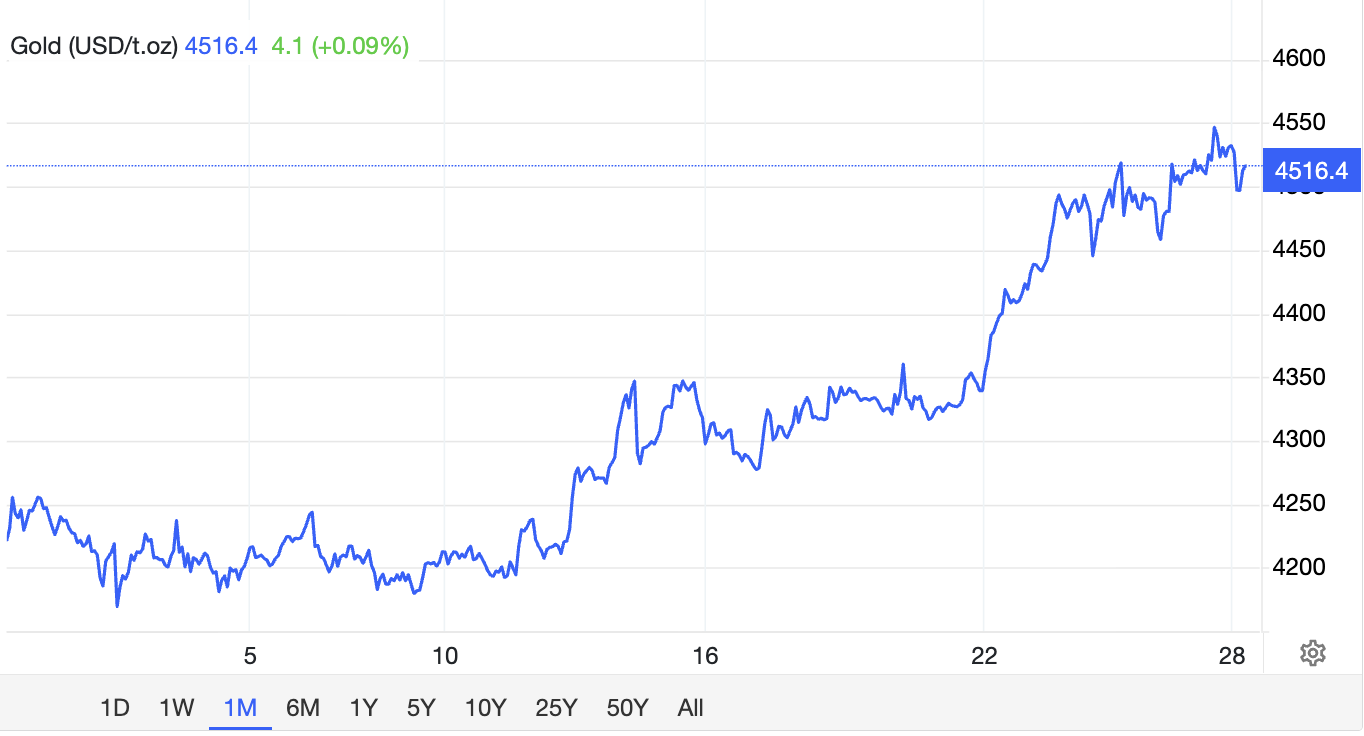
Gold: $2,644.60/oz on Jan 2, 2025 (London fixing) to $4,495.73/oz now, a gain of +70.0%. [4]
Silver: Using the same benchmark set, fine silver was €902.30/kg on Jan 2, 2025, with EUR/USD 1.03180. Converted to $/oz (1 kg = 32.1507 troy oz), that is about $28.96/oz. From $28.96/oz to $76.47/oz, silver is up 164.1%. [5]
Gold all-time high (spot): $4,549.92/oz, reached on Friday, Dec 26, 2025.
Silver all-time high (spot): $84.00/oz, reached on Dec 29, 2025.
A common mistake is to assume that higher long yields always hurt metals. The relationship is tighter with real yields, and the market cared about the direction of policy and the credibility of inflation control. With policy rates easing while long yields stayed firm, metals could rally on currency insurance even without a collapse in nominal yields.
Silver trades like a hybrid. It has monetary value in risk-off episodes and industrial value when manufacturing and electrification demand are strong. That mix can produce larger swings than gold does in either direction.
The best starting point for 2026 is the shape of the curve and the level of inflation. The U.S. policy rate target range is 3.50% to 3.75%, and the 10-year yield is near 4.14%, creating a gap that can be closed in two ways: long yields fall, or short rates rise again.
If inflation stays around 2% to 3%, the more likely path is gradual short-rate easing, with a slow drift lower in long yields. If inflation re-accelerates, long yields can stay high and short rates can stop falling, which usually tightens financial conditions quickly.
A small set of monthly indicators should dominate attention:
Inflation trend, not one print, and especially services inflation
Wage growth and labor market tightness
Government borrowing pace and auction coverage
Corporate earnings revisions, especially in AI-linked spending chains
Currency stress in economies that depend on imported energy or food
Each one maps directly into rates, equity valuation, and metals.
These are frameworks to monitor, not one-size-fits-all advice. Position sizing and risk controls matter more than the idea itself.
Setup: Long-term bonds can perform if inflation remains contained and policy easing continues.
Trigger: Inflation stays near the latest reported 2.7% pace or trends lower.
Risk: A renewed inflation uptrend keeps the 10-year pinned near mid-4% or higher, limiting bond upside.
Setup: The curve at year's end was upward sloping, with the 2-year around 3.46% and the 10-year around 4.14%.
Bull case: Short rates fall faster than long yields, steepening the curve.
Bear case: Long yields rise on supply and deficits, flattening the curve again.
This is a clean macro trade because it does not require predicting earnings; it only requires assessing the balance between policy and bond supply.
Setup: Nvidia’s quarterly revenue scale in 2025 made it a real-time gauge of AI infrastructure demand.
What to watch: Order growth versus delivery capacity, gross margin stability, and the pace of data center spending.
Risk: Any pause in customer ordering can quickly hit sentiment, as expectations are already high.
Setup: Gold held high late-December levels near $4,519/oz in active futures pricing.
Bull case: Policy easing continues while geopolitical and fiscal uncertainty stays elevated.
Bear case: A stronger currency and rising real yields reduce the need for monetary insurance.
A practical approach is to treat gold like portfolio insurance and size it as insurance, not as a leverage bet.
Setup: Silver priced near $78.84/oz late December, reflecting both monetary demand and industrial pull.
Bull case: Manufacturing demand stays firm and monetary hedging demand persists.
Bear case: Growth slows, and volatility fades, pulling silver down faster than gold.
Silver tends to reward disciplined risk limits because its swings are larger.
Setup: The deposit facility rate held at 2.00% in December 2025.
Opportunity: If inflation stays contained, holding higher-yielding cash instruments can remain attractive.
Risk: A sharper growth slowdown forces faster cuts, which can shift currency and rate dynamics quickly.
Disinflation was the core driver. Inflation cooled to 2.7% year over year in the latest U.S. data, and the policy rate was lowered to a 3.50% to 3.75% target range. That changed how investors priced risk across assets.
Long yields reflect growth expectations, inflation uncertainty, and the supply of government bonds. Late December saw a 10-year yield near 4.14% while short rates were lower, suggesting investors still demanded compensation for long-run risks and for bond supply.
AI spending appeared in reported revenue, not just in forecasts. Nvidia reported $57.0B in quarterly revenue for the quarter ended October 26, 2025, with $51.2B from data center. That scale pulled capital toward AI-linked earnings streams.
Inflation mattered, but policy credibility and currency insurance mattered as much. Late-December futures pricing around $4,519/oz for gold and $78.84/oz for silver signaled persistent demand for hard-asset protection and, for silver, industrial usage.
The yield curve is the cleanest signal. With the 2-year around 3.46% and the 10-year around 4.14% late December, 2026 can be framed as a question of whether short rates fall faster than long yields, or the reverse.
A re-acceleration in inflation would be the biggest surprise because it would challenge the easing path. Markets entered the year-end with a 2.7% inflation reading and a lower policy rate range. A reversal would tighten conditions quickly.
The most reliable way to understand 2025 is to focus on the numbers that changed the pricing regime: inflation cooled, policy rates began to fall, and long-term yields remained high enough to keep financing conditions tight.
For 2026, the highest-quality trade ideas are the ones tied to those same drivers. Watch the inflation trend, watch the curve, and treat AI-linked equities and precious metals as expressions of policy and growth expectations, not as isolated stories.
Disclaimer: This material is for general information purposes only and is not intended as (and should not be considered to be) financial, investment or other advice on which reliance should be placed. No opinion given in the material constitutes a recommendation by EBC or the author that any particular investment, security, transaction or investment strategy is suitable for any specific person.
[1] https://www.federalreserve.gov/newsevents/pressreleases/monetary20251210a.htm
[3] https://nvidianews.nvidia.com/news/nvidia-announces-financial-results-for-third-quarter-fiscal-2026
[4] https://www.westmetall.com/en/markdaten.php?action=table&field=USD_ozt_London
[5] https://www.westmetall.com/en/markdaten.php?action=table&field=Ag