Published on: 2026-05-07
Updated on: 2026-05-07
SK Hynix stock may still have upside near KRW 1.6 million, but the KRW 3 million target is a bull case rather than the current consensus view. Reaching that level requires sustained HBM shortages, high AI-memory margins through 2027, and investor acceptance of a higher earnings multiple for memory profits. For new buyers, staged accumulation is more defensible than chasing the rally.
SK Hynix has the earnings power to support the debate. In Q1 2026, the company reported revenue of KRW 52.5763 trillion, operating profit of KRW 37.6103 trillion, and net profit of KRW 40.3459 trillion. Revenue passed KRW 50 trillion for the first time in a quarter, while operating profit and operating margin reached record highs. Operating margin was 72%. (1)
The stock has already moved aggressively. SK Hynix closed at KRW 1,601,000 on May 6, 2026, up 10.64% on the day and 145.93% since January 1, according to MarketScreener end-of-day data. (2)
At this price, buyers are no longer paying for an overlooked memory recovery. They are paying for HBM leadership, tight AI-memory supply, and a market willing to value SK Hynix on durable earnings rather than peak-cycle profits.
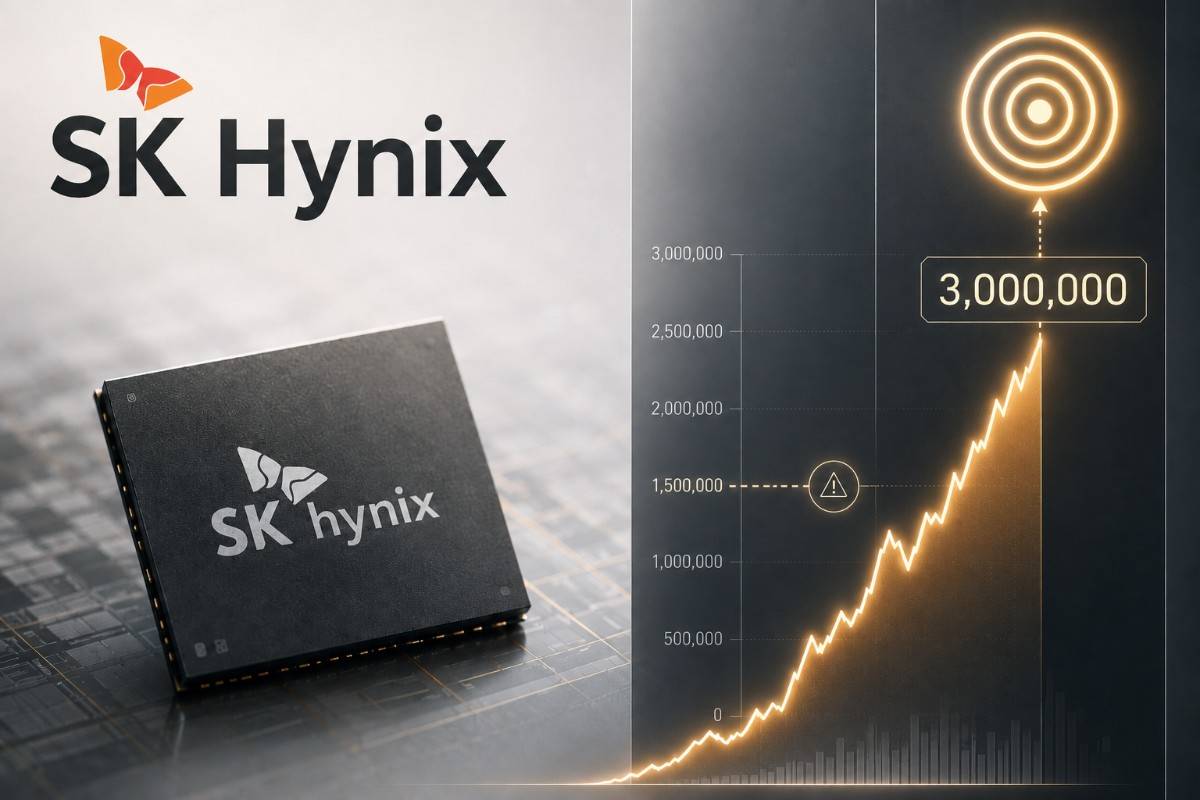
SK Securities raised its SK Hynix target price to KRW 3 million, according to Maeil Business Newspaper, based on a 10x PER framework. (3)
The same report raised SK Hynix’s 2026 operating profit forecast to KRW 262 trillion and its 2027 forecast to KRW 376 trillion.
A KRW 3 million target implies roughly 87% upside from KRW 1.6 million, but that upside depends on a valuation re-rating, not just another strong quarter.
The broader consensus is more cautious. MarketScreener shows 38 analysts, a buy consensus, an average target price of KRW 1,771,866.34, and a high target of KRW 2.5 million.
The main risks are valuation compression, HBM execution, Samsung and Micron competition, memory supply normalization, ADR dilution risk, won exposure, and profit-taking after a sharp re-rating.
The KRW 3 million target is a valuation argument, not just a price forecast.
Maeil Business Newspaper reported that SK Securities raised its SK Hynix target price to KRW 3 million and applied a 10x PER framework. The brokerage also raised SK Hynix’s 2026 operating profit forecast to KRW 262 trillion and its 2027 operating profit forecast to KRW 376 trillion.
The logic depends on a break from old memory-cycle valuation. In previous DRAM cycles, investors often discounted peak earnings because pricing, utilization, and inventory conditions could reverse quickly. A 10x PER framework assumes HBM profits are more visible, more contract-driven, and less exposed to short-cycle spot pricing than conventional memory earnings.
The KRW 3 million case requires five things:
HBM demand must stay ahead of supply, protecting premium pricing and high margins.
Customers must commit to longer supply agreements, improving confidence in forward earnings.
The market must treat AI memory as durable infrastructure demand, not another short DRAM upcycle.
SK Hynix must protect its HBM lead, limiting pricing pressure from Samsung and Micron.
Margins must remain high through 2027, making the 10x PER argument harder to dismiss as peak-cycle optimism.
If investors treat 2026 and 2027 profits as peak-cycle earnings, the KRW 3 million target becomes hard to defend. If they treat SK Hynix’s HBM earnings as scarce, strategic, and more durable, the target becomes plausible.
The KRW 3 million target sits above the broader consensus.
MarketScreener shows an average analyst target of KRW 1,771,866.34, implying only 10.67% upside from the May 6 close. Its high target is KRW 2.5 million, below the KRW 3 million figure reported by MK.
The gap shows that the KRW 3 million case depends more on multiple expansion than on consensus earnings alone. Strong earnings alone may not be enough. The market must also decide that SK Hynix deserves a higher multiple because AI memory demand has changed the quality of its profits.
The answer depends on the investor:
Existing holders with a low cost base: holding is easier to justify, but margin durability and HBM execution need close monitoring.
Momentum buyers: the trade can still work, but risk controls matter after the sharp rally.
Long-term AI infrastructure investors: staged entries are more disciplined than chasing one-day strength.
Valuation-sensitive buyers: waiting for a pullback or stronger proof of sustained margins is more reasonable.
Conservative investors: the KRW 3 million target should not be treated as the base case.
SK Hynix remains one of the clearest listed exposures to AI memory demand. The company has record profitability, a stronger balance sheet, high-value HBM exposure, and a credible argument for a higher valuation than in previous memory cycles.
The stock’s main weakness is no longer the business. It is the price investors must now pay for that business.
At KRW 1.6 million, buyers are paying for sustained HBM tightness, continued AI infrastructure spending, and margin durability. That is a stricter setup than buying an early recovery in a depressed memory cycle.
A fresh buy now requires confidence that Q1 2026 was not peak profitability. A hold is easier to justify for investors already positioned at lower prices. New buyers should treat the KRW 3 million target as an upside scenario, not the central case.
| Metric | Q1 2026 figure | Read-through for SK Hynix stock |
|---|---|---|
| Revenue | KRW 52.5763 trillion | First quarterly revenue above KRW 50 trillion |
| Operating profit | KRW 37.6103 trillion | Record operating profit |
| Operating margin | 72% | Premium memory pricing remains exceptionally strong |
| Net profit | KRW 40.3459 trillion | Earnings exceeded old-cycle expectations |
| Cash and cash equivalents | KRW 54.3 trillion | Stronger balance sheet for AI-memory investment |
| Interest-bearing debt | KRW 19.3 trillion | Lower balance-sheet pressure |
| Net cash position | KRW 35 trillion | Greater flexibility for capex and shareholder returns |
SK Hynix said Q1 demand remained strong despite normal first-quarter seasonality, as AI infrastructure investment continued to expand. The company cited higher sales of HBM, high-capacity server DRAM modules, and enterprise SSDs.
It also ended Q1 with KRW 54.3 trillion in cash and cash equivalents, KRW 19.3 trillion in interest-bearing debt, and a net cash position of KRW 35 trillion.
A 72% operating margin gives the re-rating case hard evidence, but it also raises the risk of disappointment if profitability normalizes.
HBM gives SK Hynix stronger pricing power because supply is harder to add quickly, customer qualification is stricter, and AI customers may reserve capacity earlier than in traditional DRAM cycles. MK reported that SK Securities cited discussions on three- to five-year-long-term supply contracts as support for a longer, less volatile memory-demand profile.
| Scenario | Price reference | Assumption | Retail-investor read-through |
|---|---|---|---|
| Bull case | KRW 3 million | HBM supply stays tight, contracts improve earnings visibility, and SK hynix receives a higher PER | Large upside remains, but the stock must keep proving margin durability |
| Base case | KRW 1.8 million to KRW 2.1 million | Earnings remain strong, but multiple expansion slows after the rally | Upside exists, but risk-reward is less attractive than earlier in the cycle |
| Risk case | Below KRW 1.6 million | Margins peak, HBM execution disappoints, or investors return to peak-cycle valuation logic | The stock can fall even if SK hynix remains highly profitable |
The base case deserves more weight than the KRW 3 million headline for most retail investors. The average analyst target is much closer to the current price than to the bull case, which means new buyers are relying on further upgrades or a change in how the market values memory earnings.
SK Hynix does not need weak results to fall. A merely good quarter could trigger selling if the market has priced in record margins, continuing HBM shortages, and flawless execution.
Margin normalization is the first risk. A 72% operating margin leaves little room for disappointment. A visible decline could push investors back toward old-cycle valuation logic.
HBM execution is the second risk. HBM depends on yield, packaging, customer qualification, and timing with major AI accelerator platforms. Delays in next-generation products could pressure sentiment even if broader AI memory demand remains firm.
Competition is the third risk. Samsung and Micron have strong financial incentives to close the HBM gap. Faster supply additions would weaken SK Hynix’s pricing power.
The ADR structure also needs attention. SK Hynix has confirmed that it is seeking a U.S. ADR listing and confidentially submitted a registration statement to the SEC, but the offering size, structure, timing, and final decision have not been decided. If the listing uses new shares, dilution becomes a real cost. If it mainly improves access without heavy issuance, the market may focus more on liquidity and global visibility. (4)
Foreign investors also face won exposure, Korea Exchange trading hours, and broker-access limits. SK Hynix ordinary shares are listed on the Korea Stock Exchange, while its depositary receipts are listed on the Luxembourg Stock Exchange.
Yes. SK Hynix ordinary shares trade on the Korea Stock Exchange under ticker 000660. Access depends on whether a brokerage supports Korean equity trading. The company also has depositary receipts listed on the Luxembourg Stock Exchange.
Not yet as a standard U.S.-listed ADR. SK Hynix has confirmed that it confidentially submitted a registration statement to the SEC for a potential ADR listing, but the size, structure, timing, and final decision remain unconfirmed.
SK Hynix is fundamentally strong, but the stock is no longer low-risk near KRW 1.6 million. The bullish case depends on tight HBM supply, high margins, and a higher market multiple for AI-memory earnings. The cautious case rests on valuation risk, consensus targets below KRW 3 million, and the continuing cyclicality of memory.
The KRW 3 million target can be justified only if SK hynix proves that AI memory has changed its earnings profile.
The company has evidence to support that argument: record revenue, record operating profit, a 72% operating margin, high-value HBM demand, and a KRW 35 trillion net cash position.
The stock price already reflects much of the good news. At around KRW 1.6 million, further upside depends on sustained HBM pricing power, smooth execution, and a market willing to move away from old-cycle memory valuation.
SK Hynix remains high quality. New buyers have less room for disappointment than they had earlier in the rally.
(1) https://news.skhynix.com/q1-2026-business-results/
(2) https://www.marketscreener.com/quote/stock/SK-HYNIX-INC-6494929/consensus/