Published on: 2026-01-08
Updated on: 2026-01-08
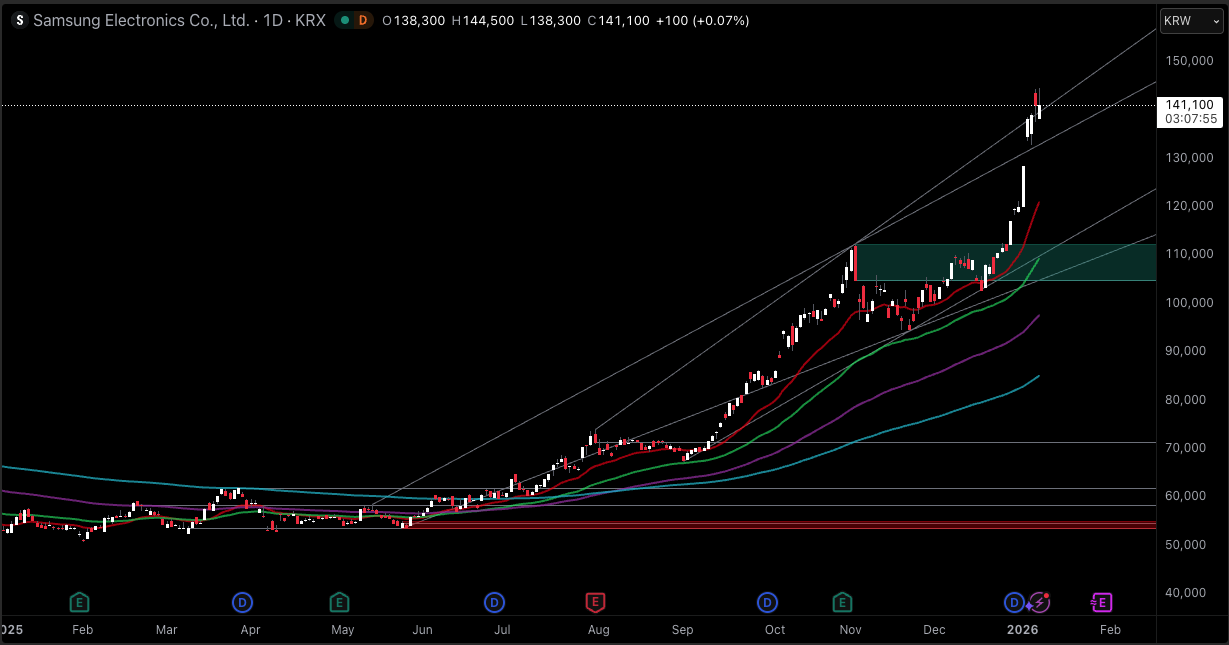
Samsung earnings are surging because AI data centres are buying far more memory than the last wave of computing, and supply is not keeping up. That tightness is lifting memory prices and pushing extra profit straight to Samsung’s bottom line.
On 8 January 2026, Samsung issued preliminary guidance for the quarter ending December 2025, pointing to a step-change in profitability. It guided to an operating profit of about US$13.8bn on revenue of roughly US$64.3bn, almost three times the operating profit posted a year earlier. [1]
Numbers at a glance (converted to US dollars)
Q4 2025 guidance (Oct–Dec 2025): Revenue ~US$64.3bn; operating profit ~US$13.8b
Q4 2024 actual (Oct–Dec 2024): Revenue ~US$52.4bn; operating profit ~US$4.5b
Q3 2025 actual (Jul–Sep 2025): Revenue ~US$59.5bn; operating profit ~US$8.4bn
Note on currency: Samsung reports in Korean won. For clarity, all figures above are converted at a single spot rate of about US$1 ≈ ₩1,446.17 (8 January 2026), so period-to-period changes reflect Samsung’s underlying results, not changing exchange rates.
The scale of the swing matters. On these figures, Samsung’s operating margin (operating profit divided by revenue) would be roughly 21% in Q4 2025, versus about 9% in Q4 2024 and about 14% in Q3 2025.
Samsung will publish the full division breakdown with its detailed results on 29 January 2026.
AI servers do not behave like normal servers. They need more memory, and they need faster memory.
More DRAM per server: AI systems move huge datasets, so memory footprints rise
HBM becomes essential: High-bandwidth memory (HBM) sits close to AI accelerators and feeds them data fast enough to keep compute busy.
Supply is slower to scale: HBM depends on complex stacking, testing, and advanced packaging steps, which limit how quickly output can grow.
Pricing signals show how tight conditions became. In late 2025, DDR5 DRAM contract pricing was cited as up about 313% year-on-year in the fourth quarter—an extreme move that highlights how fast the market tightened when AI demand met constrained supply. [2]
Memory is cyclical. When the industry overbuilds, prices fall hard. When the industry cuts back, the next demand wave can hit a leaner supply base.
The backdrop to today’s surge is that the memory sector spent much of the last cycle repairing damage from a downturn. Producers became more cautious about adding capacity and focused on higher-value products. Then AI spending accelerated, and the demand mix shifted towards premium memory.
That creates a double effect. Capacity is pulled towards AI-focused products like HBM and advanced server DRAM, while demand for mainstream DRAM does not disappear. The result is tightness across the ladder: premium products get scarce first, but the knock-on effect can lift pricing in conventional DRAM as well.
Memory is a fixed-cost business. Once factories are running, a higher selling price can translate into a much larger jump in operating profit.
Three levers are doing most of the work:
Pricing: Supply tightness pushes prices up, lifting margins.
Mix: A bigger share of HBM and server-grade DRAM improves profit per unit.
Operating leverage: Fixed costs mean profits can rise faster than revenue in an upturn.
This combination suggests Samsung can deliver record profit without needing a dramatic surge in unit shipments, as long as pricing and mix keep improving.
HBM is the strategic battleground in AI, but Samsung’s earnings swing is also powered by “regular” DRAM. Conventional memory still underpins PCs, smartphones, and general servers. When manufacturers redirect resources towards high-end AI memory, the rest of the DRAM market can tighten too—lifting prices across a much larger base.
For Samsung, scale matters. Broad-based DRAM price gains, applied across its footprint, can move profits sharply even before HBM volumes peak. That is also why investors watch not just HBM milestones, but the tone on wider DRAM supply discipline.
It is tempting to assume supply will surge the moment prices rise. With HBM, it often does not. HBM uses stacked memory dies connected through tiny vertical links, and it must meet strict performance and reliability targets under heavy workloads.
Those steps make production slower and qualification tougher. Even when wafer output rises, packaging and testing can become bottlenecks, and customers do not switch suppliers overnight. That is why a period of tightness can persist longer than in older memory cycles.
Samsung’s guidance gives the headline numbers. The detailed release should clarify:
How much of the jump came from semiconductors versus mobile and display
Whether the quarter was mainly price-led or mix-led
How Samsung is thinking about capacity and spending for 202
Management’s language on HBM progress and customer ramp
Whether memory tightness is expected to persist into the first half of 2026
These details will shape whether the market treats the surge as a one-off spike or a more durable shift.
Samsung is a bellwether for the electronics cycle and a major component of Asian equity indices. A sharp earnings upswing can lift sentiment across the semiconductor supply chain, from equipment makers to packaging and materials firms.
There is also a second-order effect: if memory stays expensive, it raises costs for cloud operators and for hardware makers that do not control their own memory supply. Over time, that can influence device pricing, corporate IT budgets, and the pace of data-centre buildouts.
Samsung’s decision to repurchase about US$1.73bn of shares for performance-linked employee and executive compensation adds another market signal: management is tying rewards to what looks like a strengthening profit cycle.
Three risks deserve attention.
Demand pull-forward: Customers may be buying early to secure supply, which can soften later quarters
Supply response: High prices encourage the industry to add capacity, which can unwind pricing power
Execution risk: HBM ramping depends on yields, packaging, and qualification timelines. [3]
Even if AI demand remains strong, memory can still swing if either supply or timing changes.
Why are Samsung's earnings rising so fast?
Because memory prices are rising sharply, and memory has high operating leverage.
What did Samsung guide for Q4 2025?
Revenue of ~US$64.3bn and operating profit of ~US$13.8bn for the quarter ending December 2025 (converted at US$1 ≈ ₩1,446.17 for comparability).
What is the key date for more details?
Samsung’s full earnings release is scheduled for 29 January 2026.
Samsung earnings are surging because AI has made memory scarce again. Data centres need more DRAM and more specialised, high-margin HBM, and supply is tightening at the same time. With prices rising across both premium and conventional memory, margins are widening and operating profit is jumping.
The next test is sustainability. If demand stays strong and capacity remains disciplined, the upswing can persist through 2026. If supply ramps too quickly or buying has been pulled forward, the cycle can turn. For now, Samsung is benefiting from a rare position in the AI buildout: it sells one of the constraints.
Disclaimer: This material is for general information purposes only and is not intended as (and should not be considered to be) financial, investment, or other advice on which reliance should be placed. No opinion given in the material constitutes a recommendation by EBC or the author that any particular investment, security, transaction, or investment strategy is suitable for any specific person.
[3] https://www.ft.com/content/6deae58c-29ae-4a52-b42b-0f41802edccf?