Published on: 2026-06-18
The KOSPI crossed 9,000 intraday for the first time on June 18, 2026, marking a historic breakout for South Korea’s benchmark equity index.
The index has surged from 4,309.63 on Jan. 2 to above 9,000, a gain of about 109% year-to-date, placing Korea among 2026’s strongest major equity markets.
Samsung Electronics and SK hynix led the advance, with AI-driven demand for high-bandwidth memory and advanced DRAM lifting earnings expectations across Korea’s semiconductor sector.
Domestic investors absorbed foreign profit-taking, as individuals bought KRW 632.1 billion and institutions bought KRW 117.6 billion, while foreign investors sold KRW 683.9 billion.
SK hynix climbed 5.67% to KRW 2,664,000, while Samsung Electronics rose 2.16% to KRW 354,000, reinforcing the semiconductor sector’s dominance in the rally.
Daishin Securities raised its KOSPI target to 11,500, but concentration risk remains elevated as the index becomes increasingly dependent on AI chip earnings momentum.
The KOSPI hit the 9,000 milestone for the first time on June 18, 2026, as South Korea’s benchmark index crossed the threshold during intraday trading, powered by Samsung Electronics, SK hynix and a sharp rally in AI-linked semiconductor stocks.
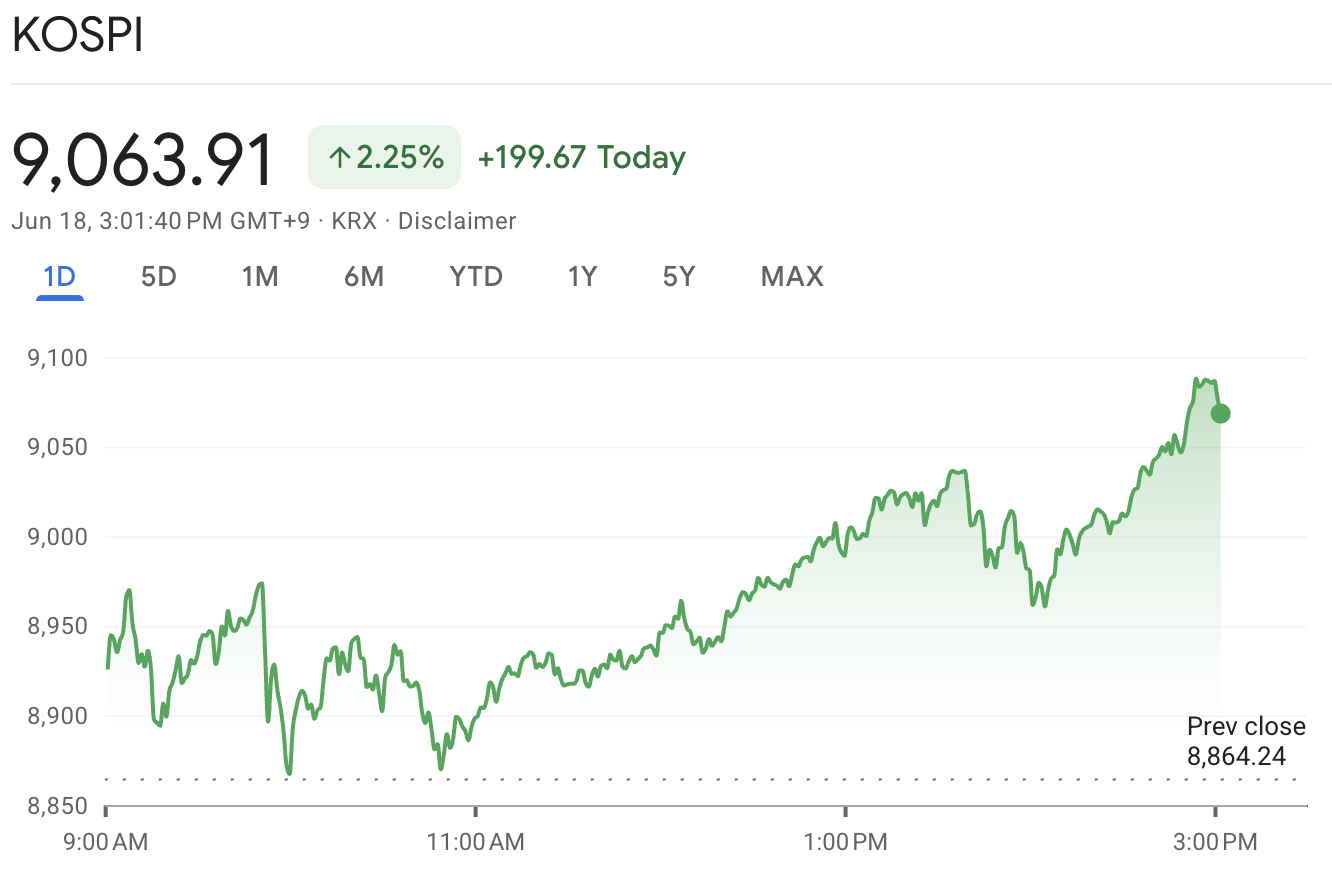
The move ranks among Asia’s fastest major equity-market re-ratings. At 1:10 p.m. KST, the KOSPI was trading at 9,021.34, up 1.77%, only 34 days, or 22 trading sessions, after first breaking above 8,000. By 1:54 p.m., the index was reported at 9,011.04, lifting its year-to-date gain to about 109.08% from the first trading day of 2026.
| Indicator | Latest Reported Reading | Market Meaning |
|---|---|---|
| KOSPI intraday level | 9,021.34 at 1:10 p.m. KST | First move above 9,000 |
| Later reported level | 9,011.04 at 1:54 p.m. KST | Breakout held into afternoon trade |
| Opening level | 8,884.92 | Positive open before acceleration |
| Year-to-date gain | About 109.08% | Major-market outperformance |
| Individual net buying | KRW 632.1 billion | Retail demand remained active |
| Institutional net buying | KRW 117.6 billion | Domestic funds supported the move |
| Foreign net selling | KRW 683.9 billion | Overseas investors took profit |
| SK hynix | KRW 2,664,000, up 5.67% | AI memory leader hit a fresh record |
| Samsung Electronics | KRW 354,000, up 2.16% | Index heavyweight extended gains |
The KOSPI’s move above 9,000 was more than a round-number break. It reflected a deeper revaluation of Korean equities as investors positioned for the next stage of the AI memory cycle.
The index opened at 8,884.92, up 20.68 points, or 0.23%, before extending gains through midday. Local reports placed the KOSPI at 9,021.34 by 1:10 p.m. and 9,011.04 by 1:54 p.m. The readings differ by timestamp, but both confirm the same market event: South Korea’s benchmark topped 9,000 for the first time during intraday trading.
The available reports confirm an intraday break above 9,000. A final close above the threshold had not yet been established.
The scale of the advance is exceptional. From 4,309.63 on Jan. 2 to above 9,000 on June 18, the KOSPI has more than doubled in less than six months.
The speed stands out in historical context. The index took more than 18 years to move from 1,000 to 2,000 and more than 13 years to move from 2,000 to 3,000. Its latest climb through successive thousand-point levels has unfolded far faster, reflecting a major reassessment of Korea’s role in the global technology supply chain.
Investors are no longer treating Korea only as an export-sensitive market. They are valuing it as a direct gateway to high-bandwidth memory, advanced DRAM and the semiconductor capacity required by global AI data centers.
The KOSPI’s move above 9,000 remains a semiconductor story first. SK hynix rose 5.67% to KRW 2,664,000, setting another all-time high. Samsung Electronics gained 2.16% to KRW 354,000, reinforcing its role as the index’s dominant heavyweight.
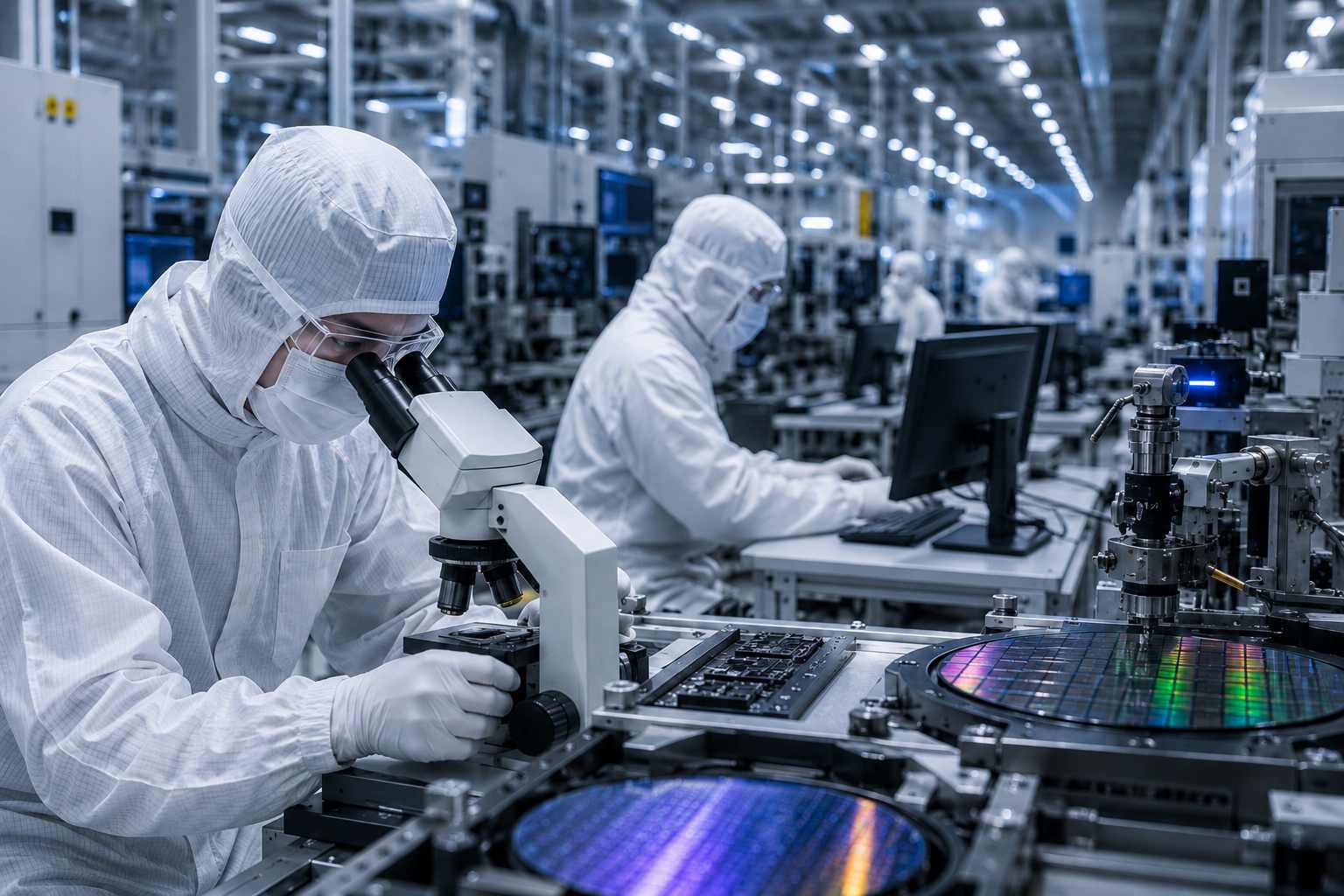
Both companies sit at the center of the AI memory cycle. Demand for high-bandwidth memory has accelerated as global technology companies expand AI data-center capacity.
Supply remains tight because advanced memory production depends on complex packaging, long qualification cycles and disciplined capital spending.
That gives Korean chipmakers pricing power and earnings leverage. Daishin Securities raised its KOSPI target from 8,800 to 11,500, saying the market had entered a “performance and policy market.” The firm expects semiconductor operating profit to rise 56% quarter-on-quarter in the second quarter, with net profit up 37%.
Thursday’s flow data showed that the rally was not driven by foreign capital alone. Individual investors bought KRW 632.1 billion and institutions bought KRW 117.6 billion, while foreign investors sold KRW 683.9 billion.
The pattern suggests overseas investors used the 9,000 break to lock in gains after a historic run, while domestic demand absorbed the selling pressure.
Sector performance also showed narrow leadership. Electrical and electronics rose 3.53%, and manufacturing gained 2.28%, while construction fell 4.08% and metals declined 4.06%.
This was not a broad risk-on move. It was a targeted repricing of Korea’s AI chip leaders.
The market’s next debate is whether the rally has enough earnings support to move toward 10,000.
The bullish case rests on persistent HBM shortages, rising earnings revisions and continued narrowing of the Korea discount. If Samsung Electronics and SK hynix deliver margins that match current expectations, investors may keep treating pullbacks as buying opportunities.
The bearish case is equally clear. The index has moved far in a short period, and chip-price expectations now carry a heavier burden. Any disappointment in AI capital expenditure, HBM pricing or customer demand could trigger a sharp correction.
The KOSPI’s strength also creates a more concentrated risk profile. Samsung Electronics and SK hynix have become both the engine and the pressure point of the index.
A narrow rally can keep pushing higher while leadership remains intact. It can also reverse quickly when momentum stalls. The next earnings cycle will need to show that AI memory demand is translating into sustained margins, not just higher revenue expectations.
Foreign selling also deserves attention. If U.S. yields rise, the won weakens or global technology shares correct, overseas profit-taking could intensify. Domestic investors have absorbed selling so far, but sustained foreign outflows would test the rally’s resilience.
The KOSPI hit 9,000 because investors repriced South Korean equities around AI semiconductor demand. Samsung Electronics and SK hynix led the move as memory shortages, HBM demand and stronger earnings forecasts supported a major market re-rating.
The available reports confirm that the KOSPI crossed 9,000 during intraday trading. They do not confirm a final closing level above 9,000. The most accurate wording is that the index broke above 9,000 intraday.
Samsung Electronics and SK hynix were the main drivers. SK hynix hit a fresh record high, while Samsung Electronics extended gains as investors priced in stronger AI memory demand and higher semiconductor margins.
The KOSPI can reach 10,000 if semiconductor earnings continue rising and valuation normalization extends. The path is unlikely to be smooth because the index is heavily concentrated in chipmakers.
The KOSPI hitting 9,000 is a defining moment for South Korea’s capital market. The rally is built on AI memory scarcity, rising semiconductor earnings and a global reassessment of Korea’s role in the technology supply chain.
The milestone also raises the market’s burden of proof. After a roughly 109% year-to-date surge, the next stage will require earnings delivery, not just momentum.
Korea Exchange, official market data:
https://data.krx.co.kr/contents/MDC/MAIN/main/index.cmd?locale=en
Korea Exchange, global official portal:
Goldman Sachs Research:
https://www.goldmansachs.com/insights/articles/koreas-stock-market-is-forecast-to-set-fresh-highs