Published on: 2026-06-22
Cathie Wood’s ARK did not sell Roku because the Fox bid broke the thesis. It sold after Fox’s $160 offer turned Roku from a streaming-growth stock into a deal-spread asset. The sale looks like disciplined capital recycling, but ARK’s performance record means the replacement bets must now prove they were worth the certainty ARK gave up.
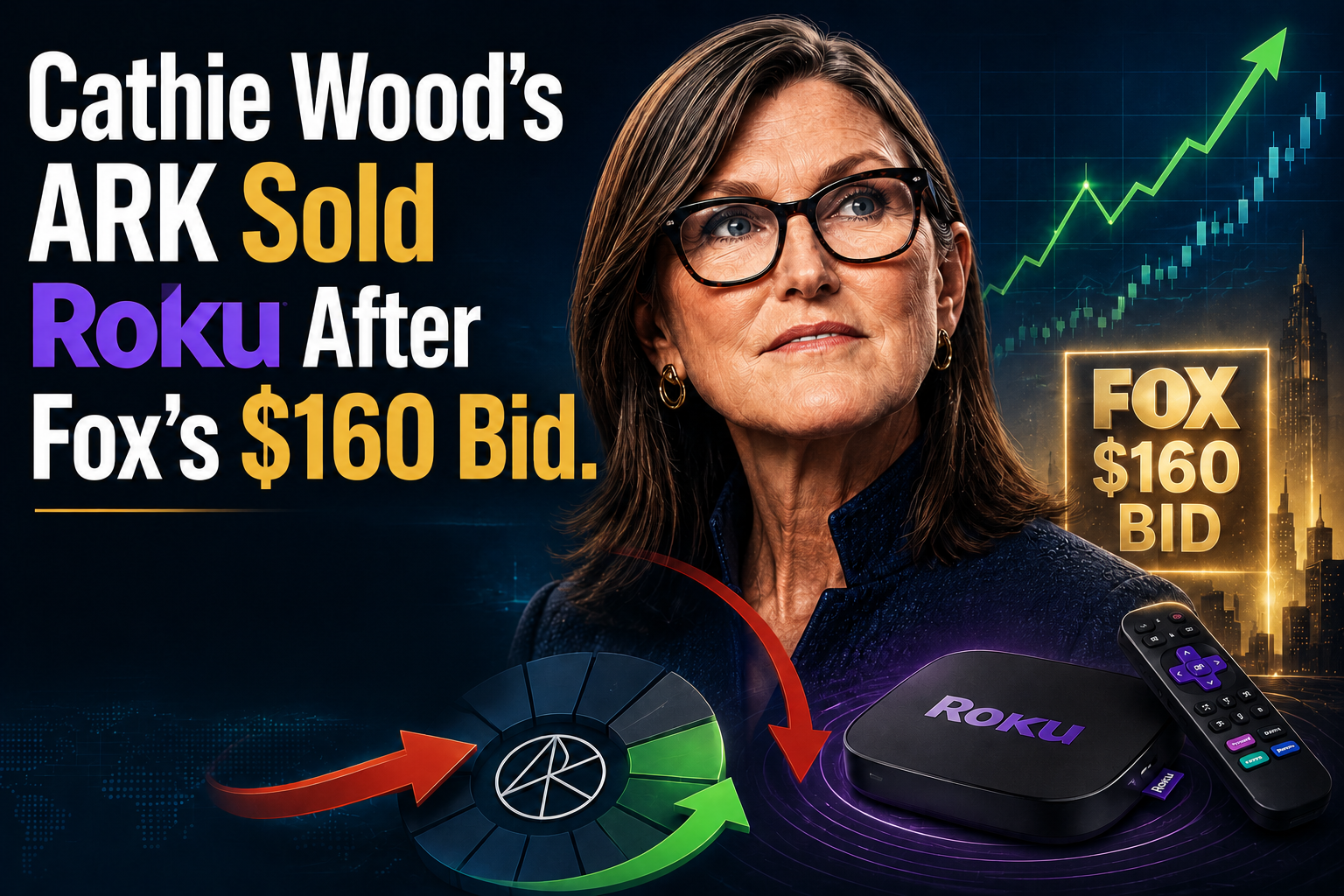
Fox agreed to acquire Roku for about $22 billion, with shareholders receiving $160 per share, consisting of $96 in cash and 0.9693 Fox Class A shares. Roku’s remaining return is now tied to Fox’s share price, approvals and closing risk, not only streaming growth.
ARK reportedly sold 239,267 Roku shares across ARKK, ARKW and ARKF, worth about $33.01 million, after the Fox deal pushed Roku closer to a defined transaction value.
ARK also sold 275,572 Robinhood shares through ARKK, worth roughly $26.7 million, after the stock rallied on optimism about margin expansion and cost-cutting.
ARK did not de-risk. It recycled capital into innovation exposure, including holdings linked to Eli Lilly, Coinbase, Block, Snowflake, Tesla, and SpaceX.
The test is whether ARK’s replacement basket beats Roku’s remaining deal-adjusted return before the Fox transaction closes.
Fox’s June 15 agreement gave Roku something growth stocks rarely receive with certainty: a transaction price. The offer values Roku at $160 per share, split between $96 in cash and 0.9693 Fox Class A shares for each Roku share. Fox shareholders are expected to own about 73% of the combined company, while Roku shareholders would own about 27%.
Roku stopped trading as a pure streaming recovery story after the bid. Before the announcement, the stock was priced on connected-TV advertising, platform monetisation, user growth and streaming sentiment. After the announcement, it became a deal-spread trade, with the remaining return depending on Fox’s share price, regulatory approval, shareholder approval, and the expected first-half 2027 closing window.
The Fox deal was not a rejection of Roku’s strategic value. It was a validation of it. Fox is buying distribution, first-party data, connected-TV reach and a larger position in ad-supported streaming. The proposed combination would bring together Roku’s operating system, The Roku Channel, and advertising data with Fox’s live sports, news, and entertainment, as well as Tubi assets.
That validation attracted a different buyer base. Event-driven funds could price the deal spread. Merger-arbitrage desks could model approval risk. Momentum accounts could trade the takeover reaction. A large holder had a cleaner market to reduce exposure.
ARK’s sale, therefore, reads less like a claim that Roku became unattractive and more like a decision that Roku no longer fit the same risk category. The stock moved from open-ended growth optionality to a transaction-linked return profile. That is a defensible reason to trim.
The uncomfortable part is opportunity cost. ARK held Roku through years of volatility and reduced exposure only after the company received external validation. The sale is not automatically wrong, but it now has to beat a visible benchmark.
Roku and Robinhood rallied for different reasons. Roku had an external transaction price. Robinhood had an operating story, with Reuters-cited reporting saying the company would cut about 10% of its full-time workforce as management pushed for a leaner cost base. ARK reportedly sold 275,572 Robinhood shares through ARKK after the move, worth about $26.65 million.
The Roku sale was driven by a different catalyst. ARK reportedly sold 239,267 Roku shares across ARKK, ARKW and ARKF after the Fox deal, worth about $33 million. The event gave Roku a defined valuation path instead of a purely speculative upside case.
The shared feature was liquidity. Robinhood had momentum. Roku had deal validation. ARK used both moments to raise capital.
That does not mean ARK was abandoning risk. It means ARK was selling positions where the near-term catalyst had become more visible and moving toward positions where the upside remained harder to price.
The cash did not move into a defensive shelter. ARK reportedly added exposure to names including Eli Lilly, Coinbase, Block, Snowflake and SpaceX-linked holdings, keeping the rotation inside innovation themes rather than shifting toward lower-volatility assets.
That indicates the Roku sale was not a retreat from risk. It was a move from a stock with more defined upside into positions where the upside remained harder to price.
Roku had become a deal-linked asset after Fox’s $160 bid. Robinhood had rallied on a cleaner margin story. ARK used both moments of improved liquidity to raise capital and redeploy into less certain opportunities.
That is the real test. ARK did not sell Roku because the thesis failed. It sold after the thesis became easier to value. The decision only works if the replacement holdings generate a better risk-adjusted return than the clearer Roku spread ARK left behind.
For readers tracking how ARK’s replacement basket behaves relative to Roku’s deal-linked return, EBC’s stock CFDs platform provides access to selected global equities and allows both long and short positions without owning the underlying shares.
Cathie Wood’s critics have numbers to back up their complaint. ARKK remains a visible symbol of pandemic-era growth investing, but the fund has struggled since interest rates rose and long-duration equities repriced. Yahoo Finance lists ARKK’s YTD total return at 4.25%, while FinanceCharts shows a -7.42% five-year average annual return through June 18, 2026.
That record changes how the Roku sale is judged. A manager with recent outperformance gets more room to sell a validated winner and fund the next idea. A manager with a weak benchmark comparison gets less benefit of the doubt.
ARKK is built to seek long-term capital growth through disruptive innovation, investing at least 65% of its assets in companies aligned with that theme under normal conditions. The mandate explains the sale. It does not prove the sale will work.
ARK disclosures are valuable because they show how one visible growth manager is reallocating capital. They are limited because they do not reveal internal price targets, redemption pressure, sizing rules, tax considerations, risk controls, or the opportunity cost behind each trade.
The Roku sale is a good example. A raw alert says ARK sold Roku. The portfolio context says Roku shifted from a streaming-growth thesis to a Fox-linked deal-spread trade. The second reading is more useful than the first.
A cleaner test for any ARK disclosure is narrow:
Did the stock change category after a catalyst?
Did ARK trim the position or abandon it?
Did the proceeds move into safer assets or new high-beta risk?
Does ARK’s performance record justify copying the move?
The buy-or-sell label is the least useful part of the disclosure. The catalyst, timing and destination of capital matter more.
The Fox-Roku deal is expected to close in the first half of 2027, subject to approvals. That gives ARK’s rotation a visible performance clock.
Roku now offers a defined path tied to the $160 deal value, Fox’s share price and closing risk. ARK’s new risk sits in less certain areas, including crypto infrastructure, fintech, healthcare innovation, software and platform technology.
That is the cleanest test of the move. ARK does not need Roku to fail. It needs to move capital out of Roku and Robinhood to earn a better risk-adjusted return than the certainty it sold.
ARK likely sold because the Fox deal changed Roku’s risk profile. Once Fox offered $160 per share, Roku’s remaining upside became tied to deal completion, Fox’s share price, and the spread to the transaction value, rather than only to Roku’s standalone growth thesis.
No. A deal can be attractive and still offer less upside for an active growth fund after the announcement. ARK may have decided that capital had a higher expected return in less-mature, higher-volatility opportunities.
ARK remains useful as a visible flow signal in speculative growth, fintech, crypto, healthcare innovation and platform technology. Its underperformance makes blind imitation harder to justify, but its trades still show where one major thematic manager is moving risk.
No. A trade disclosure shows what changed inside ARK’s funds, not whether the trade fits another portfolio. The useful information is the rotation pattern, the catalyst timing and the type of risk ARK is adding or removing.
ARK sold a stock whose upside had become easier to measure and moved capital into assets where the upside remains harder to price. That fits Cathie Wood’s innovation mandate, but it does not settle the question of performance.
The test is now visible. Roku’s remaining return depends on Fox’s $160 deal value, Fox’s share price and closing execution. ARK’s new risk depends on less certain outcomes across crypto, fintech, healthcare innovation, AI software and platform technology.
The sale was not automatically wrong. Roku had changed its category from open-ended streaming growth to a deal-linked return profile. But once ARK sold at an implied price near $138, it gave up an apparent spread of roughly 16%.