Published on: 2026-01-27
Updated on: 2026-01-27
The Federal Reserve meets this week with a simple base case. The Fed is widely expected to hold rates steady at 3.50% to 3.75% at the January 27–28, 2026, meeting.
Markets expect no move on rates with a 90% odd, but they still expect a message that matters. When the Fed is close to the next turning point, the decision often feels boring, and the tone does the real work.
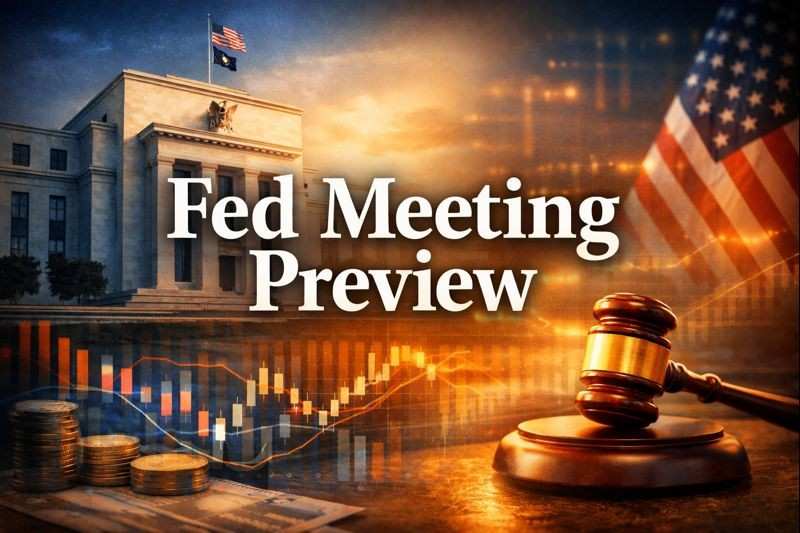
Therefore, this meeting is less about the headline decision and more about the message that it conveys. Traders will be watching for any hint that the Fed is leaning towards a dovish hold or a hawkish hold.
There is also a second layer that markets cannot ignore: political pressure and central bank independence risk have become a bigger theme around this meeting.
| Event | U.S. Eastern Time |
|---|---|
| FOMC statement | Wed, Jan 28, 2:00 p.m. ET |
| Powell press conference | Wed, Jan 28, 2:30 p.m. ET |
This is a two-day meeting, with the statement on the second day. According to the official schedule, the committee will release the statement at 2:00 p.m. Eastern Time, and the Chair will hold a press conference at 2:30 p.m. Eastern Time.
This meeting does not include a new Summary of Economic Projections (SEP), because the Fed only publishes those at specific meetings marked on its calendar.
The Fed's job is to balance inflation control with maximum employment. Currently, the latest official data suggests patience rather than urgency.
| Indicator | Latest Reading | Why it matters for this meeting |
|---|---|---|
| Fed funds target range | 3.50% to 3.75% | Starting point for any guidance |
| CPI (YoY) | 2.7% (Dec 2025) | Inflation is lower, but still above 2% |
| Core CPI (YoY) | 2.6% (Dec 2025) | Sticky services inflation remains a watch |
| PCE price index (YoY) | 2.8% (Nov 2025) | Fed’s preferred inflation yardstick |
| Nonfarm payrolls | +50,000 (Dec 2025) | Hiring is slowing, not collapsing |
| Unemployment rate | 4.4% (Dec 2025) | Fed watches labour slack closely |
CPI inflation was 2.7% YoY in December 2025, with core CPI at 2.6%.
The PCE price index was 2.8% YoY in November 2025 (the Fed's preferred inflation gauge).
Inflation is not out of control, but it has not been completely resolved either. That is one reason the Fed can defend a hold.
The December jobs report showed a 50,000 increase in payrolls, with the unemployment rate at 4.4%.
That is not a recession print. It is a softening trend that keeps the next cut on the table, but not necessarily the next cut in January.
| Metric (median projection) | End-2025 | End-2026 |
|---|---|---|
| PCE inflation | 2.9% | 2.4% |
| Core PCE inflation | 3.0% | 2.5% |
| Unemployment rate | 4.5% | 4.4% |
In its December 10 statement, the Fed said inflation "remains somewhat elevated," and it stressed that future moves depend on incoming data and the balance of risks.
It also noted that downside risks to employment had risen in recent months.
If that is still the Fed's mental model, then the most likely tone is: cuts can happen, but data must earn them.

This meeting does not feature a new "dot plot" forecast update, making the statement language and Powell's responses even more significant.
In December, the Fed said inflation "remains somewhat elevated."
If that line stays, the Fed is still guarding against easing too early.
If the Fed softens that line, markets will read it as a step closer to cuts.
In December, the Federal Reserve stated that downside risks to employment had increased.
If Powell leans into that risk again, the market may pull forward cut expectations.
If he leans back toward inflation risk, the market may push cuts out.
Expect Powell to repeat that the Fed will assess a wide range of information, including labour conditions, inflation pressures, inflation expectations, and financial developments.
Traders should focus on what he highlights first and what he tries to downplay.
Late last year, the Fed announced it would cease balance sheet runoff starting December 1, 2025.
Furthermore, its December statement said it would initiate purchases of shorter-term Treasury securities as needed to maintain an ample supply of reserves.
This meeting is unlikely to be about balance sheet mechanics, but markets may still listen for:
Confirmation that reserve conditions remain "ample."
Any hint that the Fed may adjust how it manages short-term liquidity.
When liquidity conditions tighten unexpectedly, risk markets can react even if rates are unchanged.
Furthermore, this meeting is taking place amid unusual political tension around the Fed, with questions tied to leadership, investigations, and pressure on the institution.
For traders, the key point is not politics itself. The key point is that independence risk can change market pricing by shifting long-term inflation expectations and term premiums if investors fear policy is being pushed off course.
The Fed's December projections suggested a gradual decrease rather than a rapid cutting cycle. The median expected policy rate was 3.4% at the end of 2026, nearly a one-quarter-point below the current midpoint.
The best way to think about the next cut is to focus on "proof," not hope.
| Trigger | What would support a cut case | What could delay cuts |
|---|---|---|
| Inflation trend | Core and headline inflation keep drifting lower | Inflation stalls above 2% again |
| Labour market | Broader softening beyond slow payroll growth | Jobs stay steady and wage pressure returns |
| Risk conditions | Credit or funding stress tightens financial conditions | Markets stay calm and growth stays firm |
| Fed narrative | Powell signals confidence on inflation path | Powell stresses "wait for more data" |
No single reaction is guaranteed. Markets move on surprises versus expectations.
| Outcome | What it sounds like | Typical first reaction (often, not always) |
|---|---|---|
| Hawkish hold | "Inflation remains a concern," patience stressed | USD firmer, yields up, risk assets choppy |
| Neutral hold | Balanced message, little guidance change | Smaller moves, focus shifts to next data |
| Dovish hold | More focus on jobs, confidence inflation is easing | USD softer, yields down, gold supported |
| Surprise cut | Unlikely without a shock | Big risk-on move at first, then "why?" debate |
Regardless, this is the optimal way to trade the meeting: you trade the tone, not the hold.
The Fed is in its blackout period ahead of this meeting, which limits public guidance from officials. Following the decision, the key data points will take center stage.
Two dates that often matter most for cut pricing are:
January 2026 jobs report (released February 6, 2026).
January 2026 CPI report (released February 11, 2026).
If those prints soften clearly, the next cut window becomes easier to argue. If they re-heat, the Fed can stay parked longer.
The Federal Reserve's decision statement for January is set for 2:00 p.m. ET on Wednesday, January 28, 2026, followed by a press conference at 2:30 p.m. ET.
Inflation has eased but remains above 2%, and the labour market is cooling without showing crisis-level stress. That combination supports a pause while the Fed watches more data.
Current market talk clusters around mid-2026 rather than early 2026, with expectations that the next cut may not arrive until June.
No. No. The latest official projections were released in December, and this meeting focuses primarily on the statement and the Chair's guidance.
It often does, because Powell can explain what the committee is thinking without changing the policy decision.
In conclusion, the most likely outcome is a hold at 3.50%–3.75%. With the Consumer Price Index (CPI) at 2.7%, Personal Consumption Expenditures (PCE) inflation at 2.8%, and unemployment at 4.4%, the Federal Reserve can afford to be patient as it evaluates whether inflation continues to decline and whether hiring slows down further.
If the Fed intends to signal the market about an upcoming interest rate cut, it will typically do so through its tone rather than immediate action. This is why the wording of the statements and Jerome Powell's press conference are as crucial as the actual rate changes.
Disclaimer: This material is for general information purposes only and is not intended as (and should not be considered to be) financial, investment or other advice on which reliance should be placed. No opinion given in the material constitutes a recommendation by EBC or the author that any particular investment, security, transaction or investment strategy is suitable for any specific person.