Published on: 2026-01-29
Updated on: 2026-01-29
The AUD/USD currency pair has begun 2026 with impressive momentum. The Australian dollar has moved back above 0.70 and has gained strength against several major currencies.

As of January 29, 2026, the Reserve Bank of Australia's published reference rate for AUD/USD is $0.7091, and the trade-weighted index stands at 65.2.
That is not just a number on a screen. It sets the starting line for 2026 positioning, and it tells you the market is already leaning toward a firmer Aussie than many were prepared to price a few quarters ago.
In 2026, the next significant move is likely to come from the interaction among three forces: interest rates, trade, and risk appetite.
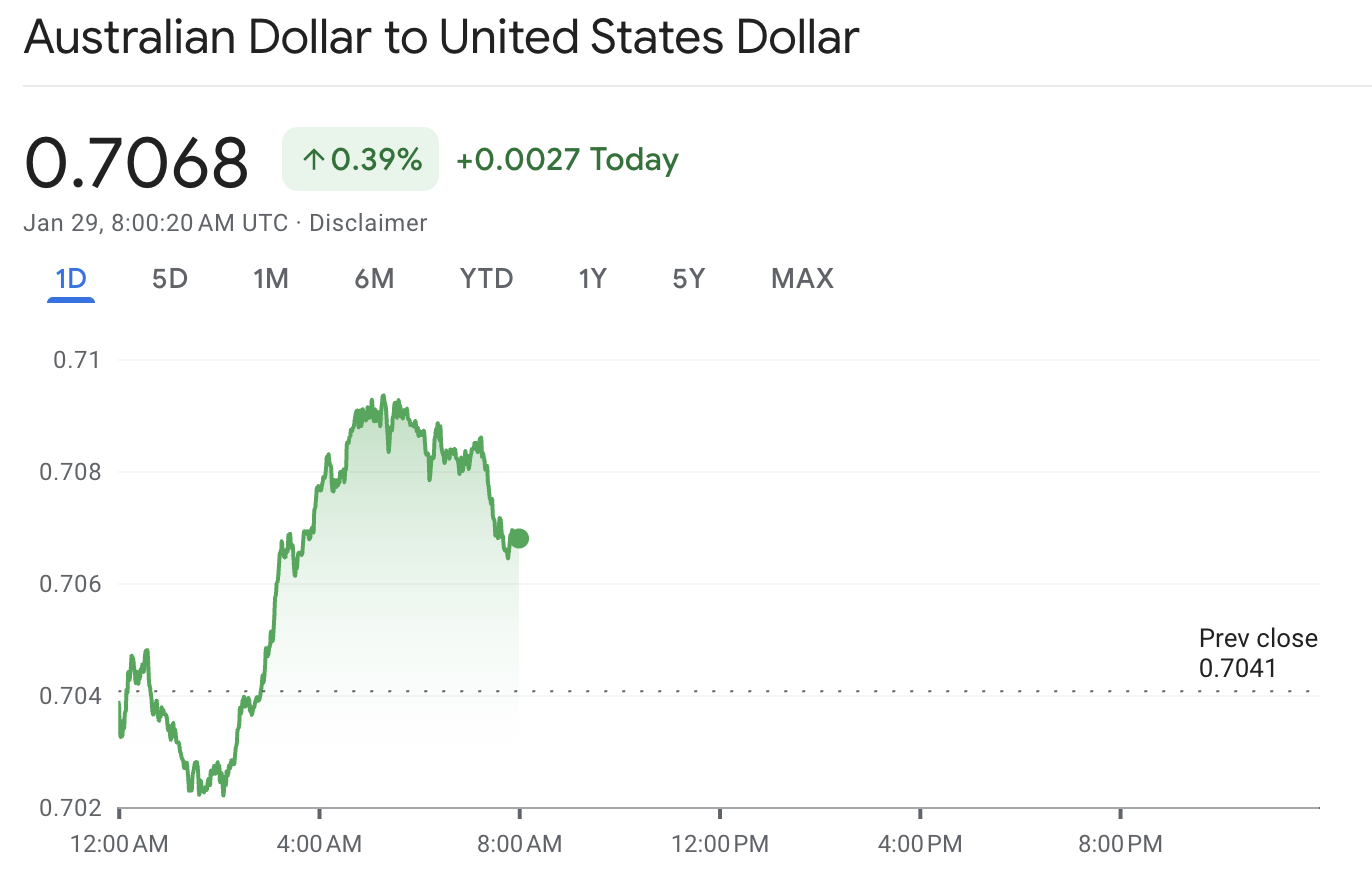
The cleanest reference point is the RBA's published daily exchange rates. These are widely used as a benchmark snapshot.
| Date | AUD/USD (USD per AUD) | Trade-Weighted Index (4pm) |
|---|---|---|
| 27 Jan 2026 | 0.6912 | 63.9 |
| 28 Jan 2026 | 0.6993 | 64.2 |
| 29 Jan 2026 | 0.7091 | 65.2 |
AUD/USD has moved back into a zone that forces the market to answer a new question: Is this strength the start of a longer trend, or is it a short burst driven by a weaker US dollar and position unwinds?
The tension is that strong trends often appear healthiest just before they start to frustrate late buyers. This is why our 2026 analysis must blend macro direction with tactical levels.

Australia's cash rate has been maintained at 3.60% since the August 2025 cut, and the RBA upheld this rate at the December 2025 meeting.
At the same time, Australia's inflation pulse has not cooled as neatly as many hoped. The ABS reported the CPI rose 3.8% in the 12 months to December 2025, up from 3.4% in the 12 months to November 2025.
That matters for AUD/USD because sticky inflation reduces the room for quick rate cuts. The RBA's Statement on Monetary Policy (November 2025) also said year-ended headline inflation was expected to remain above 3% for much of 2026 before returning closer to the middle of the target range later.
On the US side, the Federal Reserve lowered the target range to 3.50% to 3.75% in December 2025.
Additionally, the Fed held that range steady at its first meeting of 2026 and stressed it was in no hurry to cut further.
Why the Rate Gap Matters in 2026
When the Fed sits meaningfully above the RBA, the US dollar often has a carry advantage. When the gap is small, the Aussie tends to trade more on global growth, commodities, and China headlines.
Currently, the gap isn't huge.
If rates are the steering wheel, trade is the engine. Australia is a trade-heavy economy, and the Aussie tends to follow the health of global demand. For context, China is Australia's largest two-way trading partner, accounting for 24% of total goods and services trade in 2024–25, and 29% of exports.
The ABS shows that in 2024–25, Australia's top export partner was China at $188.7 billion, followed by Japan and the United States. The ABS also reported Australia's balance on goods and services was a surplus of $16.7 billion in 2024–25.
That is the key structural point for AUD/USD in 2026, as the Aussie often behaves like a proxy for Asia's growth, given that many of Australia's export bases are tied to that region.
A surplus does not guarantee a stronger currency, but it helps explain why the Aussie remains resilient when global risks are low.
What Trade Signals Traders Should Watch in 2026
Any evident change in China's demand for Australia's bulk exports
Australia's terms of trade trend, which captures the export price power
Monthly trade balance swings because they can shift sentiment quickly
Australia's export composition remains heavily reliant on commodities, so the AUD/USD often responds to fluctuations in iron ore and energy markets.
One key warning for 2026 is that the World Bank's Commodity Markets outlook has flagged broad pressure on commodity prices, describing global commodity prices as projected to fall to their lowest level in six years in 2026.
If the downward trend continues, it could impact the Australian dollar, especially if it coincides with slower growth in China and affects bulk commodity demand.
That said, commodity cycles rarely move in a straight line. Even within a broader downtrend, short bursts of tight supply, weather issues, or policy shifts can still create sharp rallies that lift AUD/USD for weeks at a time.
A 'big move" in AUD/USD usually needs one of these to happen decisively:
Because the cash rate is already at 3.60%, the signal is not the number. The signal is the reaction function. If the RBA has to defend its inflation credibility, AUD/USD can reprice quickly.
The Fed statement matters most when it changes the market's confidence about the path, not when it repeats the same stance.
The January 28 hold locks in the starting point, but the 2026 trend potential depends on whether the Fed can actually maintain restrictiveness without growth cracking.
Due to China's significant share of Australia's trade, even minor fluctuations in China's economic cycle can have a greater impact on Australia's economy than unexpected domestic events.
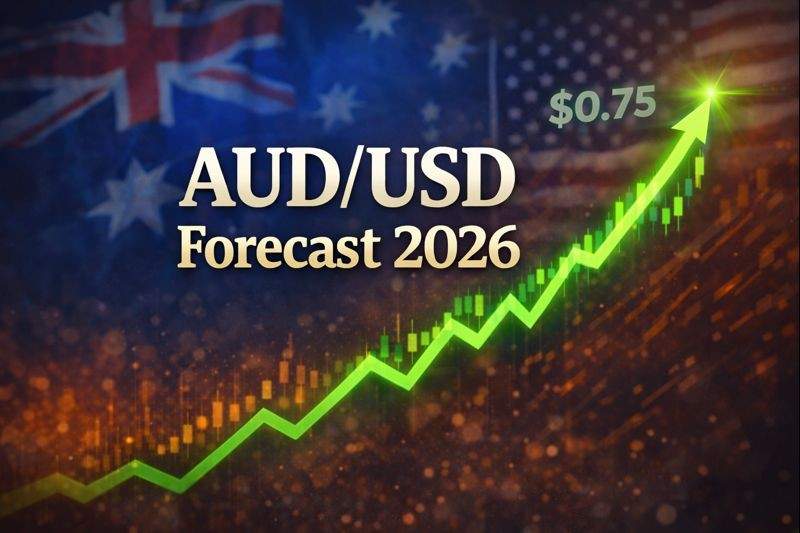
Yes, 0.72–0.75 is back on the radar, but it should be treated as a scenario range, not a promise. The reason is simple: the pair has already reclaimed 0.70 on the RBA's daily fix, with AUD/USD at 0.7091 on January 28, 2026.
That places the market back in a zone where 0.72 and 0.75 become realistic discussion points once more, especially if the drivers continue to align.
For AUD/USD to hold in a 0.70–0.75 range, you usually need at least two of the following conditions working in the Aussie's favour:
Rates Stop Being a Headwind
China-Linked Demand Holds Up
Global Risk Sentiment Stays Constructive
Even if 0.70 holds, 0.75 is usually harder, and these are the common blockers:
The US economy stays firm and the Fed delays cuts, keeping the dollar supported.
Commodity weakness becomes widespread and persistent, particularly when it affects both iron ore and energy simultaneously.
Risk sentiment shifts to a defensive stance, prompting investors to seek safety in the US dollar.
| AUD/USD zone | What usually needs to be true | What usually knocks it out |
|---|---|---|
| 0.70–0.72 | Dollar softer, RBA not rushing to cut | Strong US data or sudden risk-off |
| 0.72–0.75 | Stable risk mood, supportive China signals, commodities steady | Broad commodity slide or higher US yields |
| Above 0.75 | Strong risk-on cycle plus clear USD downtrend | Any return of USD strength or China slowdown |
This approach pragmatically addresses the situation without assuming we can predict the future.
In summary, the market has reopened the possibility of reaching 0.70–0.75 by reclaiming the 0.70 level on the RBA fix. The next important factor is whether it can maintain this level on subsequent pullbacks.
If that happens while the Fed outlook softens and China-linked trade remains stable, 0.72–0.75 becomes a reasonable working range for parts of 2026
| Indicator | Latest read | What it usually implies |
|---|---|---|
| Spot reference (RBA) | $0.7091 | Market anchored near a key psychological zone |
| RSI (14) | 73.17 | Momentum is strong, but pullback risk rises |
| MACD (12,26) | 0.003 | Uptrend bias still intact |
| MA50 (simple) | $0.6995 | First trend-support zone in a dip |
| MA200 (simple) | $0.6850 | Longer-term trend line in the sand |
Technical signals currently align with the bullish macro argument, but with an important caveat: momentum is strong enough to become unstable.
Daily Technical Read Shows:
RSI(14) at 73.17, which is elevated and consistent with overbought conditions in several sub-indicators.
MA50 near $0.6995 and MA200 near $0.6850, meaning a typical trend "support stack" sits below the spot.
Pivot levels are tightly clustered around the current price, which is typical in a steady grind higher. For traders, that often translates into two actionable ideas:
Shallow pullback support: $0.7000 area, because the MA50 is nearby and the psychological handle attracts flows.
Deeper trend test: mid-$0.68s, where the MA200 sits and where trend-followers often re-enter if the macro story has not broken
AUD/USD can trend in 2026, but the trigger is a decisive shift in relative policy expectations. With policy rates currently close, the pair may chop until either the RBA or the Fed forces a repricing.
The most important driver is the path of rate expectations. The market cares less about today's levels and more about whether the RBA tightens or holds firm while the Fed shifts toward easing.
China is Australia's largest export partner. The ABS reported exports to China of $188.7 billion in 2024–25, which is why changes in China's demand can quickly move the Aussie.
A weaker commodity backdrop is a major risk. The World Bank has pointed to commodity prices declining into 2026, which can weigh on Australia's export price power if it becomes broad and sustained.
In conclusion, the AUD/USD currency pair has demonstrated its ability to move significantly when the US dollar weakens. The Australian dollar also benefits from strong local support, driven by interest rates and improving market sentiment.
With the Reserve Bank of Australia's (RBA) cash rate at 3.60%, and Australia's inflation rate at 3.8% for the year ending December 2025, the RBA's forecast indicates that headline inflation may remain above 3% for much of 2026. This suggests that the central bank cannot afford to become complacent.
The next durable break in AUD/USD is most likely to come when the macro story becomes consistent across all three pillars: rates, trade, and commodities. Until then, the pair can still trend, but it will also be prone to fast reversals when the global mood changes.
Disclaimer: This material is for general information purposes only and is not intended as (and should not be considered to be) financial, investment or other advice on which reliance should be placed. No opinion given in the material constitutes a recommendation by EBC or the author that any particular investment, security, transaction or investment strategy is suitable for any specific person.