Published on: 2026-03-13
Updated on: 2026-03-13
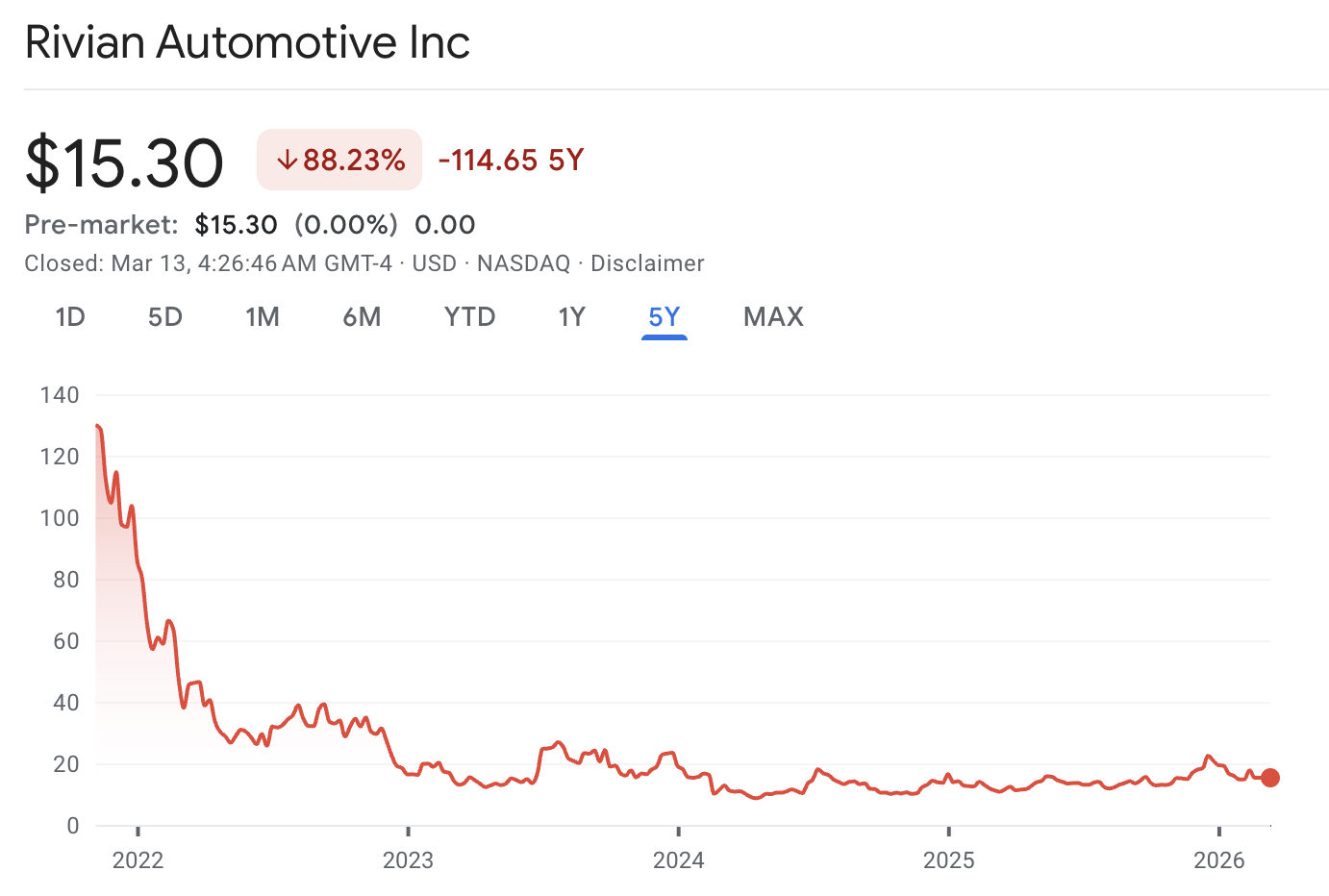
Rivian Automotive (NASDAQ: RIVN) has spent the better part of four years proving to Wall Street that it deserves to exist alongside Tesla. It has burned through billions, restructured its production plans, and watched its stock collapse from its 2021 IPO high of over $170 per share to roughly $15–$17 today.
Yet something meaningful is finally happening in 2026: the R2 is here. On March 12, 2026, Rivian officially unveiled the full R2 lineup at SXSW in Austin, Texas, a moment that CEO RJ Scaringe has called "an inflection point" for the company. But the reveal came with a notable caveat: the less expensive, entry-level $45,000 version of the R2 will not be available until late 2027.
For investors trying to estimate where Rivian stock could trade by 2030, the key question is whether the delayed lower-priced R2 variant is a warning sign or simply part of a more capital-efficient ramp.
Our 2030 forecast is a scenario framework, not a consensus price target. The key variables are annual deliveries, margin improvement, the mix of software and services, and the extent of dilution Rivian may require before the business becomes self-sustaining.
| Scenario | 2030 Price Target | Key assumptions |
|---|---|---|
| Bull case | $80 to $120 | 300,000+ annual deliveries, meaningful margin expansion, software and services become a larger profit contributor, limited dilution after the R2 ramp |
| Base case | $40 to $60 | 180,000 to 220,000 annual deliveries, steady margin improvement, software and services help but do not dominate earnings, some additional dilution |
| Bear case | $7 to $10 | Slower R2 ramp, continued pricing pressure, weak margin recovery, more capital raises and dilution |
In the bull case, Rivian scales beyond 300,000 annual deliveries by 2030, expands gross and operating margins as R2 ramps, and turns software and services into a larger profit pool.
In the bear case, R2 adoption disappoints, pricing pressure persists, and dilution offsets any improvement in the core business.

Understanding the stock's 2030 trajectory requires understanding exactly what Rivian unveiled and what it did not.
Rivian's current R2 lineup includes several models, starting with the R2 Performance, priced at $57,990 and expected to be available in Spring 2026. This model offers an EPA-estimated range of 330 miles.
Following that, Rivian lists the R2 Premium, which will be available in late 2026 for $53,990. The R2 Standard is set to launch in 2027 for $48,490, featuring an estimated range of 345 miles. There will also be an R2 Standard variant available in late 2027, starting at approximately $45,000, with an estimated range exceeding 275 miles.
Here is the full rollout timeline Rivian has confirmed:
| Trim | Starting price | Launch date | Drive | Range |
|---|---|---|---|---|
| R2 Performance | $57,990 | Spring 2026 | Dual-motor AWD | 330 miles EPA-estimated |
| R2 Premium | $53,990 | Late 2026 | Dual-motor AWD | 330 miles EPA-estimated |
| R2 Standard | $48,490 | 2027 | Single-motor RWD Long Range | 345 miles estimated |
| Additional R2 Standard variant | Around $45,000 | Late 2027 | Not yet fully specified | 275+ miles estimated |
Rivian's shift away from emphasizing the $45,000 starting point matters more because the federal clean vehicle credit is not available for vehicles acquired after September 30, 2025. For buyers comparing effective entry pricing, that raises the hurdle for early R2 demand.
It is a yellow flag, not a red one, and here is why.
Rivian moved the initial production of the R2 to Normal, Illinois, in March 2024. This decision will advance the start of production to the first half of 2026 and save over $2.25 billion compared to launching first in Georgia.
In its February 2026 shareholder letter, the company said first customer deliveries were expected in the second quarter of 2026.
The more optimistic reading is that Rivian is prioritising capital efficiency over headline volume. The company guided to 62,000 to 67,000 total vehicle deliveries in 2026, while R2 customer deliveries are expected to begin in the second quarter. That still leaves Rivian with a narrow execution window, but it also shows Rivian is trying to launch the vehicle without overextending cash or duplicating factory investment.
Furthermore, Rivian achieved its first annual gross profit in 2025 at $144 million, a positive signal that the company's unit economics are improving even before the R2 scales.
Bottom line: The delay in the $45,000 entry-level model reduces Rivian's addressable market in the near term, but the company's deliberate, staged rollout protects its margins and cash reserves. This is a manageable concern, not an existential threat.
Several structural tailwinds could drive meaningful upside for RIVN stock before the end of the decade.
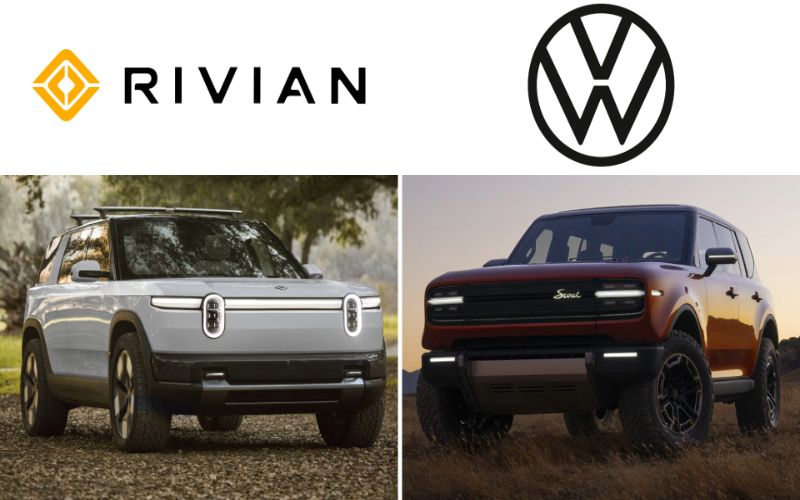
Rivian entered a $5.8 billion joint venture with Volkswagen aimed at developing scalable platforms such as the upcoming R2 mass-market vehicle.
The market often undervalues this partnership. It provides Rivian not only with a crucial cash infusion but also validates the company's technology stack at the highest level of global automotive manufacturing.
Rivian's commercial van business has expanded beyond serving a single customer. In February 2025, the company began selling its Rivian Commercial Van to fleets of all sizes across the United States. Additionally, its shareholder letter for Q4 2025 highlighted robust deliveries of electric delivery vans to Amazon.
That does not eliminate customer concentration risk, but it does make the commercial segment more credible as a second growth pillar.
Software and services are becoming more material to the story. In Q3 2025, Rivian reported $416 million in software and services revenue, up 324% YoY, with about $214 million tied to the Volkswagen joint venture. Approximately $214 million of this revenue is associated with the joint venture with Volkswagen.
In its fourth quarter 2025 shareholder letter, Rivian also announced that paid Autonomy+ subscriptions are available for either a one-time payment of $2,500 or a monthly fee of $49.99.
Additionally, the company expects that its R2 model, set to launch in late 2026, will feature a third-generation autonomy platform equipped with RAP1 chips, cameras, radar, and LiDAR technology.
Software revenue is still not large enough to carry the investment case alone, but it is now a real part of the margin story.
Rivian's expanded Normal plant is designed to produce approximately 215,000 units annually. According to its 2024 annual report, the production mix could include up to 155,000 R2 vehicles, 85,000 R1 vehicles, and 65,000 commercial vehicles.
Georgia remains an important longer-term capacity option, but Normal is the plant that matters most for the near-term R2 thesis.
Rivian may attract investors who can endure high risk and long holding periods, as it is not suitable for conservative investors. It is a high-conviction bet on execution. The R2 delay is frustrating; however, it does not indicate that the company is failing. Instead, it shows that Rivian is managing its cash burn wisely and carefully staging its launch to protect profit margins.
The Volkswagen joint venture, Amazon's fleet business, the expanding Normal plant capacity, and the software revenue roadmap all indicate a company with a credible path to profitability.
The upside case is real, but the path is still narrow. Rivian reported $144 million of full-year gross profit in 2025 and guided for 62,000 to 67,000 vehicle deliveries in 2026.
However, it also guided to an adjusted EBITDA of negative $2.10 billion to negative $1.80 billion and capital expenditures of $1.95 billion to $2.05 billion. That is why a $40 to $60 base-case outcome by 2030 is plausible, but far from guaranteed.
In conclusion, the R2 delay is a yellow flag, not a death knell. Rivian has decided to launch higher-margin trims first, conserve cash, and utilize its existing Illinois factory instead of investing more in its incomplete Georgia plant.
Whether that gamble pays off by 2030 depends on how quickly the company can ramp production, compete on price once the base R2 arrives in late 2027, and convert its technological ambitions in autonomy and software into actual recurring revenue.
Disclaimer: This material is for general information purposes only and is not intended as (and should not be considered to be) financial, investment or other advice on which reliance should be placed. No opinion given in the material constitutes a recommendation by EBC or the author that any particular investment, security, transaction or investment strategy is suitable for any specific person.