Published on: 2026-03-13
Gamma exposure quantifies how an options portfolio’s delta changes in response to movements in the underlying asset. It measures how directional risk evolves as the market moves, making it a cornerstone concept for sophisticated traders, market makers, and institutional risk managers.
Gamma exposure is especially consequential during periods of concentrated options activity, near strike prices with high open interest, and around expiration dates. It explains why prices can move sharply even without fundamental news and underpins phenomena such as gamma squeezes, where hedging flows themselves amplify market moves.
Gamma exposure measures the sensitivity of an options portfolio’s delta to changes in the underlying asset price.
High gamma exposure can force market makers to engage in aggressive hedging, amplifying volatility and price momentum.
Delta vs gamma: delta captures directional exposure; gamma captures changes in that exposure.
Gamma squeezes occur when hedging activity creates a feedback loop around concentrated strike levels.
Events such as the GameStop rally illustrate how market-wide gamma exposure can dramatically affect price dynamics.
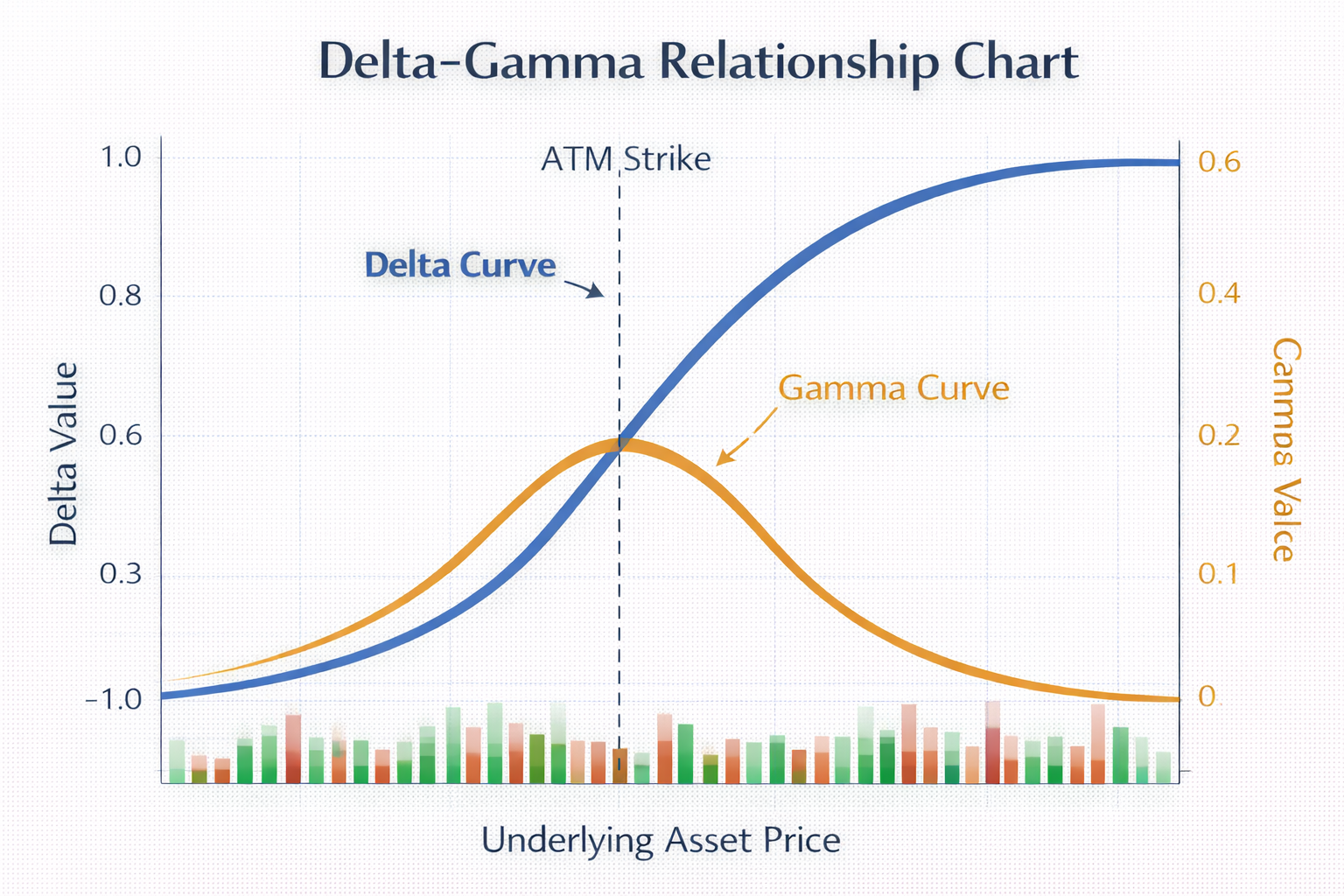
Gamma exposure represents the aggregate gamma risk inherent in options positions. To fully understand it, recall that delta measures the sensitivity of an option’s price to changes in the underlying. Gamma measures how much delta itself shifts as the underlying moves.
For example:
A call option with a delta of 0.50 will roughly gain $0.50 if the underlying rises $1.
If that option has high gamma, its delta will increase rapidly as the price approaches a critical strike, dynamically altering the trader’s directional exposure.
Gamma exposure, therefore, describes how risk profiles change in real time, particularly near strikes with heavy option concentrations. It explains why market movements can accelerate or decelerate depending on hedging activity.
Gamma exposure is critical for market makers and institutional traders because it directly influences hedging strategies. Market makers often take the opposite side of retail or institutional trades, aiming to remain delta-neutral.
When gamma is elevated , typically near popular strike prices or close to expiration , hedging activity can create feedback loops:
The underlying approaches a strike price with concentrated gamma exposure.
Market makers adjust delta hedges by buying or selling the underlying.
This hedging can push the underlying toward the strike.
Rising gamma triggers further adjustments, amplifying price movements.
This interplay is a central mechanism behind market-wide gamma exposure and explains why options can influence the underlying beyond what fundamentals suggest.
Delta represents directional exposure, while gamma represents the rate at which that exposure changes. High gamma positions require more frequent and aggressive hedging, especially during periods of rapid price movement.
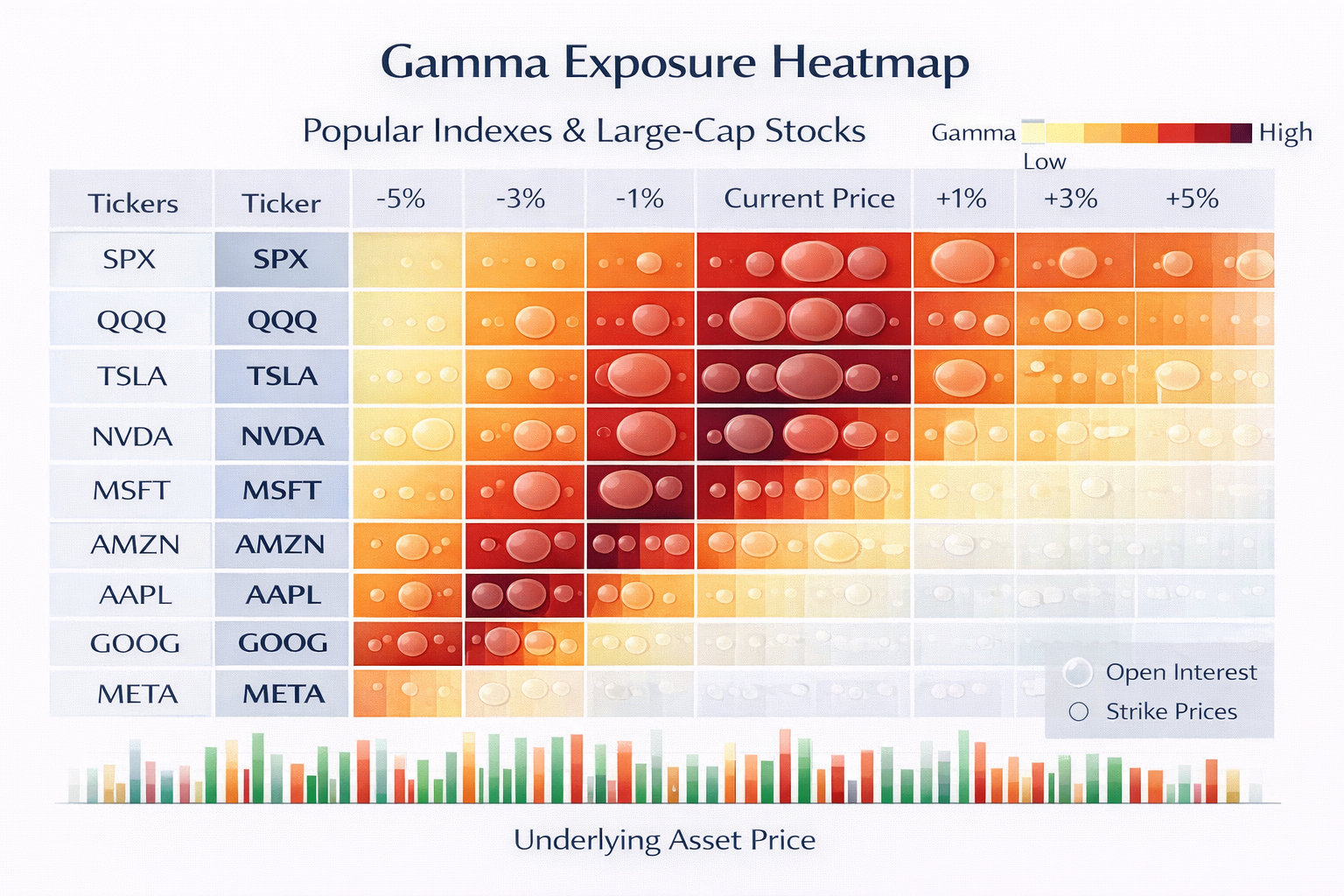
Gamma exposure is not limited to individual portfolios. Market-wide gamma concentrations emerge when many options cluster around specific strike prices , often near-the-money strikes with significant open interest.
These clusters can:
Amplify underlying price moves.
Increase short-term volatility.
Trigger gamma squeezes when hedging flows reinforce price momentum.
Concentrated gamma exposure transforms options from a purely derivative market activity into a driver of the underlying asset’s price dynamics.
A gamma squeeze occurs when hedging activity creates a self-reinforcing price move:
A substantial number of call options cluster near a key strike price.
Market makers hedge by buying the underlying to offset delta exposure.
As the underlying approaches the strike, delta increases, necessitating additional hedging.
Rising hedging demand pushes the underlying higher.
The cycle repeats, creating rapid price acceleration.
Gamma squeezes are most pronounced when concentrated gamma intersects with limited liquidity or high retail participation.
The GameStop (GME) rally in early 2021 exemplifies a gamma squeeze:
Retail traders and social media coordination drove massive purchases of call options.
Market makers hedged by buying GME shares, increasing delta exposure.
As prices approached strike prices, hedging flows intensified.
The underlying price surged dramatically, illustrating gamma’s amplification effect.
This phenomenon demonstrates how concentrated options activity can create extreme short-term market dynamics, even when fundamentals remain unchanged.
Gamma exposure allows traders to anticipate short-term volatility spikes, particularly around critical strike levels. Small movements can be magnified when gamma is high.
Traders and risk managers rely on gamma exposure to:
Measure how quickly portfolio risk changes.
Adjust hedges dynamically to maintain delta neutrality.
Anticipate liquidity demands and potential execution challenges.
High gamma concentrations can temporarily reduce market liquidity, widen bid-ask spreads, and increase trading costs. Understanding gamma exposure enables traders to prepare for these transient dislocations.
Traders and portfolio managers often adjust gamma exposure to align risk with market conditions and strategic goals. Gamma measures how sensitive an options portfolio’s delta is to changes in the underlying price, so controlling gamma is crucial for both hedging and speculative strategies.
Increasing gamma exposure makes a portfolio more responsive to price movements in the underlying asset. Traders can achieve this by:
Buying options: Purchasing calls or puts increases positive gamma, meaning delta changes more rapidly as prices move. This can enhance gains if the market moves favorably.
Using long volatility strategies: Long straddles or strangles involve buying both calls and puts near the current price, adding gamma without taking a strong directional bet. These strategies are ideal when anticipating short-term volatility.
Concentrating near-the-money options: Options close to the underlying’s current price have higher gamma, so layering positions around these strikes amplifies sensitivity to small price changes.
Traders may reduce gamma to stabilize portfolio delta and limit rapid swings:
Selling options: Writing calls or puts introduces negative gamma, making the portfolio less sensitive to small underlying moves but increasing potential losses if prices shift sharply.
Delta-hedging: Adjusting underlying positions to offset delta changes can dampen unwanted gamma effects, keeping the portfolio’s directional risk controlled.
Diversifying strikes and expirations: Spreading option positions across multiple strike prices and expiration dates reduces concentrated gamma risk and prevents sudden delta swings.
Balance with vega: Increasing gamma often increases exposure to volatility (vega), so traders must manage both sensitivities simultaneously.
Liquidity and execution: Adjustments require sufficient liquidity in both options and underlying markets to ensure smooth trading and accurate pricing.
Continuous monitoring: Gamma changes dynamically as the underlying moves, so portfolios require active oversight to avoid unintended risk spikes or margin issues.
Effectively managing gamma allows traders to exploit short-term volatility, control directional risk, and respond strategically to fast-moving markets, turning gamma from a theoretical metric into a practical tool for decision-making.
Gamma exposure measures how sensitive an options portfolio’s delta is to movements in the underlying asset, revealing how directional risk evolves as prices change.
Delta measures an option’s price sensitivity; gamma measures how delta itself changes with underlying price movement.
No. Hedging flows caused by gamma exposure can influence underlying stocks, ETFs, and broader indices.
Traders monitor open interest, strike concentration, and gamma clusters, but predicting exact timing is difficult.
Gamma is not dangerous per se. It quantifies sensitivity and risk. Unanticipated spikes can increase volatility, but informed hedging mitigates exposure.
Gamma exposure is a central concept in options trading, representing how an options portfolio’s directional risk changes as the underlying moves. It explains how market makers manage hedges, why price momentum can accelerate, and how gamma squeezes can rapidly drive asset prices.
Traders gain insight into volatility dynamics, execution risk, and market microstructure, allowing more informed decisions in environments with concentrated options activity. Historical examples such as the GameStop rally highlight gamma’s power to amplify market movements beyond fundamentals, underscoring its importance for sophisticated traders and risk managers alike.
Disclaimer: This material is for general information purposes only and is not intended as (and should not be considered to be) financial, investment or other advice on which reliance should be placed. No opinion given in the material constitutes a recommendation by EBC or the author that any particular investment, security, transaction or investment strategy is suitable for any specific person.