Published on: 2026-03-13
A pain trade is one of the most useful terms in trading because it explains why markets often move in the direction that hurts the crowd the most.
It is not just about a bad call. It is about a market move that punishes the largest group of traders who were leaning too heavily in one direction.
When market positioning becomes excessively crowded, leveraged, or complacent, the market often reaches a point that compels the greatest number of participants to exit their positions simultaneously.
A pain trade is the market move that inflicts the most damage on the largest number of traders at once.
It forms when positioning becomes too crowded, then breaks violently when a catalyst forces the unwind.
Pain trades are not limited to short squeezes; they can hit long positions, bond bets, currency trades, and entire sector themes.
Investor psychology, leverage, and herd behaviour are the core ingredients that make a pain trade explosive.
Spotting a pain trade early means watching positioning extremes, not just the headline narrative.
A pain trade is a market phenomenon where the majority of investors suffer significant losses due to unexpected market movements. It typically occurs when a popular asset class, trade, or market trend moves in the opposite direction of the consensus.
Essentially, a pain trade refers to a market movement that penalizes the majority of participants after they have adopted a similar position.
A pain trade occurs when the market inflicts the greatest losses on the largest number of participants. For example, if the majority of investors are bearish, the market may rise, whereas if most are bullish, a decline may follow.
This phenomenon is not random; it is a structural aspect of market behavior that emerges when positioning becomes extreme.
The concept of a pain trade centers on investor psychology and the tendency for market sentiment to drive unexpected price movements.
Emotional and cognitive biases play a critical role in the development of pain trades, as these biases contribute to market inefficiencies and create opportunities for contrarian strategies.
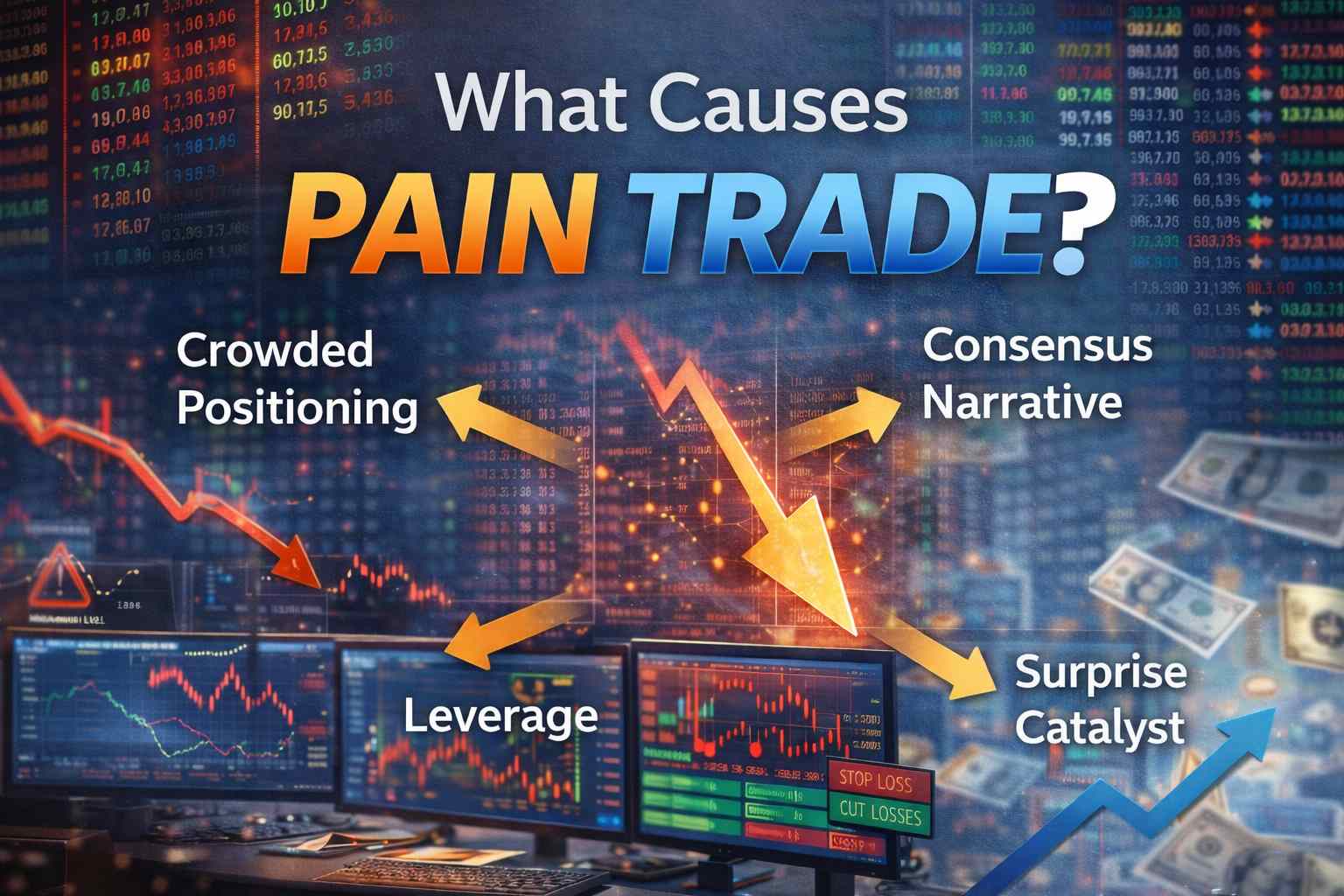
Several specific conditions tend to precede a pain trade:
Crowded consensus: One view becomes universally accepted and heavily positioned
Excessive leverage: Large leveraged bets amplify the reversal once it starts
FOMO-driven positioning: Fear of missing out pushes latecomers into a trade near its peak
Surprise catalyst: An unexpected data release, policy comment, or geopolitical event triggers the unwind
Stop-loss clustering: Large numbers of stop-losses sitting at similar levels create a self-reinforcing flush
Emotions such as fear and greed drive traders into crowded positions, increasing the market's vulnerability to sharp reversals.
When most traders hold similar positions, the probability of a market move in the opposite direction increases, resulting in significant losses for those who are short.
Although closely related, these terms are distinct. A crowded trade refers to the initial market setup, while a pain trade describes the outcome when the market moves against the prevailing consensus.
A trade may remain crowded for an extended period without causing losses. It becomes a pain trade when market movements are substantial enough to force widespread repositioning.
A pain trade often appears when several signals show up together:
One-sided positioning across funds or retail traders.
A strong consensus narrative that starts to feel obvious.
Leverage or options exposure that can magnify a reversal.
A catalyst that challenges the dominant view, such as policy comments, inflation data, or earnings surprises.
Sharp price moves that force buying or selling, rather than voluntary repositioning.
Examining specific examples is the most effective way to understand the concept of a pain trade.
| Market | Pain Trade Setup | Why It Hurts |
|---|---|---|
| Stocks | Bearish positioning into a sharp rally | Underinvested funds forced to chase higher |
| Stocks | Crowded growth names suddenly rotate out | Overowned positions unwind fast |
| Bonds | Yields spike while investors expected a rally | Long bond positions take heavy losses |
| Currencies | Dollar rebounds after heavy bearish positioning | Short dollar traders get squeezed |
| Options | Stock pins to max pain on expiration | Option buyers on both sides expire worthless |
| Commodities | Popular inflation trade reverses sharply | Consensus positioning flips at the worst moment |
A stock market pain trade frequently occurs when investors adopt overly defensive positions immediately before an equity rally. In this scenario, losses arise not from holding long positions but from insufficient market exposure during a rising market.
The pain comes from being underinvested while prices rise and performance gaps widen.
The opposite can also happen. If too many investors crowd into a small group of popular stocks, a sudden rotation out of those names can become the pain trade.
Once a pain trade begins, the movement rarely reverses smoothly. Pain trades are inherently self-reinforcing, which contributes to their destructive impact on affected participants.
This occurs because, during reversals, traders often abandon rational, fundamentals-based decision-making. Instead, they react to mounting losses, triggered stop-loss orders, margin calls, and, in institutional contexts, the pressure of underperforming benchmarks.
That emotional and mechanical pressure creates a feedback loop:
Stop-losses trigger, forcing involuntary selling or buying
Margin calls push leveraged traders to liquidate regardless of conviction
Performance anxiety causes fund managers to cut exposure to stop the bleeding
Each forced exit adds more fuel to the move, pulling in the next layer of stops
The outcome is a market that appears disconnected from underlying fundamentals. While the initial catalyst may be minor, subsequent acceleration is driven primarily by the large number of participants forced to adjust their positions simultaneously.
For this reason, experienced traders approach the early stages of a pain trade with caution. The initial phase may be driven by fundamentals, but subsequent movements are dictated by positioning, and the timing of these unwinds is unpredictable.
Traders are advised to withstand short-term market declines rather than exit positions impulsively, avoid following the majority into consensus trades, and maintain a long-term investment strategy that transforms temporary losses into sustained gains.
Beyond that, the practical steps are:
Reduce leverage before entering a trade that already feels obvious
Use defined exits so forced liquidation does not catch you off guard
Diversify across uncorrelated assets to avoid having your entire portfolio exposed to one crowded theme
Size positions are smaller when entering a trade that is already consensus
A pain trade refers to a market movement that inflicts the greatest losses on the largest number of traders, typically because an excessive number of participants held similar positions.
No. While a short squeeze represents one form of pain trade, pain trades can also affect long positions, bond strategies, currency exposures, or sector-specific themes.
Pain trades typically arise when market positioning becomes crowded and a catalyst compels traders to unwind, pursue, or reduce positions simultaneously.
Yes. For example, Bloomberg's 2023 analysis demonstrated that a rally can constitute a pain trade when underinvested or bearish traders are compelled to purchase assets at higher prices.
Recent examples include the rebound in the U.S. dollar and the market moves tied to the Magnificent Seven and 10-year Treasury yields, which strategists said punished traders with one-sided positioning.
They usually reduce leverage, avoid consensus extremes, use defined exits, and pay close attention to positioning, not just the headline story. This is an inference from how pain trades develop and unwind in crowded markets.
A pain trade is not simply a losing trade. It is the market move that causes the broadest simultaneous damage, precisely because too many traders were leaning the same way before it happened.
Markets often generate the greatest discomfort for the largest number of participants. When the majority of traders hold similar positions or expectations, the probability of a contrary market movement increases significantly.
Disclaimer: This material is for general information purposes only and is not intended as (and should not be considered to be) financial, investment or other advice on which reliance should be placed. No opinion given in the material constitutes a recommendation by EBC or the author that any particular investment, security, transaction or investment strategy is suitable for any specific person.