Published on: 2026-06-24
EUR/USD broke below 1.1400 and extended toward 1.1350, while the ECB reference rate marked a one-year low as the June rate hike failed to support the euro.
Markets read the ECB hike as a growth risk, not a pure yield signal, after weaker eurozone projections and uneven German activity.
The rate gap still favours the Dollar, with the Fed’s 3.50% to 3.75% range well above the ECB’s 2.25% deposit rate.
Germany remains the weak link, especially as services weakness points to softer domestic demand.
1.1400 is now the key pivot, with rebounds below 1.1500 vulnerable and deeper support near 1.1354 to 1.1347, 1.1290 and 1.1200.
EUR/USD fell below 1.1400 on 23 June 2026 and extended toward the 1.1350 area on 24 June, as markets treated the European Central Bank’s June rate hike less as yield support and more as a sign that policy is tightening into a weaker growth and inflation mix.
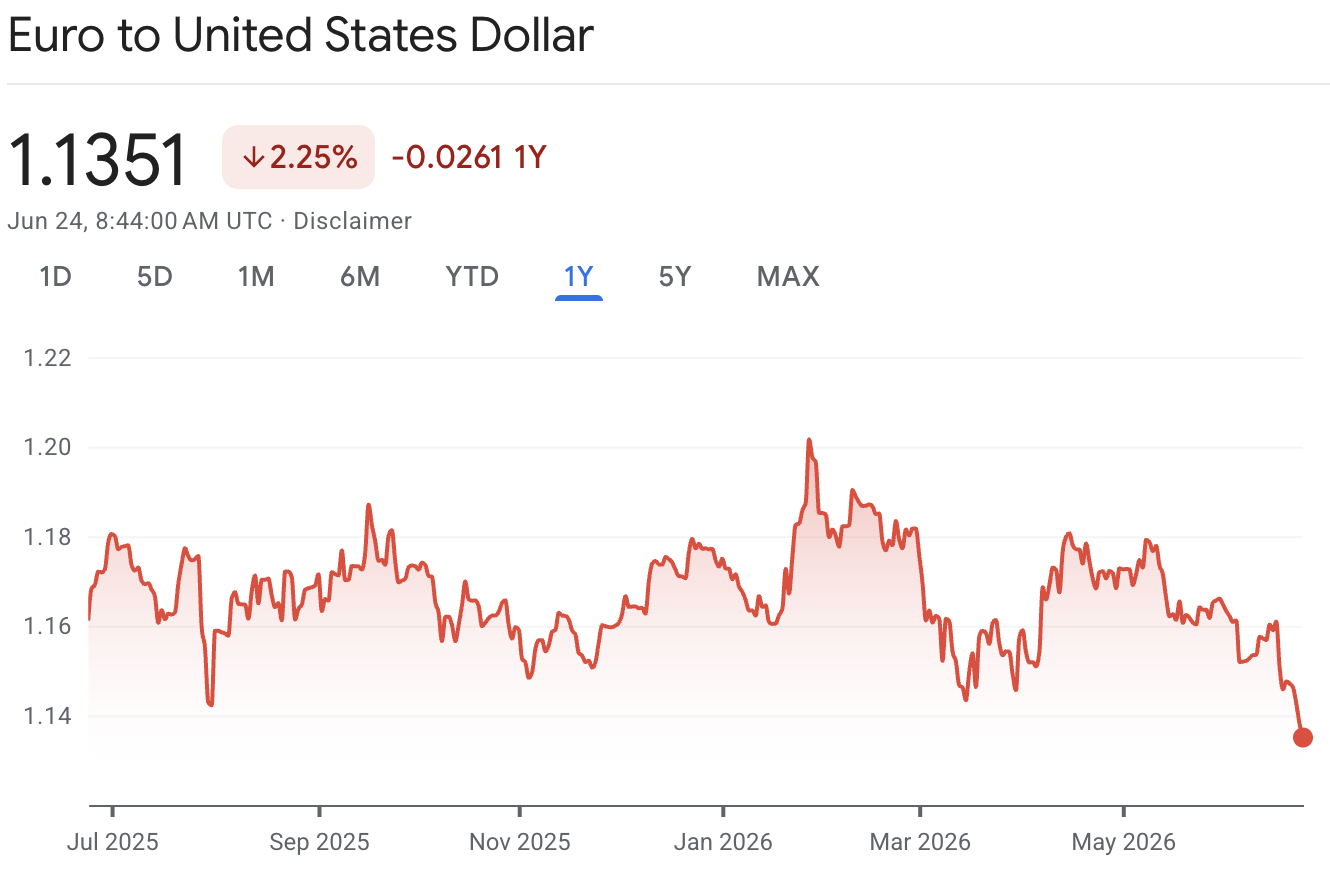
The move stood out because it followed the ECB’s first rate increase since 2023, showing that higher policy rates are not automatically currency-positive when growth momentum is fading.
The pressure reflects a widening narrative gap between the eurozone and the United States. The ECB lifted its deposit rate to 2.25% on 11 June, while its June projections pointed to slower 2026 growth and higher inflation.
The Federal Reserve, by contrast, held its target range at 3.50% to 3.75% and lifted its 2026 median rate projection to 3.8%, with US flash PMIs still in expansion territory. The ECB’s official euro-dollar reference rate fell to 1.1392 on 23 June, the low point of its one-year reference-rate range, while live market feeds showed EUR/USD trading closer to 1.1350 to 1.1375 on 24 June.
The break below 1.1400 followed three signals that lined up against the euro.
First, ECB President Christine Lagarde cooled expectations for a more aggressive policy response to energy-related inflation pressure, saying the central bank still expected inflation to return to target over the medium term.
Second, eurozone data kept growth concerns alive. Germany remained the focus because the bloc’s largest economy has shown uneven momentum, with manufacturing close to the expansion threshold and services still weak. That made the ECB hike harder to read as a positive carry signal.
Third, US data and Fed projections reinforced the Dollar’s higher-for-longer narrative. The Fed’s June projections showed a higher expected policy-rate path for 2026, while US activity remained resilient enough to keep markets focused on inflation risk rather than imminent easing.
The result was a repricing of the ECB hike. Markets did not treat it as clean support for the euro. They read it as tightening into an economy with limited growth cushion.
On 11 June, the ECB raised its three key interest rates by 25 basis points. The deposit rate moved from 2.00% to 2.25%, the main refinancing rate rose to 2.40%, and the marginal lending rate increased to 2.65%, effective 17 June. It was the first ECB hike since 2023, following a series of cuts that began in June 2024.
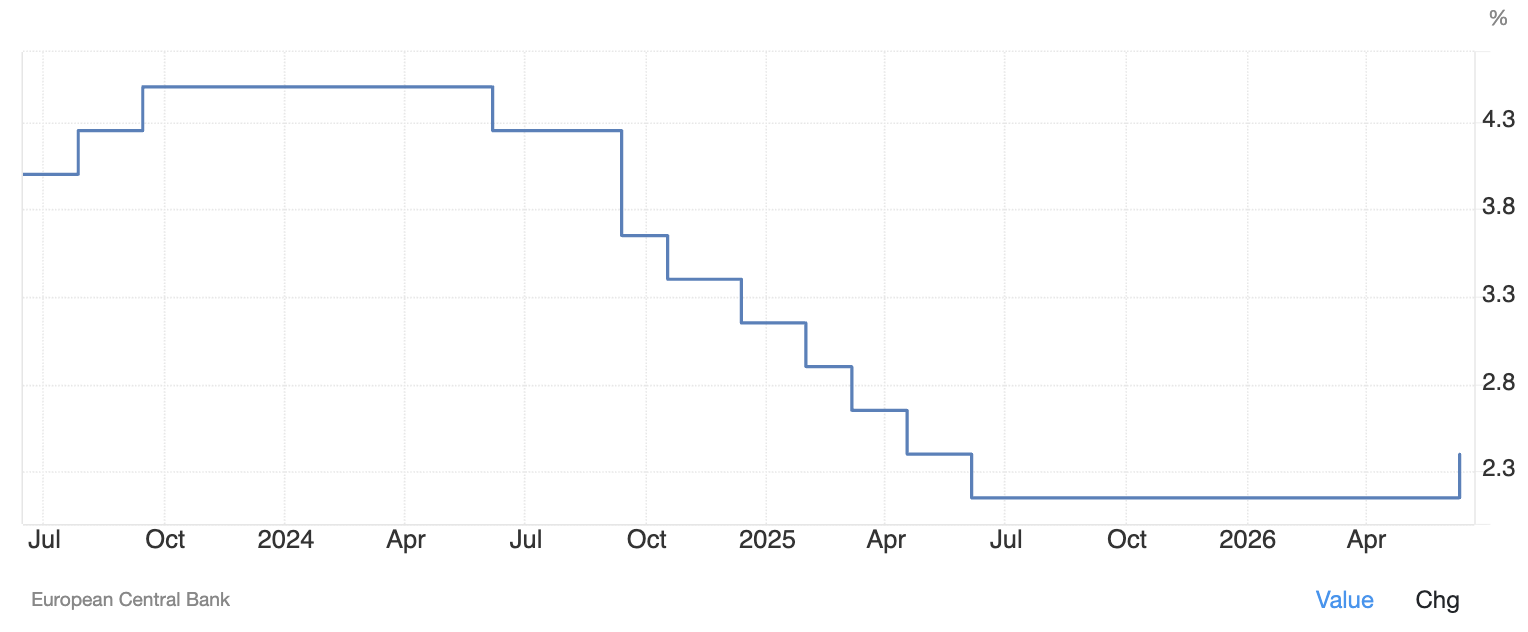
The move did not deliver lasting euro support because markets focused less on the higher rate itself and more on the conditions behind it. The ECB tightened while warning that the outlook remained uncertain, with upside risks to inflation and downside risks to growth.
A rate increase can support a currency when it reflects strong demand and attractive real returns. It can have the opposite effect when investors believe the central bank is responding to inflation pressure while growth is softening. In that environment, the rate hike becomes less of a yield reward and more of a potential drag on future activity.
The unusual part of the move is not that the Dollar strengthened. It is that the euro failed to benefit from tighter ECB policy. That suggests markets are no longer valuing ECB rates in isolation. They are weighing the cost of policy restraint on an economy already losing momentum.
While the euro’s rate support faded, the Dollar’s firmed. The Fed held rates on 17 June, but its updated projections lifted the 2026 median federal funds rate estimate to 3.8% from 3.4% in March. Eighteen participants submitted projections, and the distribution showed that several policymakers still saw room for tighter policy.
That kept the rate premium clearly on the US side. The ECB deposit rate at 2.25% remains well below the Fed’s 3.50% to 3.75% target range. For EUR/USD, that means the euro is still the lower-yielding leg of the pair despite the June hike.
The broader Dollar backdrop also matters. When markets price higher US rates alongside still-resilient activity, the Dollar tends to draw support across multiple pairs. EUR/USD’s break below 1.1400 therefore reflected both euro-specific weakness and a wider preference for the Dollar as the cleaner expression of rate risk.
Germany remains central to the euro’s problem. Manufacturing has shown signs of stabilisation, but activity remains too uneven to create a convincing growth story. Services weakness is particularly important because it points to pressure in domestic demand rather than only export-sensitive factory output.
The wider eurozone picture is not uniformly weak, but the composite PMI remaining below 50.0 makes ECB tightening harder to frame as growth-positive. A central bank can raise rates into firm activity without alarming currency markets. Raising rates while growth is fragile creates a different interpretation: investors may see tighter policy as necessary for inflation control but costly for output.
That is the key reason the euro struggled after the hike. The market is not only asking how high ECB rates can go. It is asking how much growth the eurozone can absorb before tighter policy becomes self-defeating.
The break below 1.1400 turned long-standing support into near-term resistance and confirmed the bearish short-term structure.
| EUR/USD Level | Role | Market Interpretation |
|---|---|---|
| 1.1575 to 1.1650 | Major resistance | Moving-average cluster; bearish bias holds below this zone |
| 1.1500 | First resistance | Former base and round-number recovery level |
| 1.1400 | Broken pivot | Former floor, now near-term resistance |
| 1.1354 to 1.1347 | Immediate support | Current live-market support zone after the 24 June extension |
| 1.1290 | Deeper support | 100-week moving-average area |
| 1.1200 | Extension risk | Comes into view if 1.1290 fails and Dollar momentum builds |
The technical risk is that 1.1400 becomes a sell-on-rally zone unless EUR/USD can reclaim it quickly and stabilise above 1.1500. The daily RSI moved into oversold territory near the breakdown, which can precede a short-term bounce, but oversold readings can persist during strong downtrends.
With price below its main moving-average zone around 1.1600, the broader bias remains lower until that area is recovered.
The next phase depends on four catalysts. Softer US inflation or labour data would cool Fed-hike pricing and weaken the Dollar’s rate premium. The May PCE release is the next major US inflation test because it feeds directly into the Fed’s policy reaction function.

Eurozone activity also needs to stabilise, especially in Germany. ECB guidance at the July meeting must preserve inflation credibility without deepening concern that policy is overtightening into weak growth.
Energy prices remain relevant as well. Lower energy costs could reduce eurozone inflation pressure, but the FX response would depend on whether the decline reflects improved supply conditions or weaker global demand.
EUR/USD’s fall to a one-year low is not only a Dollar rally. It is a repricing of what an ECB hike means when eurozone growth is weakening. The ECB has tightened into an uncertain outlook, while the Fed still has firmer activity data and a wider policy-rate cushion behind the Dollar.
Until US data softens or eurozone activity stabilises, rebounds toward the 1.1400 to 1.1500 zone risk being treated as corrective rather than durable. A sustained recovery above 1.1500 would suggest the euro is rebuilding support.
Failure to reclaim 1.1400 would keep the 1.1354 to 1.1347 support zone in focus, followed by 1.1290 and potentially 1.1200 if Dollar momentum builds.
Traders monitoring EUR/USD can use 1.1400 as the near-term retest level and the 1.1354 to 1.1347 zone as the immediate downside reference. EUR/USD is available through EBC Financial Group’s forex offering.
Because FX trading involves leverage and market risk, position size, stop placement and event risk around US PCE should be assessed before entering any trade.
European Central Bank: Monetary policy decisions, 11 June 2026
https://www.ecb.europa.eu/press/pr/date/2026/html/ecb.mp260611~4d41bd5e83.en.html
European Central Bank: Euro foreign exchange reference rates, US Dollar
Federal Reserve: FOMC statement, 17 June 2026
https://www.federalreserve.gov/monetarypolicy/files/monetary20260617a1.pdf
Federal Reserve: June 2026 Summary of Economic Projections
https://www.federalreserve.gov/monetarypolicy/fomcprojtabl20260617.htm
S&P Global PMI releases