Published on: 2026-08-06
Updated on: 2026-08-06
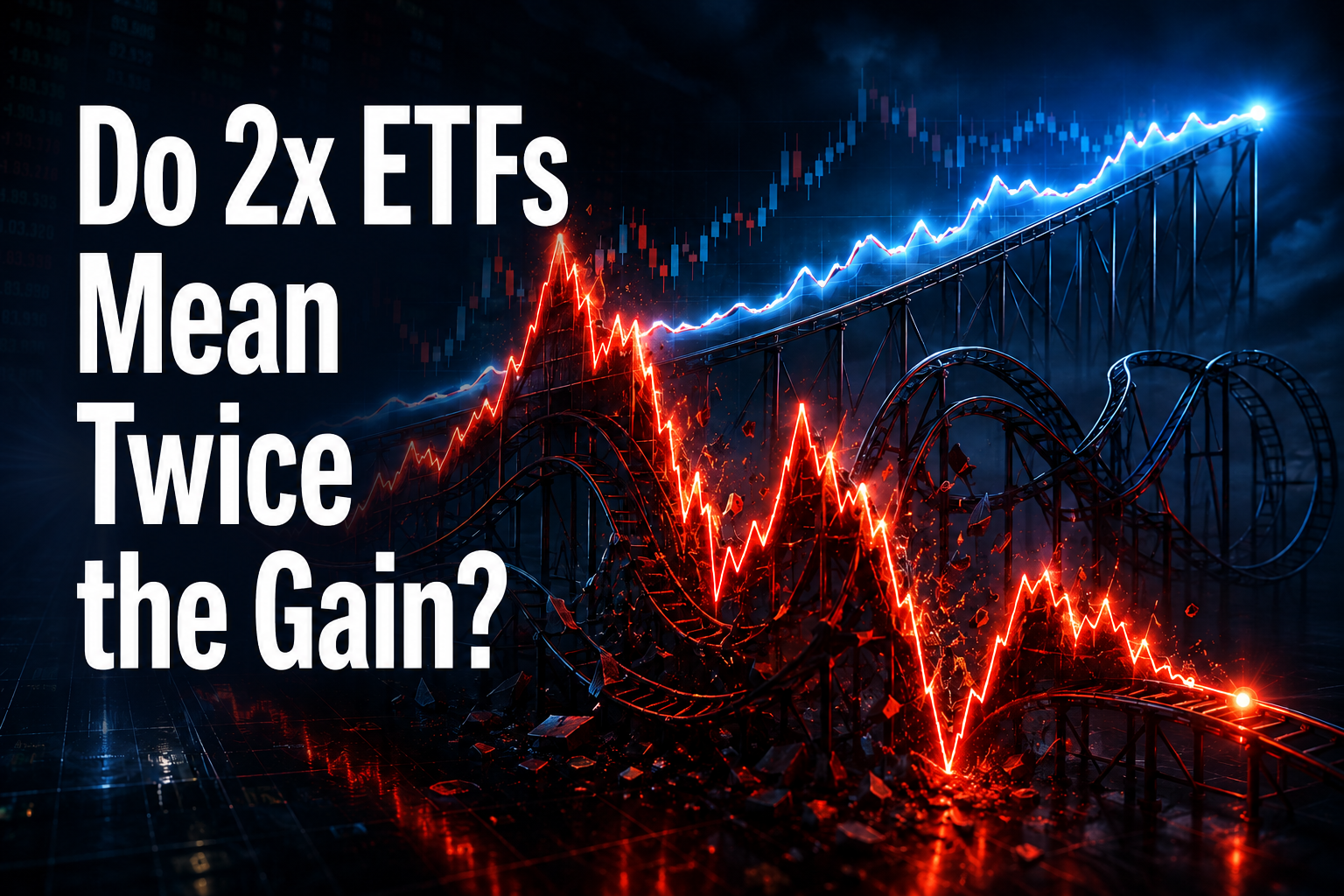
A 2x stock ETF targets roughly twice the stock’s daily return, not twice its return between the day you buy and the day you sell. It resets its exposure after every close, so each amplified move lands on whatever the fund is worth by then. Over several sessions, that compounding can leave the ETF above or below twice the stock’s cumulative return, and the order of the daily moves decides which.
A 2x stock ETF targets approximately 200% of the stock’s daily close-to-close return, before fees and expenses.
Leverage resets after every session, so the multi-day result depends on the order of daily gains and losses, not only on the first and last price.
Steady trends can produce more than twice the stock’s cumulative return, because each amplified gain is applied to a larger balance.
Sharp declines and repeated reversals can leave the fund behind, even when the stock eventually finishes higher.
The target normally covers one trading day, measured from one market close to the next. If the stock gains 3% in that window, the ETF aims for approximately 6% before fees and tracking differences. A 3% fall points to a loss of approximately 6%.
Prospectuses say it directly: a 2x single-stock ETF seeks 200% of the stock’s daily percentage change and does not seek that multiple over any period longer or shorter than one trading day. Buy in the middle of a session, and even your first day will not match the official close-to-close figure.
Everything that follows comes from one word in that sentence: daily. Issuers now build these funds on single companies too, sometimes several at once: three rival 2x funds on SK Hynix began trading within weeks of each other in July 2026.
The two paths below exclude fees and tracking differences.
Stock path |
Stock’s total return |
Theoretical 2x ETF return |
|---|---|---|
+5%, then +5% |
+10.25% |
+21% |
−20%, then +31.25% |
+5% |
−2.5% |
In the first path, the stock rises steadily. The ETF gains 10% on day one and starts day two with a larger balance, so a second 10% gain leaves it 21% higher, slightly above twice the stock’s 10.25% return.
The second path inverts the result. The stock falls from $100 to $80, then rebounds 31.25% to $105, finishing 5% higher. The ETF drops approximately 40% to $60. Its next target return is positive 62.5%, but that rebound starts from the reduced balance, so the fund ends at $97.50: a loss of 2.5% on a stock that gained.
Start and end prices cannot show this. Each day’s move is applied to whatever value survived the day before.
Leveraged ETFs hold a fixed daily exposure, so at each close the manager adjusts swaps, futures, options or other positions to start the next session targeting approximately 2x again.
Without that adjustment, the ratio drifts: a fund holding $100 in assets against $200 of exposure sees both figures move with the stock, but not by amounts that stay aligned at exactly 2x.
Restoring the ratio means buying exposure after a gain and selling it after a loss. The fund is a mechanical buyer into strength and a mechanical seller into weakness, every close. That is what delivers the daily target, and it is also what makes the longer result depend on sequence.
A daily-resetting ETF experiences two forces at the same time. One is favourable compounding during a steady trend. The other is volatility decay, which reduces returns when prices repeatedly reverse direction.
Compounding helps when the stock moves steadily in one direction. After each gain, the ETF starts the next session with a larger balance, so another leveraged gain is earned on more capital. Several consecutive advances can leave the ETF with more than twice the stock's cumulative return.
Volatility decay hurts when the stock swings up and down. Every leveraged loss reduces the capital available for the next recovery, while repeated reversals prevent gains from building on one another. The stock may eventually finish higher, yet the ETF can still lag twice the return or even lose money.
The effect becomes stronger as volatility increases and the holding period gets longer. A commonly used approximation suggests that a daily-resetting 2x fund loses roughly the underlying asset's annual variance before fees, while a 3x fund experiences an even larger drag.
Nobody deducts this as a fee. It is what repeated multiplication does to a balance. FINRA and the SEC warn that leveraged ETFs can differ significantly from their stated daily multiple when held for periods longer than one session, particularly when markets are volatile.
The paths above exclude costs. Live returns face management fees, financing costs, derivative expenses, rebalancing costs, bid-ask spreads and imperfect daily tracking, and leveraged funds may also face market disruption, derivative-liquidity and counterparty risks. Oil ETFs separate from crude for different reasons again, but the lesson holds: the wrapper is not the asset.
A severe one-day fall could leave the fund with little remaining value or, in extreme circumstances, wipe out most of the investment. Some single-stock ETF prospectuses warn that a decline exceeding 50% in one session could result in a total loss, although actual outcomes can depend on the fund’s structure and market conditions.
With a 2x ETF, the path matters as much as the destination. Five things are worth settling before the order goes in.
Holding period. One session or several. More time gives compounding, volatility and costs more room to pull the return away from twice the stock’s total move.
Likely price path. A steady move is generally more favourable than repeated reversals. The question is whether the stock travels directly towards the target or takes a large drawdown first.
Company events. Earnings, regulatory decisions, court rulings and product announcements can cause sudden price gaps. Single-stock ETFs concentrate the full leveraged exposure in one company, so nothing else in the portfolio absorbs the shock.
Exit conditions. The maximum holding period, the acceptable loss, and the condition that would invalidate the position. Waiting indefinitely for a recovery may leave the fund further behind.
Costs and liquidity. Expense ratio, bid-ask spread, volume and tracking history. A correct directional view can still produce a weak result in a product that is expensive or hard to trade.
There is no fixed limit. What changes with time is the gap: every extra session adds another round of compounding, volatility and cost between the fund and twice the stock’s cumulative move. Prospectuses state that the multiple is not sought beyond one day.
No. The fund creates leverage inside its own portfolio, while margin borrowing sits in the brokerage account. Both amplify losses, although the account mechanics and the obligations attached to them differ.
The official target normally runs from one market close to the next. Buying during the session can therefore produce more or less than twice the stock’s move after the purchase.
A severe one-day fall in the underlying stock could leave the fund with little remaining value or, in extreme circumstances, wipe out most of the amount invested.
A 2x stock ETF targets twice the stock’s daily return and does not lock in twice the gain over a holding period. The leverage resets every session and the next move is applied to whatever value remains, so smooth trends can push the result above the expected multiple while reversals, drawdowns, fees and tracking gaps can pull it below.
Direction alone will not carry the trade: a stock can reach the price you expected and still leave a leveraged fund behind if it takes a volatile route to get there.