Published on: 2026-07-10
DXY has slipped toward the lower half of its recent range and again failed to hold above 101, trading near 100.9.[1]
Elevated Treasury yields are no longer generating fresh dollar demand, because yields have stopped rising and much of the Fed’s path is priced.
Real yields are historically high but flat, and steady real returns give investors less reason to add dollar exposure.
Firmer ECB rate expectations and a resilient euro, the index’s dominant component, are capping the index.
Support at 100.70 and then 100.00 will frame the near-term direction.
The US Dollar Index is hovering near 100.9, unable to reclaim the 101 level and well below its late-June high near 101.80.[1] The drift lower has unfolded while Treasury yields sit close to multi-month peaks, with the two-year around 4.16% and the 10-year near 4.54%.[1]

A softer dollar alongside firm yields points to a market weighing relative policy expectations, positioning and the reasons behind the yield move rather than the nominal level on its own. For now the price action reads as consolidation rather than a confirmed reversal, with 100.70 the first line to watch.
The index traded in a tight band on July 9 and settled little changed near 100.9, holding beneath the 101 pivot for a third straight session.[1] It remains up roughly 1% over the past month and modestly higher on the year, having climbed back above 100 from a four-year low set early in 2026, yet it has not extended past the late-June high near 101.80.[1] The chart shows resistance clustered between 101.20 and 101.80, initial support at 100.70 to 100.80, and the round 100.00 level below that.[1]
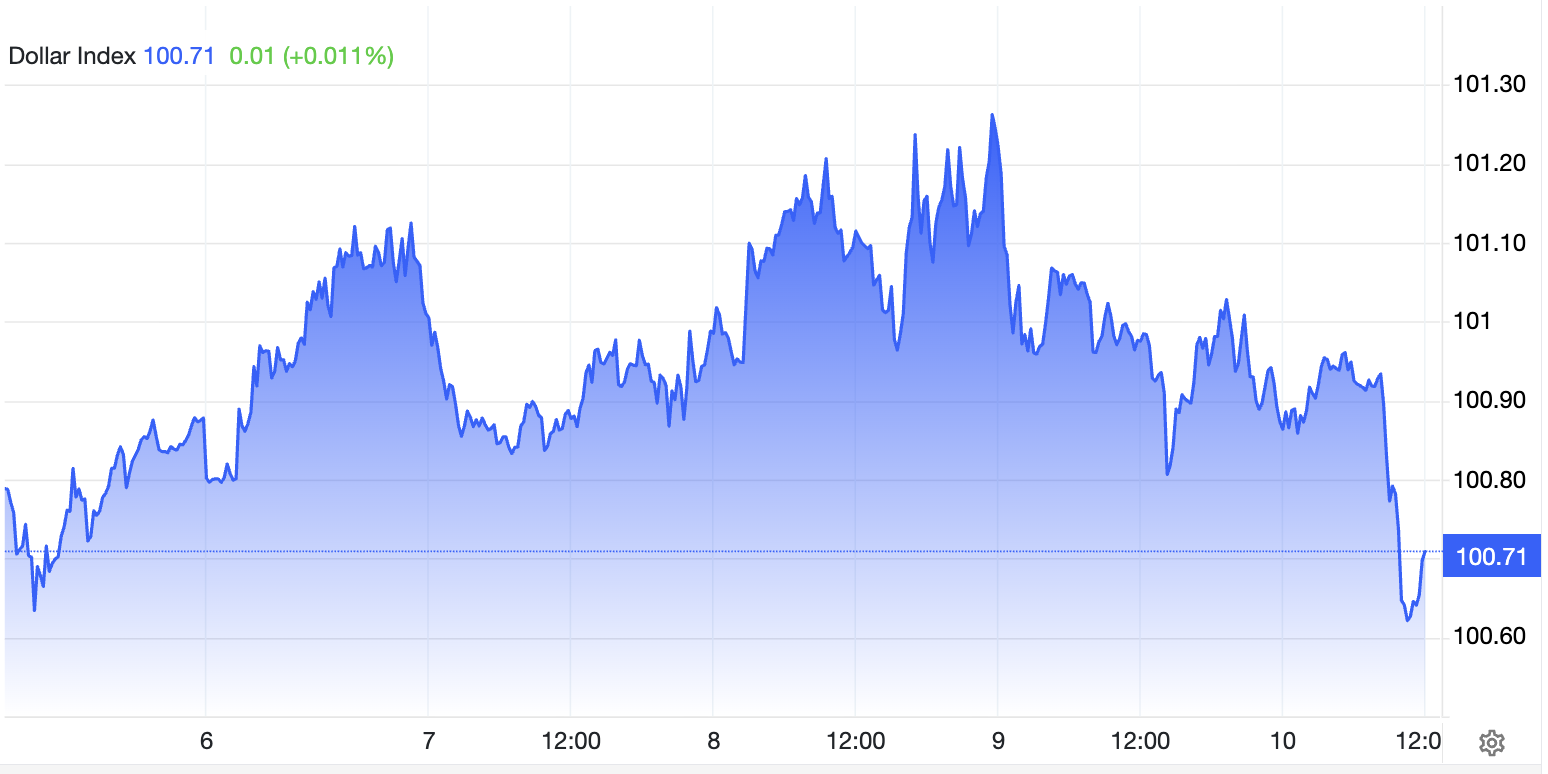
The setup is best described as consolidation beneath resistance, not a confirmed downtrend. DXY dipped toward 100.70 after the July 2 payrolls report before stabilising, and it has not closed and held below that support. A sustained break of 100.70 would open room toward 100.00, while a close back above 101.20 would keep the range tilted toward the topside.
Rising Treasury yields normally help the dollar by lifting the return on dollar assets, which draws foreign capital into US bonds and equities and raises demand for the currency. That link is strongest when yields climb on stronger US growth, higher real interest rates, or expectations of tighter Fed policy, because the US rate advantage then widens against other economies.
The relationship weakens when the source of higher yields is less benign, which is much of the story right now.
Yields are high but no longer climbing. Both the two-year and 10-year have flattened or edged down from their midweek peaks as oil retreated and the immediate inflation scare cooled.[1] Currencies react to changes in expectations far more than to static levels, so a stable yield backdrop removes the fresh catalyst the dollar would need to advance.
Real yields are steady, not rising. The 10-year real yield, measured through inflation-protected securities, is holding near 2.3%.[2] That is historically elevated and still broadly dollar-supportive, but it has not increased in recent weeks. Because capital follows the direction of inflation-adjusted returns, a flat real yield offers little reason to build exposure.
Rate expectations are largely priced, and the data has softened. CME futures show investors expecting policy to stay restrictive, with any further move tied to incoming data, and June’s FOMC minutes flagged a readiness to act only if inflation reaccelerates.[2]
The labour market has muddied that picture: June payrolls rose just 57,000 against forecasts near 110,000, and unemployment slipped to 4.2% mainly because participation fell to its lowest since early 2021.[3] A fully priced rate path does not create new dollar demand, and softer jobs data trims the odds of additional hawkish surprises.
Global rate differentials are narrowing. Exchange rates turn on relative policy, and the gap has been closing from the other side. The ECB raised its deposit rate to 2.25% in June, its first hike since 2023, and markets have moved to price a strong chance of another move as soon as September.[4]
German yields have risen with those expectations, narrowing the spread over Treasuries. The Bank of England is holding at 3.75% with sticky services inflation, keeping sterling firm, while the Bank of Japan near 1% leaves USD/JPY above 162, close to a four-decade low.[4]
The euro drives DXY more than any other currency, at roughly 57.6% of the basket, so its direction tends to set the index’s.[1] EUR/USD is trading near 1.143 as ECB tightening bets firm, and even a modest euro gain can outweigh dollar strength elsewhere, including against the yen.[1]
That is why the index can soften while the dollar still rises against weaker currencies. EBC’s existing DXY explainer covers the index construction in detail.
Speculative positioning has become one-sided. The latest CFTC data put net-long dollar exposure at about $33.5 billion, a 17-month high, after roughly $30 billion was added over six weeks.[5]
Euro longs have thinned to almost nothing and sit close to flipping short, sterling shorts have reached a record, and yen shorts are near a two-year high.[5] Crowded long-dollar positioning leaves fewer new buyers to drive the currency higher and raises the risk of a sharp unwind if sentiment turns, though the position is not yet at the extremes seen earlier in the cycle.
| DXY Level | Significance |
|---|---|
| 101.20–101.80 | Resistance zone and late-June highs |
| 101.00 | Psychological pivot |
| 100.70–100.80 | Initial support area |
| 100.00 | Major psychological and technical support |
| Below 100 | Would strengthen the case for a broader bearish shift |
Energy has shifted the backdrop as well. West Texas Intermediate fell about 2% to $72.08 as the acute phase of Middle East tensions eased, cooling both inflation expectations and the safe-haven bid that had supported the dollar.[1] Lower oil also softens the case for further Fed tightening at the margin.
The reason yields are high matters too. When long rates reflect fiscal strain, heavy Treasury issuance or inflation risk rather than strong growth, higher yields work more as compensation for risk than as a marker of economic strength, and the currency benefits less. That reading, rather than the yield level itself, is doing much of the work in the current divergence.
A fuller read comes from watching several markets at once. The two-year Treasury yield tracks Fed expectations, the 10-year reflects the longer-term growth and inflation outlook, and real yields alongside inflation breakevens separate genuine return from inflation compensation.
The US-German yield spread is the cleanest guide to EUR/USD and therefore to DXY. Oil prices feed the inflation impulse, Treasury auction results test appetite for US debt, and CFTC positioning shows how crowded the trade has become.
A softer dollar tends to ripple across assets, though the links are not fixed. EUR/USD and GBP/USD usually gain when DXY falls, and emerging-market currencies often find relief when global risk appetite holds, while oil importers can still struggle when energy prices climb.
Gold and other dollar-priced commodities frequently rise as the currency weakens, but elevated real yields can blunt that pull. A weaker dollar can also flatter the overseas earnings of large US multinationals. Real yields, local central-bank policy and geopolitical risk can each override these relationships in a given week.
The dollar’s stall shows that high Treasury yields on their own no longer guarantee a stronger currency. With yields flat rather than rising, real returns steady, the Fed’s path largely priced and other central banks closing the rate gap, the drivers behind the yield move now count for more than the level.
The near-term tests are clear: support at 100.70 and 100.00, CME pricing into the July 29 Fed meeting, ECB expectations into July 23, and the US-German yield spread. Until DXY closes and holds below 100, the move looks like consolidation.
US Dollar Index level, range, performance and technical levels; US Treasury yields; WTI crude; EUR/USD and USD/JPY; ICE basket weights.
US Treasury / Federal Reserve H.15 and CME Group FedWatch Tool, 10-year real (TIPS) yield, June 2026 FOMC minutes and Fed rate pricing.
US Bureau of Labor Statistics, The Employment Situation, June 2026.
European Central Bank, Bank of England and Bank of Japan, June 2026 monetary policy decisions and policy rates.
Commodity Futures Trading Commission (COT report) via forex.com, speculative currency positioning, early July 2026.